5-Year Investment of 2.2 Trillion Won to Become a 'Vaccine Hub'
Targeting 5th Place in the Global Vaccine Market by 2025
[Asia Economy Reporter Kim Ji-hee] The government will invest 2.2 trillion won by 2026 to leap forward as a global vaccine hub. Through this, it aims to complete the development of the first domestically produced COVID-19 vaccine by the first half of next year and rank fifth in the global vaccine market by 2025. The plan is to remove barriers between ministries and provide comprehensive support through collaboration.
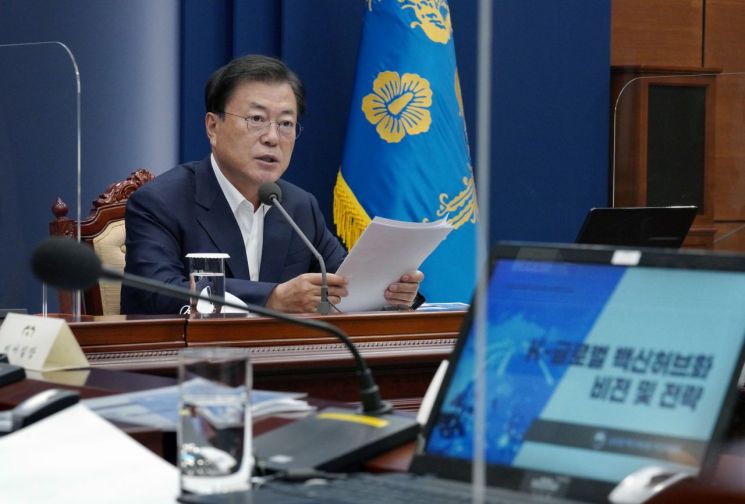
On the 5th, the Ministry of Health and Welfare announced that it held a 'K-Global Vaccine Hub Vision and Strategy' briefing session chaired by President Moon Jae-in at the Blue House and government offices in Seoul and Sejong. At this briefing, the basic direction for becoming a global vaccine hub was established, and the 'Global Vaccine Hub Promotion Committee,' chaired by the Prime Minister, was launched.
The government plans to focus on three major strategies for building the K-Global vaccine hub through joint efforts of 11 related ministries: rapid development of domestic COVID-19 vaccines, expansion of global production cooperation, and swift establishment of a global vaccine hub infrastructure.
First, to expedite the development of domestic COVID-19 vaccines, various supports for Phase 3 clinical trials will be promoted. Currently, seven companies are conducting clinical trials for COVID-19 vaccines, and some companies, including SK Bioscience, are expected to enter Phase 3 trials in the second half of the year. The government will concentrate funding for Phase 3 trials (166.7 billion won in 2021). Additionally, for COVID-19 vaccines that have produced interim results from Phase 2 trials and have approved Phase 3 trial plans, pre-purchase will be pursued considering immunogenicity, safety, and success probability comprehensively. To this end, 72 billion won has been secured through this year's supplementary budget.
To support rapid entry into Phase 3 trials, the clinical approval period will be halved, and a nationally designated Central Clinical Trial Review Committee will be activated to promote integrated multi-center reviews. Support will also be provided to secure comparator vaccines for 'comparative clinical trials,' which compare domestically and internationally approved vaccines with domestic vaccine candidates.
For the development of domestic messenger ribonucleic acid (mRNA) vaccines, overseas patent analysis and avoidance strategies will be established, and research for independent development of core technologies based on this will be supported. To secure mRNA vaccine technology that enables rapid development, preclinical and clinical trials, as well as raw and subsidiary materials, will be supported across the government. Furthermore, active support will be given to operate complementary consortia among mRNA vaccine developers to maximize short-term domestic production capacity.
To strengthen global production cooperation, collaboration with major leading countries will also be enhanced. To ensure smooth supply of vaccine raw and subsidiary materials, cooperation such as linking demand and supply companies between Korea and the U.S. will be promoted, and corporate contact and cooperation will be supported through the Global Vaccine Business Forum. Participation will also be made in discussions on the global vaccine technology transfer hub and workforce training hub led by the World Health Organization (WHO).
Additionally, to build the vaccine hub foundation, efforts will focus on four key tasks: expanding production capacity, rapid development of next-generation vaccines, global advancement of domestic vaccines, and fostering the vaccine industry ecosystem. First, up to 3 billion won per company (a total of 18 billion won this year) will be supported for the establishment of various vaccine and raw material production facilities and equipment to expand production infrastructure. The use of global-level vaccine GMP-grade public manufacturing facilities will also help companies without their own facilities commercialize vaccines.
Since infectious disease pandemics may recur in the future, support for various strategic vaccines will also be strengthened. Development will include multivalent and universal vaccines usable against various variant viruses, rapidly producible vaccine platforms, high value-added vaccines, and vaccines avoided by the private sector. To support this, vaccine base technologies such as immune enhancers and basic and fundamental research will also be reinforced.
Efforts will also be made to promote the global market entry of domestic vaccines. The trade insurance limit for vaccine export will be expanded up to twice the current amount. Financial support will be promoted for domestic production facility investments aimed at vaccine exports. To strengthen international cooperation at the national level and collaboration for responding to new variant infectious diseases, pathogen resource information and specimens will be secured, and overseas research bases will be established.
Prime Minister Kim Boo-kyum said, "We must concentrate national capabilities to truly become a global vaccine hub through this opportunity," and added, "We will unite efforts to realize the vision and strategy shared today, centered on the newly launched public-private 'Global Vaccine Hub Promotion Committee.'"
© The Asia Business Daily(www.asiae.co.kr). All rights reserved.

















