UNIST Professor Goseongan's Team Develops AI-Based Visualization Technology to Aid History Study
Links Historical Events with Temporal and Geographic Information for Recommendations ‥ Published in IEEE TVCG
[Asia Economy Yeongnam Reporting Headquarters Reporter Kim Yong-woo] What if artificial intelligence could take you on a time machine to ancient Greece and Rome?
It has become possible. A learning system based on artificial intelligence has been created to help study history.
This system organizes complex historical information clearly and presents it at a glance. The labor-intensive task of organizing historical materials is handled by artificial intelligence.
Learners can choose topics that suit their tastes. History, often considered a boring memorization subject, can now be studied enjoyably on one’s own.
Ulsan National Institute of Science and Technology (UNIST) introduced on the 5th that Professor Go Seong-an’s team from the Department of Computer Science developed a history learning system that visualizes historical information.
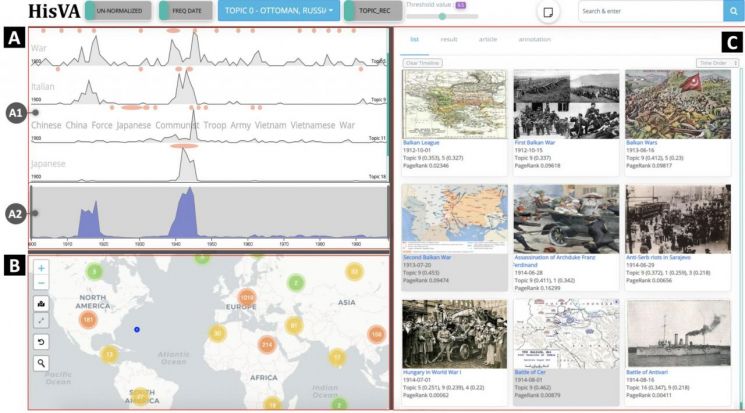
The system links historical events, timelines, and geographical information, displaying them on the screen and recommending learning topics.
The new system was created by applying AI topic modeling techniques to historical data documents. When AI extracts various world historical events, the occurrence time and location of the extracted events are displayed on the screen. Important historical events are also highlighted on the screen.
The system screen is composed of three main modules: an event view where keyword frequency of specific topics can be checked on a timeline, a map view where historical events are displayed on a map, and a resource view that visualizes classified important historical event information along with images (thumbnails).
When users change the topic and timeline or select a specific area on the map, the materials provided in the resource view change accordingly.
An automatic recommendation feature is also included. When users click and read documents in the resource view, the system recommends historical facts most related to the learner’s interests or those most read by other users. This provides motivation for learners to stay engaged and continue studying history.
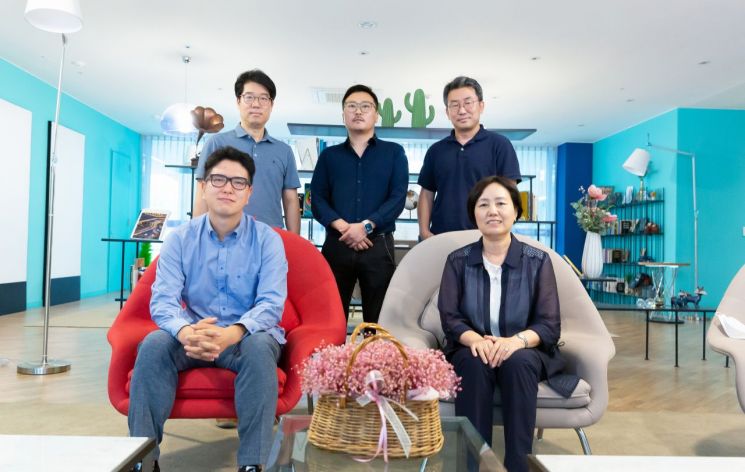 (From the back row, left to right, clockwise) Professor Lee Ju-young, Researcher Shim Jae-gyeom, Professor Kwon Oh-sang, Professor Son Kyung-ah, Professor Go Seong-an.
Professor Go Seong-an explained, “We introduced AI technology into the field of history, where self-study was difficult due to the vast amount of learning data and lack of learning methods, enabling students to easily and enjoyably study historical events according to their individual preferences.”
Professor Go added, “It could also be applied to learning in related academic fields such as politics, economics, society, and culture, which share similar characteristics.”
Professor Lee Ju-young from the Department of Humanities said, “Traditional history classes rely heavily on textbooks, which can easily cause loss of interest and are prone to the subjective influence of textbook authors. This system attracts learners’ interest, encourages multifaceted interpretation of historical events, and allows learners to create and verify hypotheses themselves, enabling self-directed learning.”
Professor Son Kyung-ah from the Science and Technology Education Center said, “Learners have experienced cognitive overload due to the vast amount of materials, but the AI system solves this problem by enabling self-directed learning.”
The research results, conducted jointly by Professor Lee Ju-young of the Department of Humanities and Social Sciences, Professor Son Kyung-ah of the Science and Technology Education Center, Professor Kwon Oh-sang of the Department of Biomedical Engineering, and Researcher Shim Jae-gyeom of the Leadership Center, are scheduled to be published in the ‘IEEE Transactions on Visualization and Computer Graphics’ and have been released online first.
The research was supported by the Ministry of Science and ICT’s AI Graduate School and the Mid-career Researcher Support Project of the National Research Foundation.
© The Asia Business Daily(www.asiae.co.kr). All rights reserved.
![Clutching a Stolen Dior Bag, Saying "I Hate Being Poor but Real"... The Grotesque Con of a "Human Knockoff" [Slate]](https://cwcontent.asiae.co.kr/asiaresize/183/2026021902243444107_1771435474.jpg)

















