Cheong Chooses Bureaucrats Over Private Sector for Harmony Among Financial Authorities
Appoints After Record 3-Month Vacancy... Financial and Economic Expert Bureaucrats
Go Seung-beom, BOK Monetary Policy Committee Member, Nominated as Next Financial Services Commission Chairman
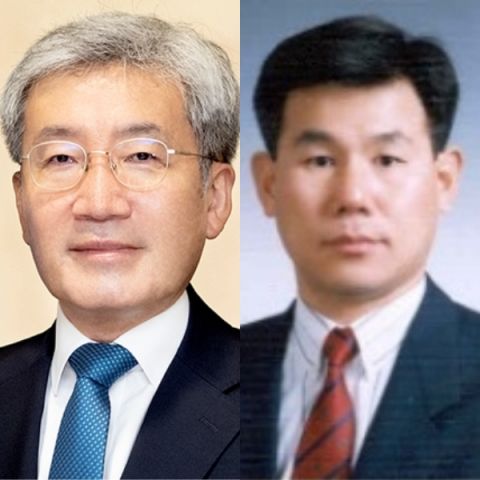 (From left) Ko Seung-beom, nominee for Chairman of the Financial Services Commission, Jeong Eun-bo, nominee for Governor of the Financial Supervisory Service.
[Asia Economy Reporter Kim Jin-ho] Jeong Eun-bo, South Korea-US defense cost-sharing negotiation ambassador, has been nominated as the Financial Supervisory Service (FSS) chief, a position vacant for three months. The Blue House, which had consistently insisted on appointing professors, is now said to have chosen a ‘bureaucrat’ card to promote harmony with the higher institution, the Financial Services Commission (FSC), and to strengthen internal unity within the FSS.
The FSC announced on the 5th that it would recommend Jeong as the new FSS chief. The appointment procedure for the FSS chief involves the FSC passing a resolution, the FSC chairman recommending the candidate, and the president appointing them.
Jeong is a seasoned bureaucrat in the financial and economic policy field, having served as the FSC Secretary-General, Deputy Minister of Strategy and Finance, and FSC Vice Chairman. He is evaluated as having expertise in financial policy and international finance, as well as broad understanding and experience in macroeconomics. The FSC explained the reason for the nomination, stating, "He is considered the right person to lead the FSS’s new leap forward and enhance trust."
Initially, the Blue House was known to prefer a civilian candidate, like the previous three heads. However, after the FSS labor union and others strongly raised issues about professors lacking political sense and leading the organization based solely on theory, they ultimately chose a bureaucrat. It is analyzed that the urgent need for internal cohesion influenced this decision.
Jeong’s top priority is to stabilize the FSS internally. Since the resignation of former chief Yoon Seok-heon, the FSS has been struggling with the aftermath of the private equity fund scandal. The atmosphere is unsettled as employees face disciplinary actions from the Board of Audit and Inspection, and the National Assembly is pressuring for organizational reform, holding the FSS accountable for inadequate supervision.
Another challenge Jeong must address is the precedent where the previous three heads repeatedly clashed with the FSC, resulting in disadvantages in budget and personnel support. However, since Jeong comes from the FSC, the higher institution, many expect this to help foster harmony among financial authorities.
Major tasks also include regulation of cryptocurrencies, which are full of consumer protection issues, and strengthening management measures for household debt, which has become the biggest risk factor in the Korean economy. However, there is skepticism about whether Jeong can overcome the limitation of being a de facto temporary appointee with a term of about 10 months, as he is likely to step down after the next presidential election. Critics argue that his term is too short to resolve the many challenges facing the FSS.
Surprise Appointment for FSC Chairman... Ko Seung-beom Appointed as Bank of Korea Monetary Policy Committee Member
Ko Seung-beom, a member of the Bank of Korea’s Monetary Policy Committee, has been nominated as the next FSC chairman. Ko is a seasoned economic bureaucrat who served as a standing member (Grade 1) at the FSC and has been working at the Bank of Korea since 2016. During his tenure at the FSC, he held key positions such as Director of Financial Services, Director of Financial Policy, and Secretary-General, and is highly regarded for his understanding of major financial issues such as household debt and corporate restructuring.
Ko’s vacancy will be filled by a new member recommended by Bank of Korea Governor Lee Ju-yeol and appointed by the president, according to Article 16 of the Bank of Korea Act. The newly appointed member’s term will be the same as the predecessor’s, ending in April 2023.
At the Monetary Policy Committee meeting held on the 15th of last month, Ko was the sole dissenter advocating for a rate hike. At that time, he emphasized ‘financial stability’ and was the only member to argue that the base interest rate should be raised from 0.5% to 0.75%. When Ko first joined the Monetary Policy Committee, he was classified as a ‘dove’ (favoring monetary easing), but since October 2018, when he and member Lee Il-hyung first presented a minority opinion for a rate hike, he has shown a ‘hawkish’ (favoring monetary tightening) stance.
© The Asia Business Daily(www.asiae.co.kr). All rights reserved.

![Clutching a Stolen Dior Bag, Saying "I Hate Being Poor but Real"... The Grotesque Con of a "Human Knockoff" [Slate]](https://cwcontent.asiae.co.kr/asiaresize/183/2026021902243444107_1771435474.jpg)















