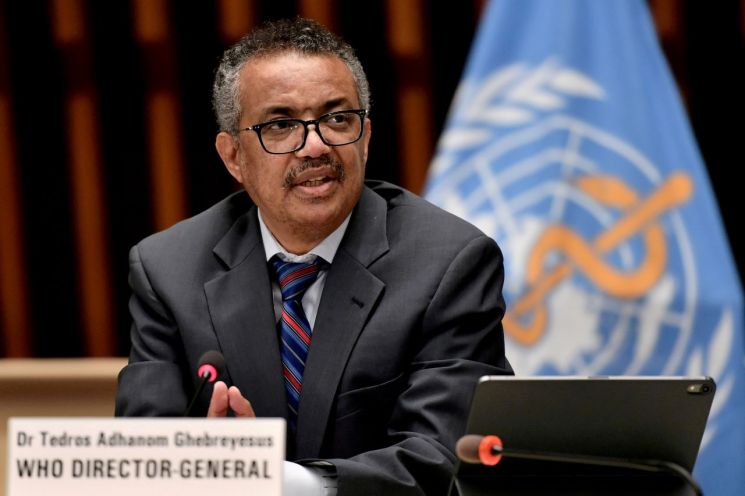
 Tedros Adhanom Ghebreyesus, Director-General of the World Health Organization (WHO)
 [Photo by Reuters Yonhap News]
[Asia Economy Reporter Cho Hyun-ui] The World Health Organization (WHO) has requested countries leading in vaccinations that have introduced or are discussing booster shots (third doses) to halt these vaccinations at least until the end of September. This is because the supply imbalance between high-income and low-income countries is severe, and priority should be given to vaccinating countries that have not even completed the first and second doses.
On the 4th (local time), WHO Director-General Tedros Adhanom Ghebreyesus urged, "We hope that developed countries will not proceed with booster shot vaccinations at least until the end of September." While understanding the measures taken by governments to protect their citizens from the Delta variant, Director-General Ghebreyesus raised his voice, saying, "We cannot accept countries that have already used most of the global vaccine supply to proceed with additional vaccinations."
The reason WHO publicly opposed booster shot vaccinations is that the vaccination rate gap between high-income and low-income countries is widening further. Director-General Ghebreyesus said, "In May, high-income countries administered about 50 doses per 100 people, but since then, it has doubled to nearly 100 doses. Meanwhile, low-income countries have only been able to administer 1.5 doses per 100 people."
WHO aims to vaccinate at least 10% of each country's population by the end of September. Director-General Ghebreyesus emphasized, "More than 4 billion vaccine doses have been administered worldwide so far, and over 80% of these have gone to upper-middle-income countries that make up less than half of the world's population. It is urgent to shift most of the vaccines held by high-income countries to poor countries."
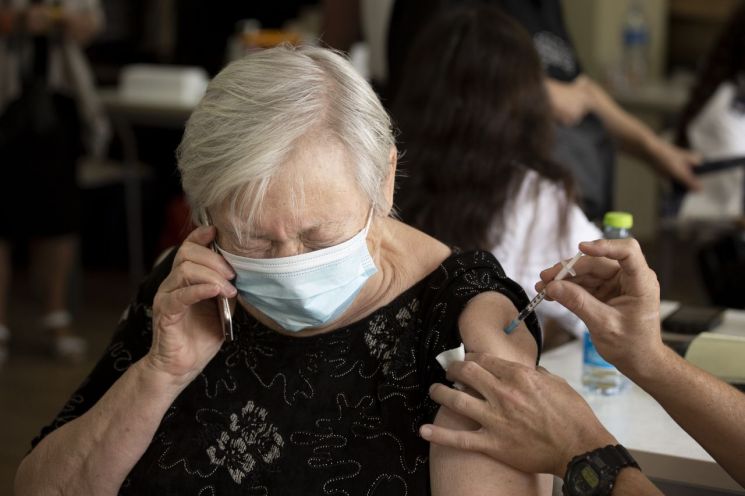 On the 4th (local time), a woman is receiving a booster shot at an elderly center in Jerusalem, Israel. [Image source=AP Yonhap News]
Among countries worldwide, Israel, the United Kingdom, and Germany have announced booster shot vaccination plans, while the United States, still reviewing the necessity, was the first to push back.
White House Press Secretary Jen Psaki said at a briefing that day, "We can do both (expand vaccinations globally and administer booster shots). It is not a matter of choosing one over the other." This means that supplying vaccines to low-income countries and administering third doses within the United States can happen simultaneously.
Israel began administering booster shots to seniors aged 60 and over starting this month. The United Kingdom and Germany also plan to vaccinate the elderly and immunocompromised individuals starting next month.
South Korea is discussing vaccinations for high-risk groups in the fourth quarter of this year. The United States has been discussing the necessity since last month.
© The Asia Business Daily(www.asiae.co.kr). All rights reserved.
![Clutching a Stolen Dior Bag, Saying "I Hate Being Poor but Real"... The Grotesque Con of a "Human Knockoff" [Slate]](https://cwcontent.asiae.co.kr/asiaresize/183/2026021902243444107_1771435474.jpg)

















