Preparing for Climate Change and Sea Level Rise: Building Offshore Cities for Water and Food Self-Sufficiency and Resource Recycling
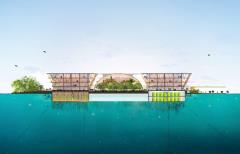 Conceptual diagram of the modern-day Noah's Ark.
[Asia Economy Yeongnam Reporting Headquarters Reporter Kim Yong-woo] Busan City is promoting a modern-day "Noah's Ark" construction project to create a safe and massive maritime city in preparation for the era of climate change.
Busan City has received a partnership proposal for this project from UN-Habitat (United Nations Human Settlements Programme).
Busan Mayor Park Hyung-jun and Victor Kisob, Deputy Executive Director of UN-Habitat, will meet virtually at 5 p.m. on the 5th in the 7th-floor video conference room of City Hall to sign a partnership agreement for a "Sustainable Maritime City."
Due to climate change, sea levels are predicted to rise by about 1.1 meters by 2100 compared to now.
In such a case, 2.4 billion people, or 30% of the global population living in coastal areas, and an enormous scale of land infrastructure could be exposed to flooding risks, raising discussions on the need for proactive measures against the global climate crisis.
UN-Habitat, the highest authority overseeing global urban policies, found solutions to the threat of sea-level rise due to climate change at the General Assembly held at the UN Headquarters in April 2019.
This organization first announced the "maritime city plan" and resolved to select pilot partner cities for product development.
A maritime city is a modern-day Noah's Ark concept that is self-sufficient in energy, water, and food, and capable of recycling resources.
Partner cities do not create separate budgets but serve as administrative supporters by providing project sites and cooperating with various permits and approvals.
This virtual meeting is mainly to confirm Busan City's intention to participate as a partner city for the "Sustainable Maritime City" and to discuss the schedule for signing the related agreement.
Busan City plans to proceed with discussions on the maritime city through the formation of an expert advisory group and visits by the UN working group to Busan, aiming to sign an MOU within this year.
Regarding the UN's partner city proposal, Busan Mayor Park Hyung-jun said, "The UN's goal to prepare for sea-level rise caused by greenhouse gas emissions aligns with Busan City's administrative direction aiming for a carbon-neutral transition city," adding, "It seems that the world’s top technology in shipbuilding and plant sectors that our city possesses has been recognized."
Busan City stated that through the construction of the maritime city, it expects to ▲secure advanced technology for maritime city construction ▲create quality jobs and revitalize the local economy ▲raise Busan's status globally by attracting foreign tourists as the world's first maritime city, and expressed hope that "if the practical consultations are smoothly concluded, we will actively cooperate as a partner city."
© The Asia Business Daily(www.asiae.co.kr). All rights reserved.