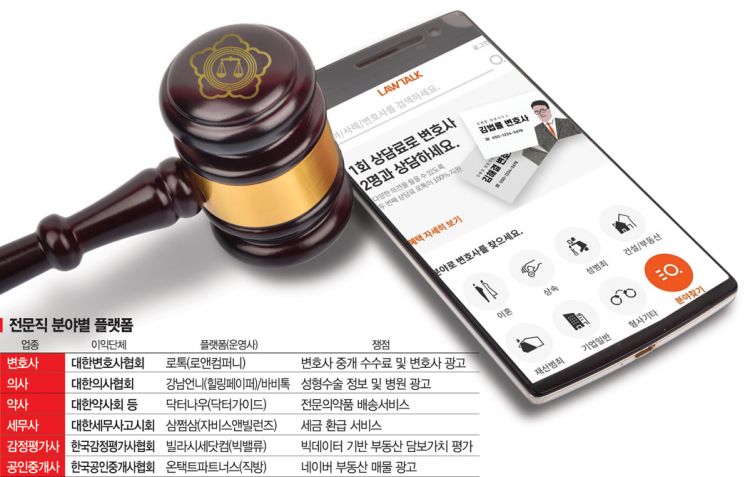
[Asia Economy Reporter Choi Seok-jin, Legal Affairs Specialist] The regulation banning lawyer advertisements through legal service brokerage sites represented by Lotoc came into effect at midnight on the 5th.
While the Korean Bar Association (KBA) and the Seoul Bar Association have taken a stance to enforce disciplinary actions against affiliated lawyers who have not withdrawn from Lotoc even after the implementation of the revised regulations, Lotoc is resisting by stating that despite the decrease in membership, it will make every effort to innovate the legal service market and protect the remaining members.
The key issue in this situation is whether the services provided by Lotoc violate the current Attorney-at-Law Act. However, opinions are divided even within the legal community, and confusion is growing as the Ministry of Justice and the Bar Association have fluctuated in their positions over time.
Ultimately, the conclusion on whether Lotoc’s services are legal depends on whether the prosecution will dismiss the case as it did in the past or indict it in the ongoing police investigation against Lotoc, and if indicted, what final judgment the court will make.
Meanwhile, in the constitutional complaint case filed by Lotoc against the advertising regulations revised by the Bar Association in May, the Constitutional Court’s ruling on whether the regulations infringe on fundamental rights and are unconstitutional will determine the legitimacy of the disciplinary actions pursued by the Bar Association or the Seoul Bar Association against lawyers registered with Lotoc.
The Bar Association revised the “Regulations on Lawyer Advertising” in May.
The revised Article 5 (Restrictions on Advertising Methods), Paragraph 2 states that “Lawyers and others shall not request advertising, promotion, or introduction from, or participate or cooperate with, persons (individuals, corporations, or other organizations) who engage in the following acts,” listing prohibited advertising methods.
The prohibited advertising methods include ▲ receiving money or other economic benefits (such as referral fees, brokerage fees, commissions, membership fees, registration fees, advertising fees, regardless of name or regularity) from lawyers or consumers to connect lawyers and consumers or to advertise, promote, or introduce lawyers for legal consultations or cases (Item 1) ▲ advertising acts violating other laws, the Lawyer’s Ethical Code, or the rules of the association and local bar associations (Item 6).
Article 5, Paragraph 2, Item 1 of the regulation can be seen as targeting legal service brokerage sites like Lotoc.
Currently, Lotoc does not charge a membership fee but charges advertising fees, and the regulation prohibits requesting advertising or promotion from corporations that advertise lawyers in exchange for advertising fees.
The Bar Association also added a clause to the Lawyer’s Ethical Code stating that lawyers shall not participate in or join as members in electronic media-based businesses such as applications that introduce lawyers or legal services. Violating this ethical code would constitute a violation of Article 5, Paragraph 2, Item 6 of the regulation.
The final judgment on whether these revised regulations targeting Lotoc infringe on Lotoc’s freedom to perform their profession, property rights, or consumers’ right to choose will be made by the Constitutional Court.
Meanwhile, the determination of whether the services provided by Lotoc violate current law (Attorney-at-Law Act) is the court’s responsibility.
Article 34 (Prohibition of Partnership with Non-Lawyers) Paragraph 1 of the Attorney-at-Law Act prohibits receiving money for legal cases or legal affairs and introducing, referring, or inducing parties or related persons to lawyers. Violations are punishable under Article 109 (Penalties) by imprisonment of up to seven years or a fine of up to 50 million won.
If a Supreme Court ruling, which holds the final authority on legal interpretation, is issued, the controversy over illegality could be resolved. The issue is that the court’s judgment can only be made if investigative authorities determine that Lotoc’s service violates the Attorney-at-Law Act and bring the case to trial. According to Lotoc’s operator, Law&Company, two previous complaints were dismissed without charges.
The Bar Association expects prosecution this time, citing changes in Lotoc’s services and sufficient evidence collection, but since opinions are divided even among legal experts, the outcome remains uncertain.
Within the legal community, opinions are sharply divided: some argue that Lotoc merely charges lawyers advertising fees to display them on its website and does not directly connect clients with specific cases or involve itself in fees, so there is no legal problem; others contend that since it ultimately connects lawyers with clients for cases and receives money for lawyer referrals, it violates the Attorney-at-Law Act.
In this regard, the positions of the Ministry of Justice and the Bar Association have also been inconsistent.
Minister of Justice Park Beom-gye has repeatedly stated that Lotoc is a “legal service.” However, just six years ago, the Ministry of Justice responded to a complaint on the National Petition Board that legal service brokerage sites charging membership fees might violate the Attorney-at-Law Act. (Exclusive report on the 4th: Ministry of Justice "Legal service brokerage sites charging membership fees violate Attorney-at-Law Act"... 2015 interpretation)
Currently, Lotoc does not charge a separate membership fee but charges advertising fees to display lawyers on its website. The Ministry of Justice’s past response suggests that even if it is not a commission for case acceptance itself, charging a membership fee can be considered a fee for lawyer referral. Therefore, legal service brokerage sites receiving certain fees such as advertising fees or commissions, regardless of the name “membership fee,” are interpreted as illegal.
Law&Company claims that the Bar Association also responded in past inquiries that the advertising service provided by Lotoc does not violate the Attorney-at-Law Act or advertising regulations.
Law&Company stated, “The Seoul Bar Association sent an email to all member lawyers on April 20 claiming that ‘legal platforms like Lotoc receive economic benefits in the form of advertising fees to avoid controversy over violating the Attorney-at-Law Act, but in substance, this is equivalent to broker behavior subordinating lawyers, violating Article 34, Paragraph 1 of the Attorney-at-Law Act,’ and that ‘the Korean Bar Association has consistently interpreted this since September 2, 2015,’ but this is not true.”
Law&Company emphasized, “Upon reviewing the Bar Association’s inquiry responses, the Bar Association has consistently regarded advertising methods like Lotoc’s as legitimate paid advertising media since around 2011, before Lotoc started its service in 2014, through at least eight inquiry responses. Furthermore, they have consistently answered that paying ordinary advertising fees as consideration for advertising does not violate the Attorney-at-Law Act or advertising regulations.”
As opinions are divided on whether Lotoc’s services violate the Attorney-at-Law Act and no ruling has been made on the constitutionality of the revised regulations targeting Lotoc, confusion is expected to continue for the time being.
The disciplinary procedures promoted by the Bar Association are also known to take considerable time, going through several stages including the Seoul Bar Association’s preliminary investigation committee, investigation committee, standing committee, and the Bar Association’s disciplinary committee.
In this situation, the number of lawyers registered with Lotoc decreased by 28%, from 3,966 at the end of March to 2,855 as of the 3rd.
Voices are growing that the government or the National Assembly should step in to revise related laws for a final resolution of the issue.
© The Asia Business Daily(www.asiae.co.kr). All rights reserved.
![Clutching a Stolen Dior Bag, Saying "I Hate Being Poor but Real"... The Grotesque Con of a "Human Knockoff" [Slate]](https://cwcontent.asiae.co.kr/asiaresize/183/2026021902243444107_1771435474.jpg)
















