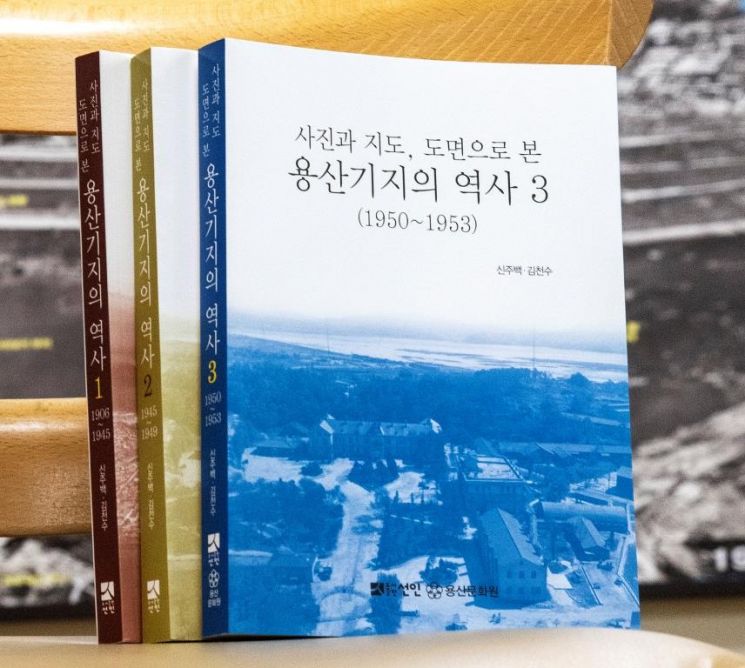
Yongsan Cultural Center and Seonin Publishing Publish Volume 3 of Yongsan Base Historical Records... Co-authored by Shin Juback and Kim Cheonsu... Utilizing Materials from the U.S. National Archives (NARA)... Covering Japanese Colonial Period to Post-Liberation (Volumes 1 & 2) and Korean War Era (Volume 3)
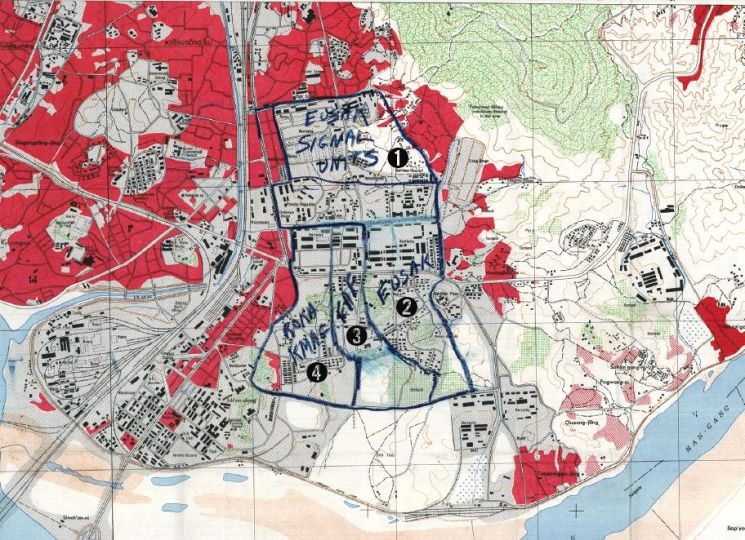 Reallocation plan of Yongsan Base in 1952 included in three booklets (Original source: U.S. National Archives)
[Asia Economy Reporter Jongil Park] Yongsan Cultural Center and Seonin Publishing House have published the third volume of the Yongsan Base Historical Records series. The title is "The History of Yongsan Base Seen Through Photos, Maps, and Drawings."
It was co-authored by Shin Ju-baek, Director of the Korean Independence Movement History Research Institute at the Independence Hall of Korea, and Kim Cheon-su, Head of the History and Culture Research Office at Yongsan Cultural Center. Following Volume 1 (published in 2019) covering 1906?1945 and Volume 2 (published in 2020) covering 1945?1949, Volume 3 deals with the years 1950?1953.
In particular, this book allows readers to see photos, drawings, and maps showing the complete destruction of the base during the Korean War and the restoration of the facilities by the U.S. Forces Korea as a semi-permanent base.
The table of contents is as follows: ▲ Part 1: The Beginning of the Korean War_1950 ▲ Part 2: The 1st and 4th Retreats and Seoul, Yongsan Base_1951 ▲ Part 3: Beginning the Reconstruction of Yongsan Base_1952 ▲ Part 4: The End of the War and Yongsan Base_1953 ▲ Part 5: Panmunjom and the Armistice Agreement.
Photos that catch the eye include the bombing scene of the Yongsan marshalling yard by a U.S. Air Force B-29 bomber (1950.7.16), an aerial view of Namsan and Seoul Station area immediately after the recapture of Seoul (1951.3.16), Lieutenant General Van Fleet, Commander of the Eighth U.S. Army, driving the last nail into the restored Hangang footbridge (1951.6.1), and the newly established Eighth U.S. Army Headquarters at Yongsan Base (1953.7.19).
The 1952 Yongsan Base relocation plan and the 1953 base restoration and reconstruction status reveal the ‘original form’ of today’s Yongsan Base.
Director Shin Ju-baek explained, “Except for buildings destroyed and unusable during the Korean War, the U.S. military used the Japanese military buildings as they were. The base’s internal spaces were also divided based on roads constructed by the Japanese military, and the center shifted upward in connection with conditions inside and outside the base.”
He added, “During the parkification process, I hope the historical and locational significance of the space surrounding Yongsan Base will be restored, and that this place will be reborn as a space for historical healing for residents of the Korean Peninsula.”
Most of the materials included in the book were collected directly by the authors during visits to the U.S. National Archives and Records Administration (NARA) in 2017?2018. Some materials from the National Institute of Korean History were also utilized.
Head Kim Cheon-su said, “Yongsan Base is a treasure trove of modern and contemporary Northeast Asian history. By systematically collecting and preserving related records and sharing them with citizens, we will maximize the historical and locational significance of Yongsan Park.”
He also expressed gratitude again to Cha Sang-seok, Vice Chairman of Hanil Historical Materials, who sponsored the visit to the U.S. National Archives.
In addition, in April, Kim co-published an integrated edition (3 volumes) titled "Searching for the History of Yongsan Base" with Yongsan District Office. The titles are ▲ Searching for the History of Yongsan: AD 97?1953 ▲ Searching for the History of the Lost Dunjimi Old Village within Yongsan Base ▲ The Korean War and Yongsan Base. This was the first comprehensive achievement to clarify the history of the base, receiving positive responses from academia and citizens alike.
© The Asia Business Daily(www.asiae.co.kr). All rights reserved.


















