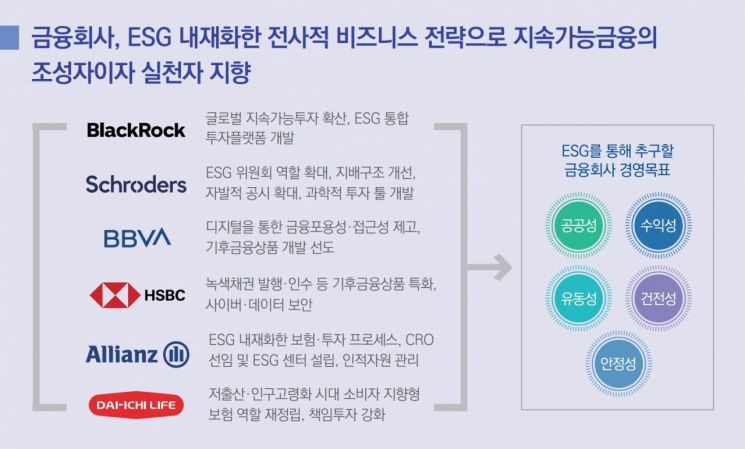
[Asia Economy Reporter Park Jihwan] As the global trend of sustainable finance rapidly emerges, an analysis has been made that financial companies need to enhance sustainability and competitiveness through enterprise-wide business strategies that internalize ESG (Environmental, Social, and Governance).
In a report published on the 4th, Samjong KPMG emphasized that domestic financial companies should implement ESG in overall business processes such as business strategy and risk management under a long-term ESG vision and goals to enhance corporate value.
They also added that it is necessary to actively establish sound governance and strengthen its role, develop ESG-linked financial products, disclose ESG information, and raise awareness of financial companies' social responsibilities.
The scale of global sustainable investment continues to expand. As of the end of last year, the size of sustainable investment reached $35.3 trillion, growing approximately 2.7 times compared to 2012. ESG factors are being considered not only in stocks and bonds but also in private equity (PE), venture capital (VC), and real estate sectors.
Last year, the issuance and lending of global ESG bonds reached nearly $789.8 billion, a 36.9% increase from the previous year, with social bonds issued amounting to $155.1 billion, a 767% increase year-on-year.
By region, Europe accounted for 42% of ESG investments centered on pension funds as of last year. In the United States, asset managers are recently expanding investments by considering ESG in index investment methods. Japan was the first Asian country to introduce the Stewardship Code in 2014 and has been actively pursuing ESG investments since 2017.
Domestic sustainable investment is strengthening responsible investment led by the National Pension Service. Since COVID-19, interest has increased in the private sector as well, including ESG bond issuance, ESG funds, and exchange-traded fund (ETF) products.
The scale of responsible investment by domestic pension funds grew more than threefold to 103 trillion KRW last year compared to the previous year. ESG ETF net assets reached 684 billion KRW in May this year, a 3.3-fold increase from the end of last year. As of June 25, the listed balance of domestic Socially Responsible Investment (SRI) bonds was 124 trillion KRW, a 100-fold increase compared to the end of 2018.
Kim Jingwi, Executive Director of Samjong KPMG ESG CoE (Finance), stated, "To secure sustainability for domestic financial companies, the government should act as a sustainable finance facilitator by building infrastructure and creating a balanced market mechanism through cooperation and communication with various stakeholders." He emphasized, "Domestic financial companies should set long-term ESG visions and goals and strengthen sound governance establishment and roles, such as by establishing ESG committees."
He added, "The ESG risk management process should be scientific and consistent throughout the series of steps including ESG information acquisition, risk identification, measurement and evaluation, monitoring, and reporting. Financial companies also need to seek to enhance their core social roles by advancing ESG-related financial product development and strengthening information disclosure."
© The Asia Business Daily(www.asiae.co.kr). All rights reserved.

















