Confirmed Cases Continue to Rise Amid Ongoing Challenges for Self-Employed Livelihoods
Concerns Over Surge During Summer Vacation Season... Authorities on Alert as 'Breakthrough Infections' Increase
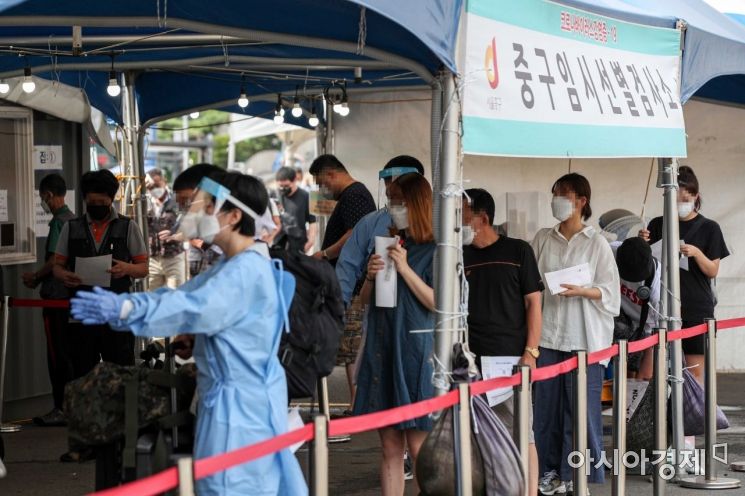 On the 4th, with 1,725 new COVID-19 cases reported, returning to the 1,700 range after five days, citizens waiting to be tested at a temporary screening clinic set up at Seoul Station Plaza. Photo by Jinhyung Kang aymsdream@
[Asia Economy Reporter Seo So-jung] As the number of domestic COVID-19 cases surged back to the 1,700 range on the 4th, the possibility of extending the metropolitan area’s Level 4 “social distancing” measures, scheduled to end on the 8th, is gaining weight. Despite a month of high-intensity measures, the government is deliberating whether to apply a “plus alpha (+a)” or partially ease the quarantine measures, as the spread has not been curbed. Experts pointed out that it is not the time to loosen the reins on quarantine, as cases may increase further due to the summer vacation effect and the spread of the Delta variant followed by the Delta Plus variant.
◆Weight on extending ‘Metropolitan Area Level 4’= Currently, Level 4 measures are in place in the metropolitan area and Level 3 in non-metropolitan areas. The government will finalize the social distancing adjustment plan on the 6th after reviewing this week’s case trends and gathering opinions from local governments and experts. Prime Minister Kim Boo-kyum stated, “We will closely monitor the trend of (confirmed) cases for another day or two and decide on the social distancing level to be applied from next week at the Central Disaster and Safety Countermeasures Headquarters on the 6th.” He added, “We have implemented strong quarantine measures nationwide over the past month. We also need to review whether there are any areas that need improvement in terms of quarantine effectiveness.”
On the same day, appearing on a radio program, Prime Minister Kim said, “Prohibiting gatherings of two or more people after 6 p.m. is excessively harsh on self-employed business owners,” and added, “While social distancing has quarantine effects, the damage to self-employed and small business owners is critical, so those aspects must also be considered.”
Initially, when the government announced the extension of Level 4 in the metropolitan area on the 23rd of last month, it stated that if the daily average number of cases did not drop below the Level 3 threshold of 500 to 1,000, stronger social distancing measures such as banning gatherings at high-risk facilities and tightening operating hours would be considered. In the metropolitan area, the daily average number of cases has hovered precariously in the high 900s over the past three weeks. Son Young-rae, head of the Social Strategy Division at the Central Disaster and Safety Countermeasures Headquarters, said, “The stabilization of the rapidly spreading epidemic is a meaningful achievement,” but expressed concern, “Since it has not reversed into a decline, if vigilance relaxes, the spread could resume at any time.” Especially, the number of confirmed cases in non-metropolitan areas reached a record high of 628 on the day, showing signs of a nationwide large-scale outbreak. With the summer vacation season prompting active interregional movement, the share of cases in non-metropolitan areas, which had briefly dropped to the low 30% range, surged again to 37.7%, approaching the 40% range.

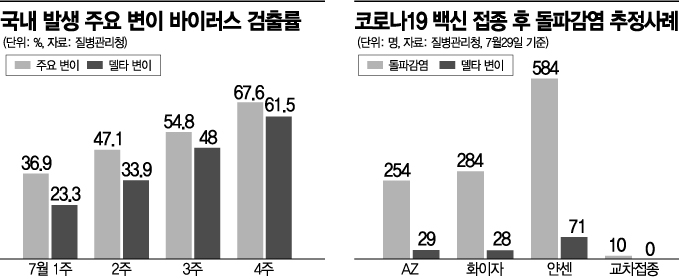
◆Growing concerns over Delta Plus variant= With the dominance of the Delta variant and the first confirmed cases of Delta Plus infections domestically, numerous variables have accumulated. According to the Central Disease Control Headquarters, an analysis of 3,014 COVID-19 cases from July 25 to 31 showed that 2,109 cases were newly infected with one of the four major variants originating from the UK, South Africa, Brazil, and India. Among these, the India-origin Delta variant accounted for 1,929 cases, representing 91.5% of the total.
In the metropolitan area, the detection rate of the Delta variant surged from 48.2% to 62.9% within a week, indicating that the Delta variant is leading the epidemic. Furthermore, it has been confirmed that two individuals who completed the AstraZeneca vaccination in Korea were infected with the Delta Plus variant, making it impossible to rule out the possibility that the Delta Plus variant has already spread domestically.
Experts agree that, as countries with high vaccination rates such as the United States and Israel have experienced resurgence due to variant spread, extending social distancing is inevitable. Professor Chun Eun-mi of the Department of Respiratory Medicine at Ewha Mokdong Hospital said, “The decline in confirmed cases is slower than expected for the current social distancing level,” and added, “Additional quarantine measures such as restrictions on multi-use facilities and strengthening telecommuting are necessary.” Professor Chun emphasized, “As those who went on vacation at the end of July and early August return to the metropolitan area, infections will increase again. With the rise in confirmed cases and severe patients, it is not the time to loosen quarantine measures.”
Some predict that the current situation, where confirmed cases decrease and then rise again, may continue until nationwide herd immunity is achieved. Professor Jung Jae-hoon of the Department of Preventive Medicine at Gachon University College of Medicine stated, “The situation will not change significantly until high-risk groups complete vaccination,” and diagnosed, “Level 4 measures are effective only in preventing further spread, so the current situation may continue until early September.”
© The Asia Business Daily(www.asiae.co.kr). All rights reserved.



















