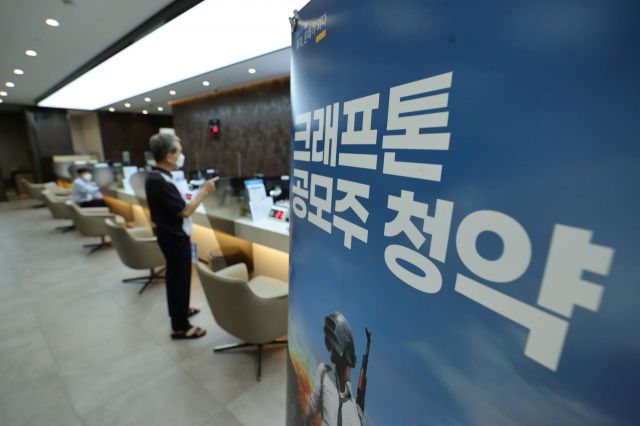
[Asia Economy Reporter Lee Seon-ae] Krafton, which was expected to rewrite the history of initial public offerings (IPO), has seriously lost face due to controversy over an overvalued offering price. Despite being the second-largest "mega IPO" ever at 4.3098 trillion KRW, the subscription deposit totaled only 5.0358 trillion KRW (competition rate 7.8 to 1), failing to achieve a "major fish-level subscription." Although triple subscriptions were possible through three securities firms, the deposit amount not reaching tens of trillions KRW is effectively a box office failure. It was less than one-tenth of SK IE Technology (80.9 trillion KRW) and SK Bioscience (63.6 trillion KRW), which allowed multiple subscriptions, as well as KakaoBank (58.3 trillion KRW), which blocked multiple subscriptions. It also fell far short compared to mid-to-large scale IPOs SD Biosensor (31.9 trillion KRW) and HK Innoen (29 trillion KRW), which conducted subscriptions last month.
The reason for the box office failure was the "high offering price." As controversy over the overvalued offering price continued, individual investors judged that high returns could not be expected and thus did not participate in the subscription. Experts agree that the box office failure was predictable when looking at the Q2 IPO performance report.
According to the Korea Exchange on the 4th, the IPO market in Q2 was the most active since 2017. The number of IPO companies in Q2 was 27, raising about 2.978 trillion KRW through IPOs. This is the largest amount since 4.4 trillion KRW in Q2 2017 when Netmarble (2.7 trillion KRW) was listed, reflecting an active IPO trend. Although the number of companies decreased compared to Q1 (32 companies), it nearly doubled compared to the same period last year (14 companies). The amount raised exceeded 2.799 trillion KRW in Q1 and increased significantly compared to 1.09 trillion KRW in the same period last year.
Despite this activity, returns fell short of expectations. The average market price increase rate compared to the offering price in Q2 was 50.8%, 25 percentage points lower than 75.8% in Q1. The average market price increase rate compared to the offering price in July was 47.5%, showing a more pronounced slowdown in listing day performance. The Daishin Securities Research Center analyzed, "The high offering price had a significant impact on these IPO performance trends."
Broadening the scope, the average market return of IPO stocks over the past five years was 41.8%. By year, the average market return, which was around 30% from 2017 to 2019, exceeded 50% in 2020 and surpassed 75% in Q1 this year, driving IPO subscription success. However, with the weakening performance in Q2 and July, a cautious approach to IPO investment has formed. Among IPO stocks from 2017 to 2021, about 40% had an opening price exceeding the offering price by more than 40%, while 23% had an opening price below the offering price.
This year's lowest-performing stocks compared to the offering price include CNTOOS Seongjin, Jin System, HPO, Prestige Bio Pharma, Nano CMS, and CNC International. These stocks still hover below the offering price. Based on closing prices at the end of July compared to the offering price, they showed poor returns of -36.3%, -20.0%, -14.9%, -12.8%, -10.0%, and -7.3%, respectively.
The failure of Krafton's IPO success is expected to change companies' IPO strategies. To avoid the stigma of overvaluation controversy, companies are likely to be cautious in pricing. Lotte Rental, the No. 1 car rental company preparing for a KOSPI listing this month, recently took a conservative approach to valuation considering the current atmosphere. Lotte Rental calculated enterprise value (EV) based on how overvalued competitors SK Rental and AJ Networks' stock prices were relative to EBITDA, then deducted net debt to calculate an appropriate market capitalization (2.85 trillion KRW). From this, they applied a discount of 24.07% to 39.52% to determine the desired offering price. An investment banking industry insider hinted, "Companies preparing for listing are setting higher discount rates from a conservative perspective."
The third quarter traditionally has low expected returns, so the selection process in the IPO market is expected to intensify. Domestic IPO performance tends to lag the KOSDAQ index, which accounts for a high proportion of IPOs, by 3 to 6 months. The KOSDAQ index formed a peak in the first half of 2018 and continued a downturn until the end of 2019. Additionally, domestic IPO investment performance is good in Q2 but relatively poor at year-end and early year. Since most companies have a December fiscal year-end, they prepare based on solid performance and typically list from mid-Q2 to early Q3. The Daishin Securities Research Center stated, "At year-end, institutional investors respond passively due to performance measurement issues, and stock market gains are limited by KOSDAQ major shareholder issues, resulting in somewhat poor IPO investment performance."
© The Asia Business Daily(www.asiae.co.kr). All rights reserved.

















