Professor Hwang Geontae's Team at Pukyong National University Advances Realization of Implantable Wearable Devices
[Asia Economy Yeongnam Reporting Headquarters Reporter Kim Yong-woo] A component device that generates and stores electrical energy even from small muscle movements has been developed, attracting attention.
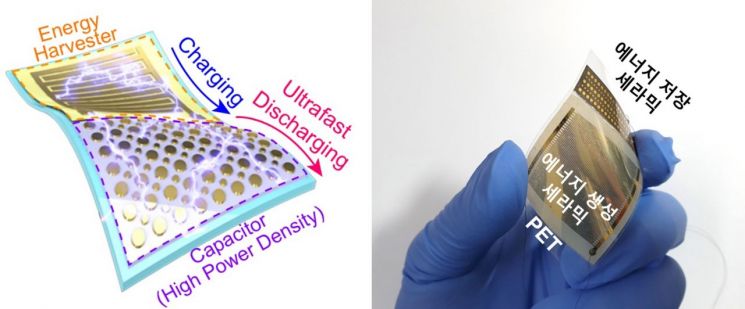
It is a ‘self-charging flexible energy storage device’ that can be implanted inside the human body and generate and store power solely from muscle movements.
Professor Hwang Geon-tae’s research team (Department of Materials Engineering) at Pukyong National University, in collaboration with Dr. Yoon Un-ha’s team at the Korea Institute of Materials Science, Professor Lee Geon-jae’s team at KAIST, Professor Ryu Jeong-ho’s team at Yeungnam University, and Professor Park Jeong-hwan’s team at Kumoh National Institute of Technology, announced on the 3rd that they have developed a new concept energy ‘harvesting & storage integrated device’ capable of self-generating and storing electrical energy.
Energy harvesting, which has recently gained attention, is a renewable energy technology that collects wasted energy around us and converts it into useful electrical energy.
In this study, the research team implemented a ceramic-based flexible self-charging energy storage system that produces electrical energy from small muscle movements and effectively stores it.
To achieve effective energy storage, the team increased the energy storage efficiency by fabricating the grains of the ferroelectric ceramic Pb(Mg1/3Nb2/3)O3?PbTiO3 (PMN-PT) to nanometer (nm) scale.
They also succeeded in enabling the release of stored energy within a very short time of several hundred nanoseconds.
The newly developed system achieves a significantly higher energy output density compared to conventional batteries, making it promising for applications such as bio-implantable cardiac defibrillators that require large instantaneous energy.
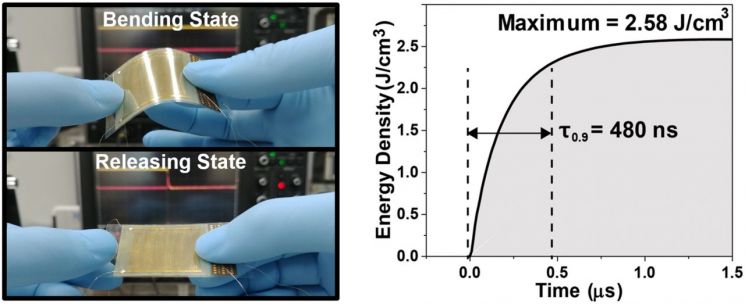 Operation of a self-charging flexible energy storage device (left), graph of the release of electrical energy stored in the device (right).
In particular, wearable devices represented by smartwatches are expected to advance into body-attached and bio-implantable technologies in the future, signaling progress in the healthcare field through this technology.
The smart healthcare sector, which monitors basic health conditions such as heart rate in real time, has also paved the way.
Batteries widely used to power wearable devices have limitations due to capacity issues, requiring repeated charging or replacement.
The self-charging energy storage system developed by the research team is thin and easily bendable, making it easy to apply to wearable devices, and it can generate and store electrical energy by itself, enabling it to replace or supplement existing batteries.
This research was supported by the National Research Foundation of Korea and others, and the paper detailing the research results, titled ‘Flexible Self-Charging, Ultrafast, High-Power Density Ceramic Capacitor System,’ was recently published in the world-renowned energy journal ‘ACS Energy Letters’ (IF: 23.1).
© The Asia Business Daily(www.asiae.co.kr). All rights reserved.


















