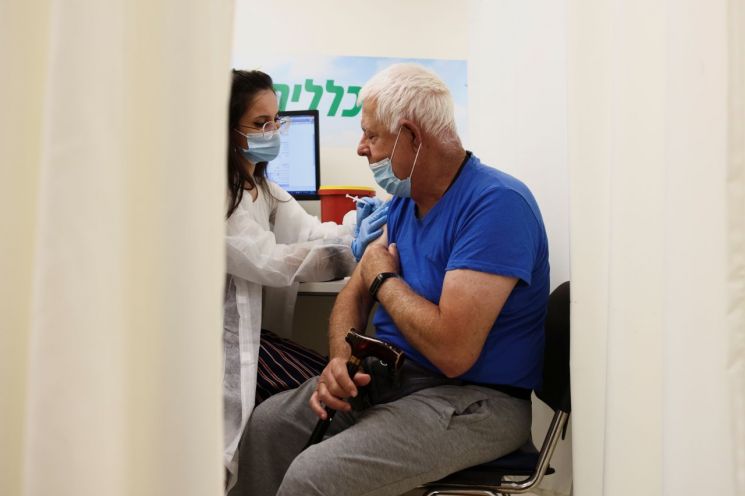
[Asia Economy Reporter Kim Bo-kyung] 'Booster shot' vaccinations are beginning in earnest, mainly in countries with relatively high COVID-19 vaccination rates.
The first country to start booster shot vaccinations is Israel, where about 60% of the population has completed vaccination. Israel began administering booster shots to immunocompromised individuals on the 12th of last month. Then, on the 30th, booster shots were given to those aged 60 and over who had received their second vaccine dose more than five months ago.
Foreign media reported on the 2nd (local time) that the UK will also begin administering booster shots next month to 32 million people, including immunocompromised individuals and those aged 50 and over. The UK government is said to plan to complete booster shot vaccinations within this year.
By the 31st of last month, 72.5% of those aged 18 and over in the UK had completed their second vaccine dose. Including those who have only received the first dose, the vaccination rate reaches 88.6%.
AFP reported on the 1st that Germany will also start administering booster shots to the elderly and vulnerable groups next month. The German government plans for medical staff to visit nursing home residents to vaccinate them, while elderly or immunocompromised individuals receiving home care will be vaccinated by their primary care physicians. In Germany, 61.6% of the population has received at least one vaccine dose, and 52.0% have completed vaccination.
In Asia, Cambodia announced on the 1st that it will administer booster shots to 500,000 to 1 million frontline epidemic control personnel. Those vaccinated with Chinese vaccines will receive the AstraZeneca vaccine as a booster shot, and those who received the AstraZeneca vaccine will get the Chinese Sinovac vaccine as a booster.
Japan is also reported to be considering booster shot vaccinations. The Nihon Keizai Shimbun reported that the Japanese government is reviewing plans to start booster shots from next year. Taro Kono, Minister in charge of administrative reform and vaccines, stated in an interview broadcast the day before that booster shots will be recommended starting next year.
Korea is also planning to consider booster shot vaccinations. The Korea COVID-19 Vaccination Task Force announced on the 30th of last month that it will review plans to administer booster shots starting with high-risk groups such as the elderly, patients and residents in nursing hospitals and nursing facilities, and those vaccinated with viral vector vaccines like AstraZeneca and Janssen.
The United States is also moving toward booster shot vaccinations. The Advisory Committee on Immunization Practices (ACIP) of the Centers for Disease Control and Prevention (CDC) effectively recommended booster shots for immunocompromised individuals last month. On the 22nd of last month, ACIP reviewed data from recipients of messenger RNA (mRNA) vaccines such as Pfizer and Moderna and expressed 'preliminary support' for administering booster shots to immunocompromised individuals.
The New York Times (NYT) reported that health officials in the Biden administration, who were previously negative about the necessity of booster shots, are changing their views. However, President Joe Biden drew a line on the 29th of last month, stating in a speech, "Booster shots are not necessary at this time."
The reason booster shot discussions have intensified is due to the resurgence of COVID-19 worldwide caused by the Delta (India-origin) variant.
The fact that vaccine effectiveness decreases over time after vaccination also supports the opinion that booster shots are necessary. A recent study sponsored by Pfizer showed that six months after completing Pfizer vaccination, the effectiveness against symptomatic COVID-19 dropped from 96% to 84%.
Pfizer announced in its Q2 performance report released on the 28th of last month that receiving a booster shot increases neutralizing antibody levels against the Delta variant by 5 to 11 times or more.
However, the World Health Organization (WHO) has criticized wealthy countries for selfishly administering booster shots amid severe 'vaccine inequality' between rich and poor countries.
WHO points out that 85% (about 3.5 billion people) of the population in low- and middle-income countries have not yet received even one vaccine dose, and providing vaccines to these populations would be more helpful in ending the pandemic.
© The Asia Business Daily(www.asiae.co.kr). All rights reserved.

















