Vaccination for General Public Aged 18-49 Starts from the 26th
"Overseas Vaccine Price Increase Likely to Affect from Next Year"
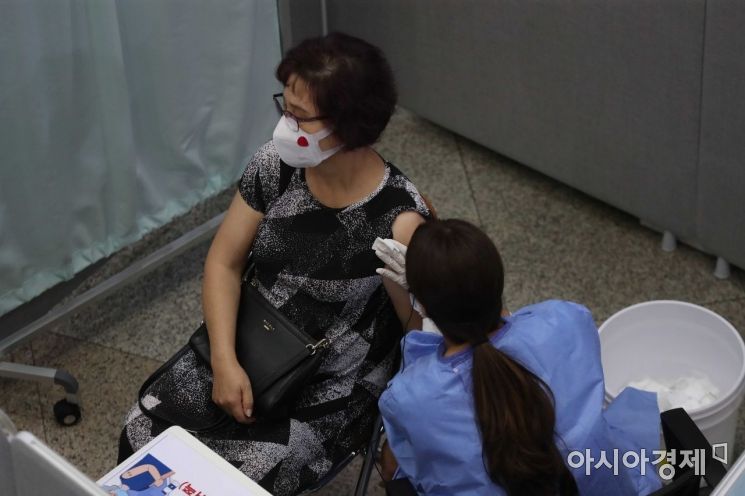 On the 2nd, citizens are receiving vaccines at the COVID-19 vaccination center set up at the Eunpyeong-gu Culture and Arts Center in Seoul. Photo by Mun Ho-nam munonam@
[Asia Economy Reporter Lee Chun-hee] As the cumulative number of COVID-19 cases surpasses 200,000, nationwide vaccination for all citizens will begin at the end of this month.
According to health authorities on the 2nd, COVID-19 vaccination for the general public aged 18 to 49 will start from the 26th. A total of 17.77 million people in their 20s to 40s, who are highly active but were previously lower priority for vaccination, are targeted. In addition, first doses will be administered to a total of 24 million people by next month, including △300,000 people with developmental disabilities △10,000 seafarers and international navigation workers △1.87 million unvaccinated elderly △3.9 million people aged 50 to 54 △and 100,000 other university entrance exam candidates.
Among them, 1,269,000 unvaccinated elderly aged 60 to 74 will be given the opportunity to make booster vaccination reservations starting today. They will receive the AstraZeneca (AZ) vaccine at 8-week intervals. Unvaccinated people aged 75 and older, totaling 600,000, can receive the Pfizer vaccine at vaccination centers whenever they wish.
The authorities had initially maintained the position that since these groups had already been given one chance to get vaccinated, considering fairness with other age groups, they would only be allowed to receive vaccination after November, when all willing citizens complete their vaccinations. However, with the spread of the Delta variant causing a fourth wave, the policy shifted to prioritize the elderly, who have higher fatality and severe illness rates. The proportion of confirmed cases aged 60 and over among total cases had remained in the single digits for four consecutive weeks at 8.1% → 7.6% → 7.9% → 9.2%, but rose to 10.5% last week.
Meanwhile, there are concerns that the significant increase in international vaccine supply prices may affect future vaccine procurement. Pfizer and Moderna have reportedly raised the unit prices of their mRNA vaccines sold to the European Union (EU), believing their vaccines to be superior to others. Pfizer increased the price per dose from 15.5 euros (about 21,000 KRW) to 19.5 euros (about 27,000 KRW), a 25.8% increase, while Moderna raised it from 22.6 dollars (about 26,000 KRW) to 25.5 dollars (about 29,000 KRW), a 12.8% increase.
Son Young-rae, head of the Social Strategy Division at the Central Disaster and Safety Countermeasures Headquarters, explained on the day, "Since contracts have already been signed, there is no impact on the prices for this year's vaccine supplies," but added, "It is likely to affect negotiations for next year's supplies." He said, "mRNA vaccines are notably evaluated as more effective and safer than other vaccines," and added, "Considering negotiation power and the prolonged COVID-19 situation, it is important to have domestically produced vaccines."
© The Asia Business Daily(www.asiae.co.kr). All rights reserved.
![From Bar Hostess to Organ Seller to High Society... The Grotesque Con of a "Human Counterfeit" [Slate]](https://cwcontent.asiae.co.kr/asiaresize/183/2026021902243444107_1771435474.jpg)
















