Entry to Beijing Restricted for Residents in 95 Middle and High-Risk Areas
Concerns Over Economic Impact in China if COVID-19 Spreads Nationwide from Zhangjiajie
[Asia Economy Beijing=Special Correspondent Jo Young-shin] Chinese health authorities are tightening quarantine measures, including controlling the entry and exit of residents from high-risk and medium-risk areas to Beijing. The capital city, Beijing, which had no confirmed COVID-19 cases for the past six months, is showing clear signs of tension after being breached.
According to Chinese media such as Huanqiu Shibao on the 2nd, Beijing health authorities closed two residential complexes located in Fangshan District, Beijing, the previous morning. After a family of three who traveled to the tourist destination Zhangjiajie tested positive for COVID-19, Beijing health authorities immediately locked down the area. Subsequently, nucleic acid tests were conducted on more than 6,000 close contacts. The number of people testing positive in Beijing has increased to seven (including two asymptomatic cases).
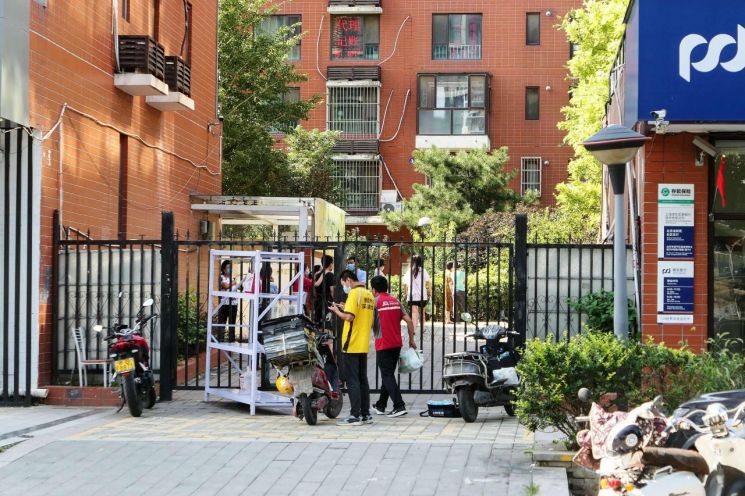
Beijing authorities promptly implemented measures equivalent to a lockdown. The entire country was classified into four high-risk areas and 91 medium-risk areas, restricting the entry and exit of residents from medium- and high-risk areas to Beijing. Additionally, the number of visitors to shopping malls, cinemas, hotels, and tourist sites within Beijing was limited, and previously relaxed quarantine measures such as temperature checks, health code verification, and mask-wearing were reinforced.
Huanqiu Shibao reported that as of the 1st, more than 320 positive cases were confirmed in 27 cities across 18 provinces, stating that China is facing a serious challenge from the Delta variant virus.
As the COVID-19 resurgence that began at Nanjing Lukou International Airport shows signs of spreading nationwide through Zhangjiajie, Chinese authorities are on high alert. Zhangjiajie, a famous tourist destination in China, is highly likely to become a breeding ground for the COVID-19 virus. There is considerable anxiety that if it spreads nationwide, it could hinder China's economic growth.
In fact, China's economy is showing signs of slowing down, with the manufacturing Purchasing Managers' Index (PMI) for July, announced by the National Bureau of Statistics of China, dropping to its lowest level in 17 months. The PMI has consecutively declined since peaking at 51.9 in March: 51.1 in April, 51.0 in May, and 50.9 in June.
Both inside and outside China, there are growing forecasts that if the Delta variant spreads throughout China, the pace of economic growth in the second half of the year will slow down, potentially having a negative impact on the global economy.
© The Asia Business Daily(www.asiae.co.kr). All rights reserved.












