July Exports Reach $55.44 Billion... Highest Monthly Total in 65 Years of Trade Statistics
System Semiconductors Rank 5th, Biohealth Enters Top 10
Increased Share of High-Value Items Like Eco-Friendly Cars, OLED, LNG Ships
Entering Structural Change Phase from 'Quantitative Growth' to 'Qualitative Improvement'
[Sejong=Asia Economy Reporter Kwon Haeyoung] Last month, exports reached $55.44 billion (approximately 63.8 trillion KRW), the highest in 65 years, and evaluations suggest that South Korea's export structure has entered a phase of 'qualitative improvement' through advancement beyond simple 'quantitative growth.' Although dependence on traditional key items such as semiconductors, automobiles, and ships remains high, the export share of high value-added system semiconductors has significantly increased, and the shares of new growth engines such as biohealth, secondary batteries, and cosmetics have also expanded compared to ten years ago.
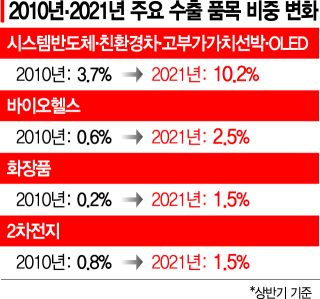
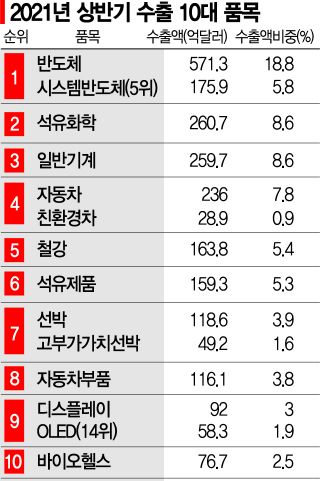
According to the Ministry of Trade, Industry and Energy on the 2nd, as of the first half of 2021, items such as system semiconductors and biohealth, which were outside the top 10 export items about ten years ago in 2010, newly entered the top 10 export items. The biohealth sector recorded $7.67 billion in exports in the first half of this year, ranking 10th, rising eight places from 18th in 2010. Its export share increased from 0.6% in 2010 to 2.5% in the first half of this year.
The remarkable rise of system semiconductors is also notable. For semiconductors, the undisputed number one export item, exports are usually aggregated by combining memory and system semiconductors, but even when system semiconductors, which are relatively weaker compared to memory semiconductors, are classified as a separate item, exports in the first half reached $17.59 billion (5.8% export share), ranking 5th. This is a significant rise from 11th place (3.5%) in 2010, reflecting the results of expanded investments over time.
Looking in detail at the top 10 export items, the share of high value-added items has greatly increased compared to about ten years ago. Within traditional items such as semiconductors, cars, displays, and ships, the share of high value-added items (system semiconductors, eco-friendly cars, organic light-emitting diodes (OLED), and high value-added ships) increased from 3.7% in 2010 to 10.2% in the first half of this year. OLED expanded from 0.2% to 1.9%, jumping in ranking from 19th to 14th when classified separately, and the shares of high value-added ships and eco-friendly cars, which were close to zero in the past, expanded to 1.6% and 0.9%, respectively.
The expansion of export shares in new growth industries is also noteworthy. Aside from biohealth, which is already in the top 10, secondary batteries increased their export share from 0.8% in 2010 to 1.4% in the first half of this year, and cosmetics increased from 0.2% to 1.5%.
This improvement in export structure is also reflected in the National Assembly Budget Office's investigation. According to the Budget Office's analysis of the high value-added index of major export items, semiconductors jumped from 100 in 2015 to 182.8 in 2019, shipbuilding from 100 to 169.4, and biohealth from 100 to 169.1. Future cars rose from 100 in 2017 to 113.3 in 2019. This means that Korean companies have sold more high value-added items to overseas markets compared to before.
An official from the Ministry of Trade, Industry and Energy said, "Recent export growth should be noted not only for the record-high volume increase but also for the improvement and advancement in export quality," adding, "It is significant that the domestic export structure has qualitatively improved, with traditional industries becoming more high value-added and the share of new industry items such as biohealth and secondary batteries increasing."
The export share to advanced markets such as the United States and the European Union (EU) is also increasing. According to the Ministry, the export share to the U.S. increased from 13.2% in 2015 to 15.3% in the first half of this year, and the EU share (excluding the UK) expanded from 7.7% to 10.3%. Meanwhile, China’s share decreased from 26.1% to 25.1%. Jeong Wonil, a researcher at Yuanta Securities, analyzed, "The increase in exports to advanced countries means that exports of final goods and consumer goods, which create high added value, are increasing more than exports of intermediate goods."
Some argue that the recent export boom is a reflection of the benefits from the COVID-19 pandemic and that it is difficult to overstate its significance. Professor Sung Taeyoon of Yonsei University’s Department of Economics said, "Due to COVID-19, digital transformation and demand for pharmaceuticals increased, benefiting sectors where we have competitiveness such as semiconductors and biohealth," adding, "The recent export boom is largely influenced by the global economic recovery, and it is too early to say that qualitative improvement of the traditional export structure has begun."
© The Asia Business Daily(www.asiae.co.kr). All rights reserved.

![Clutching a Stolen Dior Bag, Saying "I Hate Being Poor but Real"... The Grotesque Con of a "Human Knockoff" [Slate]](https://cwcontent.asiae.co.kr/asiaresize/183/2026021902243444107_1771435474.jpg)
















