First Surplus Since 1998 Statistics Compilation
Achieving 1.394 Trillion Won
80% of Total Exports Are Finished Pharmaceuticals
8 Biosimilars Among Top 20 Products
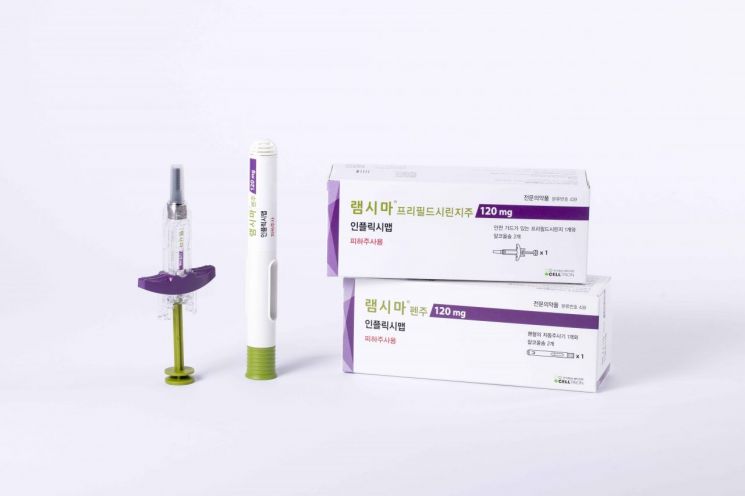
[Asia Economy Reporter Lee Chun-hee] The annual trade balance of pharmaceuticals recorded a surplus for the first time in history. This was driven by a 92% increase in exports of finished pharmaceuticals, led by three biosimilars from Celltrion: 'Remsima Inj.', 'Herzuma Inj.', and 'Truxima Inj.'
The Ministry of Food and Drug Safety (MFDS) announced the analysis results of production, export, and import performance of pharmaceuticals and quasi-drugs in 2020.
The pharmaceutical trade balance achieved a surplus of 1.394 trillion KRW for the first time since the MFDS began compiling statistics in 1998. The MFDS explained, "The main reason is the export of finished pharmaceuticals, which accounted for 79.6% of the total export amount of 9.9648 trillion KRW, increasing by 92.3% year-on-year to 7.9308 trillion KRW."
Last year, pharmaceutical production reached 24.5655 trillion KRW, up 10.1% from the previous year. Of this, 9.9648 trillion KRW was exported, and imports totaled 8.5708 trillion KRW, resulting in the surplus achievement.
The MFDS evaluated that pharmaceutical production has grown at an average annual rate of 6.9% over the past five years, demonstrating its potential as a future growth industry. This growth rate is more than six times higher than the 1.1% growth rate of domestic manufacturing gross output.
Two companies produced pharmaceuticals worth over 1 trillion KRW last year: Celltrion and Hanmi Pharmaceutical. Celltrion ranked first with 1.4769 trillion KRW, a 149% increase from the previous year, and Hanmi Pharmaceutical ranked second with 1.0143 trillion KRW.
The surplus in the trade balance is largely attributed to the significant increase in exports of finished pharmaceuticals. Last year, exports of finished pharmaceuticals amounted to 7.9308 trillion KRW, a 92.3% increase from the previous year, accounting for 79.6% of total pharmaceutical exports.
The top three export items were the three biosimilars produced by Celltrion. The first was the rheumatoid arthritis treatment 'Remsima Inj. 100mg' (543.5 billion KRW), followed by the breast and stomach cancer treatment 'Herzuma Inj. 150mg' (98.6 billion KRW), and the arthritis and lymphoma treatment 'Truxima Inj.' (75.3 billion KRW). Expanding to the fourth and fifth places, biosimilar exports from LG Chem's 'Yusept' and Chong Kun Dang's 'Nesvel' also showed strong performance. Among the top 20 export items, eight were biosimilar products.
Production of prescription pharmaceuticals, which has been the core of the domestic pharmaceutical production market, amounted to 17.845 trillion KRW, accounting for 85% of finished pharmaceuticals and remaining central to the market. Notably, six domestic new drugs demonstrated strong production capabilities, each exceeding 10 billion KRW: HK Inno.N's 'K-CAB Tab.', Boryung Pharmaceutical's 'Kanarb Tab.', LG Life Sciences' 'Gemigliptin Tab.', Ilyang Pharmaceutical's 'Noltec Tab.', Chong Kun Dang's 'Duvie Tab.', and Dong-A ST's 'Suganon Tab.'
Production of quasi-drugs also increased significantly. Due to increased production of COVID-19 prevention supplies, it recorded 3.7149 trillion KRW, a 124% increase compared to the previous year. In particular, production of masks and external disinfectants increased by 818% and 926%, respectively. Consequently, the trade balance of quasi-drugs also showed a surplus of 214 billion KRW.
© The Asia Business Daily(www.asiae.co.kr). All rights reserved.
![User Who Sold Erroneously Deposited Bitcoins to Repay Debt and Fund Entertainment... What Did the Supreme Court Decide in 2021? [Legal Issue Check]](https://cwcontent.asiae.co.kr/asiaresize/183/2026020910431234020_1770601391.png)
















