[Asia Economy Reporter Seulgina Jo] LG Electronics will put an end to its 26-year history in mobile on the 31st. Amid a cumulative loss of 5 trillion KRW in the mobile division, the company chose 'selection and concentration.' The much-anticipated 'world's first' rollable phone commercialization also became an unfulfilled dream. Having decided to completely withdraw from the mobile phone business, LG Electronics plans to focus on future new businesses such as the electric vehicle market and automotive components.
◆ Official End of MC Business on This Day
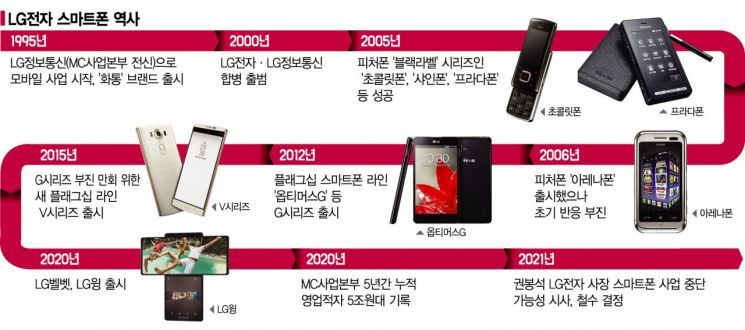
According to industry sources on the 31st, LG Electronics will cease production and sales of its Mobile Communications (MC) division, which has been responsible for the smartphone business, as of this day. This marks 26 years since LG Information & Communications, the predecessor of the MC Business Division, started the mobile business in 1995.
Although LG Electronics is completely withdrawing from the mobile business, it will support after-sales service (AS) for previously sold smartphones for four years from the product's final manufacturing date to ensure customers can use LG phones without inconvenience. Consumables such as batteries and chargers can also be purchased at service centers. The LG Pay mobile payment service will be maintained for at least three years after the business closure.
Since deciding to end the mobile business at the board meeting in April, LG Electronics has been reallocating about 3,400 MC division employees. Approximately 2,800 were reassigned within LG Electronics, while the remaining 600 moved to affiliates such as LG Energy Solution, LG Uplus, and LG Display.
The core proprietary technologies, intellectual property (IP), and patents accumulated in the mobile field will be utilized in future new businesses. LG Electronics stated, "We hold about 24,000 patents related to 4G, 5G, and other communication standards, and core IP assets will be used mainly in smart home appliances and the Internet of Things (IoT). Communication patent technologies can be applied to automotive components and connected vehicle core technologies, so we plan to actively use them in developing telematics, displays, and infotainment."
The net operating loss from the MC division's business withdrawal in the first half of the year is around 1.3 trillion KRW. LG Electronics explained, "Costs for customer services such as future operating system (OS) upgrades and app service maintenance have been fully reflected. Operating losses of about 530 billion KRW occurred during the first half due to ongoing operations related to withdrawal, and excluding this, the pure withdrawal cost is about 770 billion KRW."
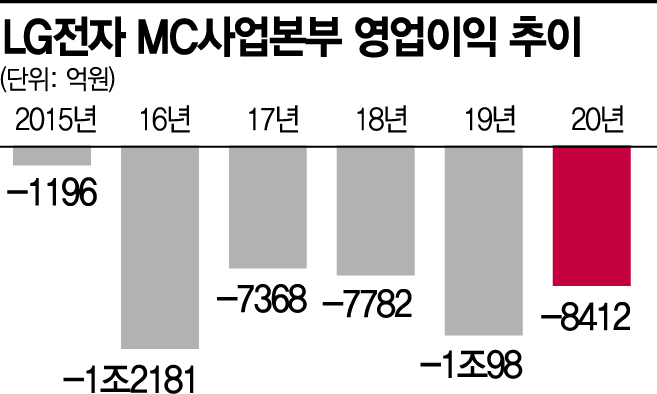
LG Electronics' exit from the smartphone market is widely seen as an inevitable step. The MC division has posted consecutive operating losses since Q2 2015. The cumulative operating loss reached 5 trillion KRW by the end of last year. Additionally, global market share remained stagnant in the single digits. In the premium market, LG was overshadowed by Samsung Electronics and Apple, while in the mid-to-low price segment, Chinese manufacturers with price competitiveness dominated, leaving LG with a market share in the 2% range.
◆ New Start Foreseen... Accelerated Company-wide Business Portfolio Restructuring
With the withdrawal from the smartphone business, LG Electronics is expected to accelerate its company-wide business portfolio restructuring. The company will focus its capabilities on AI-based home appliances and future automotive components while expanding new businesses such as robotics. These areas have been highlighted as key growth sectors since Koo Kwang-mo became chairman of LG Group in June 2018, amid the Fourth Industrial Revolution.
Cooperation with the Canadian joint venture 'LG Magna e-Powertrain,' launched on the 1st of this month, is also anticipated. The future automotive components business will likely focus on three pillars: infotainment, vehicle lighting, and electric vehicle powertrains. Patents and core IT assets accumulated in the mobile field are expected to be primarily utilized. AI and robotics industries are also considered representative future growth engines selected by LG Electronics. Previously, LG Group launched the 'LG AI Research' organization, an AI-dedicated team involving 16 affiliates.
Additionally, LG Electronics will start selling Apple iPhones through its own retail network, LG Best Shop. This move is expected to maintain employment for existing LG Best Shop mobile staff and sustain influence in the smartphone market. Particularly, the influx of young customers, the main demographic for iPhones, visiting LG Best Shop is expected to boost additional sales.
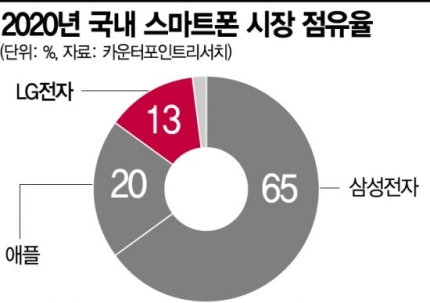
An LG Electronics official said, "Initially, sales will start at less than half of the stores, and the number of sales locations will increase through mutual consultation. The iPhone sales launch is expected around mid-next month, considering staff training." Industry insiders also analyze that LG Electronics could strengthen its close relationship with Apple, a customer for displays and batteries, following the smartphone business withdrawal. According to Counterpoint Research, last year’s domestic smartphone market share was Samsung Electronics (65%), Apple (20%), and LG Electronics (13%).
◆ From Chocolate Phone and Prada Phone to History... 'LG Rollable Phone' Will Not Be Seen
LG Electronics' mobile phone business dates back to 1995. The mobile business began in 1995 with LG Information & Communications, the predecessor of the MC division, and the first brand was 'Hwatong (話通).' In 2000, LG Electronics merged with LG Information & Communications, and the brand names evolved from Freeway and CION to settle on CYON. Alongside Samsung Electronics' Anycall, this marked the start of a golden era that dominated the Korean feature phone market and attracted global attention.
The representative feature phone that led LG CYON's golden era was the Chocolate Phone. Released in November 2005, it surpassed 10 million units sold by 2017, becoming LG Electronics' first 'ten million seller phone.' Following this, the Prada Phone, planned in collaboration with the world-renowned luxury brand Prada in 2007, became a sensation with its large screen and ultra-lightweight design despite its high price of 880,000 KRW.
The golden era of feature phones, including the Chocolate Phone, Shine Phone, and Prada Phone, solidified LG Electronics' reputation as a mobile phone powerhouse. At that time, LG held the number one market share in the US CDMA market. In 2010, LG ranked third in the global mobile phone market by quarterly sales volume, following Nokia and Samsung Electronics.
The crisis for LG Electronics began in the late 2000s with the advent of the smartphone era. The success of feature phones ironically caused a delayed response to the smartphone era that began in 2009. While Apple's iPhone created a global sensation and Samsung hurriedly prepared smartphones like the Galaxy S, LG Electronics remained focused on feature phones.
In June 2009, LG ambitiously launched the Arena Phone equipped with Windows OS, but market response was poor. To recover from the Arena Phone's failure, LG released the New Chocolate Phone in September of the same year, leveraging the Chocolate Phone's reputation, but this was also insufficient. Although LG introduced the 'Optimus' series starting with the Optimus Q in June 2010, results were below expectations.
The smartphone G3, launched in 2014, sold over 10 million units and briefly marked a turning point, but the resurgence was short-lived. Eventually, LG abandoned the G and V series. This contrasts with Samsung Electronics and Apple, which have continued their 'Galaxy' and 'iPhone' series for over a decade. Moreover, LG Velvet and LG Wing, introduced through such brand restructuring, also failed to gain traction.
The LG Rollable, teased at CES 2021 with a teaser video and expected to launch in the first half of the year, was seen as LG Electronics' last chance to recover from its smartphone business slump. However, it was also discontinued following the business closure.
© The Asia Business Daily(www.asiae.co.kr). All rights reserved.
![Clutching a Stolen Dior Bag, Saying "I Hate Being Poor but Real"... The Grotesque Con of a "Human Knockoff" [Slate]](https://cwcontent.asiae.co.kr/asiaresize/183/2026021902243444107_1771435474.jpg)













