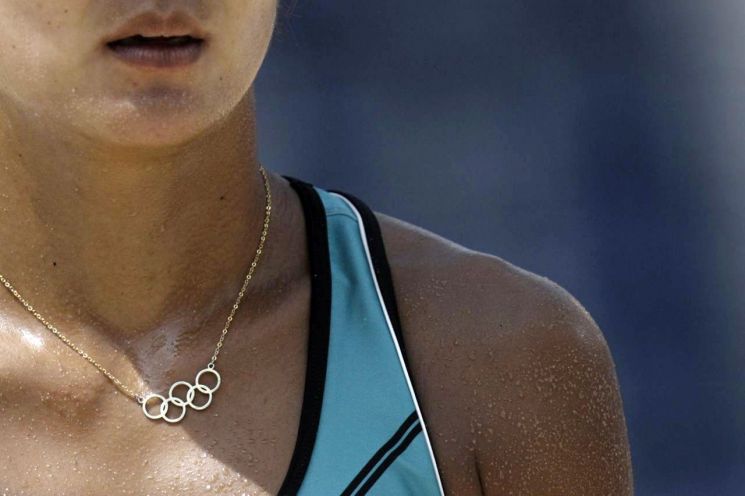
 Japanese athlete participating in the beach handball event at the 2020 Tokyo Olympics. [Image source=Yonhap News]
[Asia Economy Reporter Hwang Sumi] Female athletes participating in the Tokyo Olympics are increasingly choosing their competition attire independently and wearing a variety of outfits.
At the women's gymnastics qualifying event held on the 25th, the German women's team appeared wearing unitard uniforms that covered them from torso to ankle. The previous uniforms were leotards, which were one-piece swimsuits with long sleeves added.
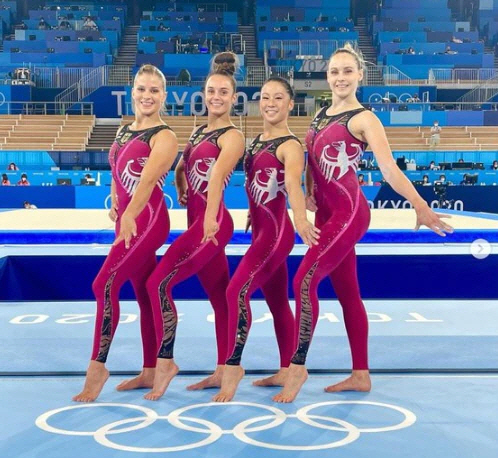 On the 25th, during the Tokyo Olympics women's gymnastics qualifying competition, the German women's national team appeared wearing unitard uniforms.
 [Photo by Instagram capture]
The German women's gymnastics team stated that they chose these uniforms instead of the revealing ones to prevent sexual objectification.
This received much support as it drew attention to the misguided view of female athletes as sexual objects and expanded female athletes' rights to choose their uniforms.
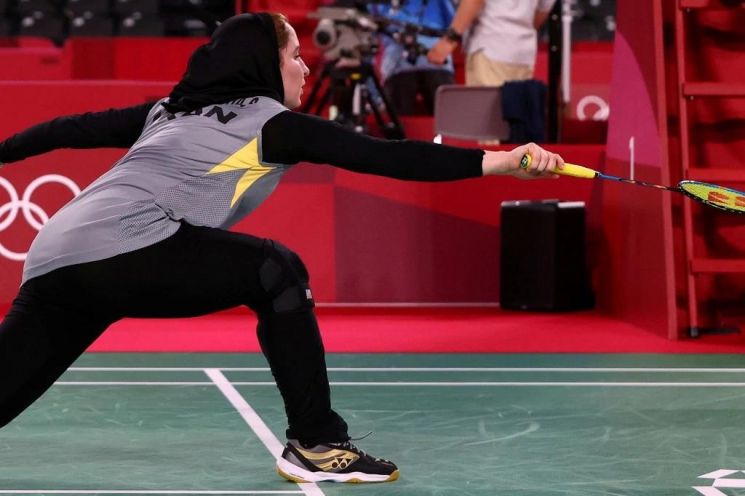 On the 28th, during the women's badminton preliminary match, Soraya Agehi Hajia from Iran is playing wearing a hijab, long-sleeved top, and leggings.
 [Image source=Yonhap News]
The freedom of attire among female badminton players participating in the Tokyo Olympics is also a hot topic.
At the women's badminton qualifying matches held on the 28th, about one-third of the 30 female badminton players freely wore leggings, skorts, skirts, shorts, dresses, and other outfits besides shorts.
India's Pusarla Sindhu, a silver medalist at the Rio Olympics, competed wearing a blue dress. Also, Iran's Soraya Aghaei Hajiagha competed wearing a hijab, long-sleeved shirt, and leggings despite the hot weather, facing off against China's He Bingjiao.
Earlier, the Badminton World Federation introduced a rule before the 2012 London Olympics mandating mini-skirt uniforms for female players to increase badminton's popularity and corporate sponsorship, but after public criticism, the dress code was liberalized.
Meanwhile, at the European Beach Handball Championship held earlier this month in Bulgaria, the Norwegian beach handball team refused to wear bikini bottoms. They cited that the bikini bottoms required by regulations were too restrictive, overly sexualized, and uncomfortable.
Beach handball is played on sand, and according to the European Handball Federation regulations, unlike male players, female players' bottoms must not exceed 10 cm in side width.
The Norwegian beach handball players who competed wearing shorts instead of bikinis were fined 50 euros (about 67,000 KRW) per player per game for "inappropriate clothing and violation of clothing regulations," but public criticism was strong.
As the attire controversy gained attention, the American newspaper USA Today published an article on the 31st titled "Why do some female athletes still wear revealing uniforms at the Olympics?" pointing out that the issue is not about the amount of exposure.
The newspaper explained, "In beach volleyball, players can wear shorts or longer clothing instead of bikinis," and introduced interviews with U.S. national team players. They said they preferred more revealing uniforms because "they are more comfortable." They also added, "If a player finds less revealing uniforms more comfortable, they can wear those uniforms."
© The Asia Business Daily(www.asiae.co.kr). All rights reserved.
![Clutching a Stolen Dior Bag, Saying "I Hate Being Poor but Real"... The Grotesque Con of a "Human Knockoff" [Slate]](https://cwcontent.asiae.co.kr/asiaresize/183/2026021902243444107_1771435474.jpg)


















