Fish and Seaweed Cultivated in Tanks Containing Diluted Contaminated Water
Netizens Fiercely Criticize, "If It's That Safe, Why Sacrifice Fish Instead of Drinking It Directly?"
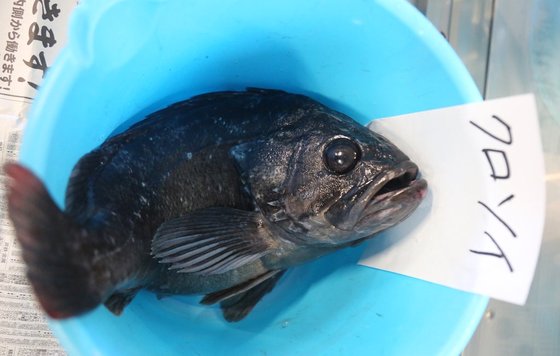 In March, spotted seabass caught off the coast of Fukushima were placed in buckets at the Onahama Fish Market inspection station in Iwaki City, Fukushima Prefecture, Japan. At that time, radioactive substances exceeding five times the Japanese government’s standard were detected in the Fukushima-caught spotted seabass, leading to a suspension of shipments of this species. Photo by Yonhap News
[Asia Economy Reporter Na Ye-eun] On the 30th, according to Japanese media including the Yomiuri Shimbun, Tokyo Electric Power Company (TEPCO), the operator of the Fukushima Daiichi Nuclear Power Plant in Japan, announced that it will conduct experiments raising fish such as flatfish, shellfish, and seaweed in water diluted with contaminated water generated from the nuclear power plant.
According to TEPCO's plan, fish and seaweed will be raised in tanks containing diluted contaminated water. Separately, tanks will also be created using seawater drawn from around the nuclear power plant to raise shellfish and other aquatic animals. They will livestream the fish online and investigate and disclose any abnormalities, tritium concentration in the fish, survival rates, and other data.
Since the accident at the Fukushima Daiichi Nuclear Power Plant caused by the Great East Japan Earthquake in March 2011, contaminated water containing radioactive materials has been generated at an average of about 140 tons per day. The Japanese government purifies this contaminated water using the Advanced Liquid Processing System (ALPS) and stores it in tanks on the nuclear power plant site. However, even after purification by ALPS, the contaminated water contains tritium, a radioactive substance that is technically impossible to remove.
Earlier, the Japanese government announced in April its policy to dilute and discharge the contaminated water into the ocean, judging that the storage tanks cannot be increased indefinitely. Accordingly, the diluted contaminated water is scheduled to be released into the ocean starting in spring 2023.
Before discharging the contaminated water into the sea, it will be diluted 400 to 500 times with seawater to reduce the tritium concentration to less than 1,500 becquerels (Bq) per liter, which is one-fortieth of the Japanese government’s standard, according to TEPCO. In this case, only an extremely small amount of tritium remains, which they claim is harmless to the human body.
However, fishermen in Fukushima oppose the discharge of contaminated water into the ocean. In addition, as opposition from neighboring countries such as South Korea intensifies, Japan has decided to include South Korea in the international verification team that will assess the safety of the contaminated water before discharge.
Meanwhile, TEPCO explained the purpose of raising shellfish in Fukushima’s contaminated water as wanting to "not only explain with numbers but also allow people to visually confirm the safety." However, netizens have criticized this, saying things like "Isn't this abuse of flatfish?" and "If it’s that safe, why sacrifice fish instead of drinking it directly?"
© The Asia Business Daily(www.asiae.co.kr). All rights reserved.

















