Renminbi Weakness May Lead to Emerging Market Capital Outflows
KOSDAQ, Which Started Higher, Also Shows a Decline of Over 1%
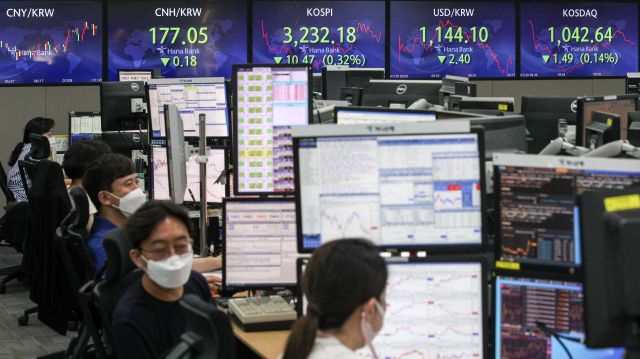 On the 30th, KOSPI opened at 3,234.37, down 8.28 points (0.26%) from the previous trading day, as dealers were working in the dealing room of Hana Bank in Jung-gu, Seoul. On the same day, the USD-KRW exchange rate started trading at 1,144.1 won, down 2.4 won from the previous trading day. Photo by Jinhyung Kang aymsdream@
[Asia Economy Reporter Gong Byung-sun] Foreign investor supply and demand issues are emerging due to regulatory problems originating from China. Both the KOSPI and KOSDAQ are showing declines of over 1%, with the downward trend intensifying.
As of 11:08 a.m. on the 30th, the KOSPI recorded 3,210.10, down 1.00% (32.55 points) from the previous trading day. The KOSPI started the day lower at 3,234.37 and is expanding its losses in the early session.
The foreign investor supply and demand issues caused by regulatory news from China appear to be impacting the domestic stock market. Recently, China has regulated not only platform companies such as Tencent and Didi Chuxing but also the private education market, causing the stock market to plummet. On the same day, the Shanghai Composite Index was down 0.95%, the Shenzhen Composite Index fell 0.61%, and the Hong Kong Hang Seng Index dropped 1.27%.
Han Dae-hoon, a researcher at SK Securities, explained, "The impact of Chinese government regulations on the domestic stock market is limited, but the foreign investor supply and demand issue is concerning. If anxiety about the Chinese market grows, the yuan may weaken, which could lead to a depreciation of emerging market currencies and capital outflows from emerging market investors."
In fact, foreigners and institutions are showing selling pressure. On this day, foreigners and institutions net sold 176 billion KRW and 373.6 billion KRW, respectively. Individuals net bought 542.7 billion KRW.
All sectors except steel and metals declined. The transportation and warehousing sector had the largest drop at 1.78%, followed by pharmaceuticals (-1.48%), transportation equipment (-1.23%), distribution (-1.20%), and machinery (-1.10%). Steel and metals rose 0.91%.
Many of the top 10 market capitalization stocks showed weakness. Samsung SDI had the largest decline at 2.75%, followed by Celltrion (-1.72%), Samsung Biologics (-1.65%), Kia (-1.51%), Hyundai Motor (-0.90%), NAVER (-0.57%), SK Hynix (-0.44%), and Samsung Electronics (-0.38%). LG Chem rose 0.84%, and Kakao remained flat.
At the same time, the KOSDAQ recorded 1,033.63, down 1.01% (10.50 points) from the previous trading day. The KOSDAQ started the day higher but soon turned downward, with losses increasing.
Foreigners and institutions' selling pressure led to the index decline. Foreigners and institutions net sold 118.8 billion KRW and 81.5 billion KRW, respectively. Individuals net bought 210.4 billion KRW.
Almost all sectors declined. Digital content had the largest drop at 2.28%, followed by entertainment and culture (-2.01%), broadcasting services (-1.50%), IT software & services (-1.41%), and distribution (-1.40%). General electric and electronics (0.39%), telecommunications services (0.28%), and textiles and apparel (0.01%) rose.
Most of the top 10 market capitalization stocks declined. Pearl Abyss had the largest drop at 4.46%, followed by Celltrion Pharm (-2.30%), Seegene (-1.94%), Alteogen (-1.93%), CJ ENM (-1.92%), Celltrion Healthcare (-1.80%), Kakao Games (-1.50%), and SK Materials (-1.06%). EcoPro BM (3.38%) and HLB (1.29%) rose.
© The Asia Business Daily(www.asiae.co.kr). All rights reserved.

















