Serious Exposure of Personal Information in Manual Logs
Increase in Customers Using Safe Call
Verification Completed in 3 Seconds with One Call
Applied to Local Governments and Rest Areas
KT Reports Rapid Increase in Safe Call Volume Over 9 Months
Small Business Owners' Burden Remains a Challenge
[Asia Economy Reporter Minyoung Cha] "I received a message from an unknown number asking if I have a boyfriend." Kim Ji-yeon (alias), in her 20s, was startled after receiving a text from a stranger whose face she did not even know. Nowadays, it has become routine to write down names and phone numbers even when buying just a cup of coffee, but the flaws of handwritten logs have led to serious personal information leaks. Some inconsiderate stores have even started sending promotional texts to the phone numbers listed in these logs. To prevent such personal information leaks, the number of businesses using telecom companies' ‘Safe Call Service’ is rapidly increasing.
Local Governments and Rest Areas Expand ‘Safe Call’
According to industry sources on the 30th, KT’s 080 Safe Call Service, first introduced in September last year in Goyang City, Gyeonggi Province, is now being expanded nationwide to local governments and highway rest areas. The Safe Call Service is a solution that combines KT’s intelligent network with the existing 080 number, allowing identity verification to be completed in just 3 seconds with a single call. It is preferred over QR codes, especially among the elderly who are less familiar with smartphones.
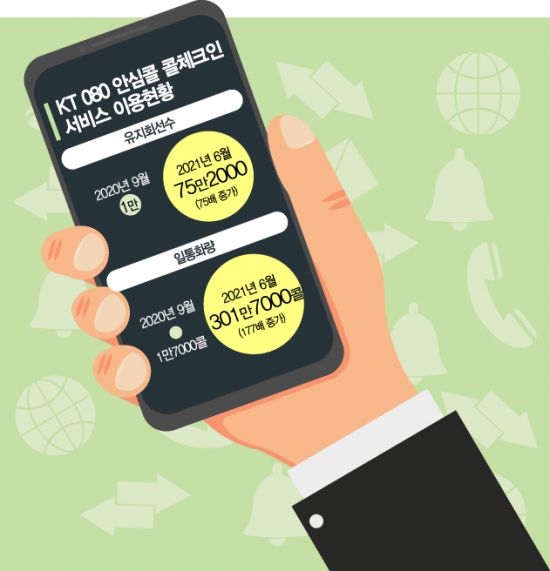
The number of Safe Call check-in lines has steadily increased since last year. As of the end of June, KT reported that the number of subscribed lines from local governments, public institutions, companies, and small business owners nationwide reached 750,000, a 75-fold increase from the 10,000 lines at the time of the pilot launch in September last year, achieved in just nine months. Daily call volume has also surged to 3,017,000 calls recently, a 177-fold increase compared to about 17,000 calls previously. Monthly sales of Sejong Telecom’s 080 caller-pays service increased by about 10.6% in June compared to the beginning of the year. Sales of the 050 Safe Number service, which assigns virtual personal numbers, rose by 4.3%. LG Uplus also launched a small business package including free 080 check-in calls in July. SK Telecom operates the T Safe Call service as well.
There is a strong expectation that demand for Safe Call services will continue to grow. Starting from the 30th, installation of Safe Call and QR codes will be mandatory in department stores and large marts nationwide with an area of 3,000㎡ (approximately 909 pyeong) or more. However, neighborhood supermarkets and traditional markets are excluded from this requirement. The number of places using telecom companies’ value-added services is also expected to increase. The Central Disaster and Safety Countermeasures Headquarters announced this policy on the 27th, citing examples such as the Safe Call operation in Goyang City, Gyeonggi Province, and the pilot application of entry logs at the Hyundai Department Store Trade Center branch in Seoul.
Small Business Owners’ Cost Burden... National Support Needed
There is also the issue that small business owners face a significant cost burden when applying individually for the Safe Call service from telecom companies. Since the expansion of the Safe Call service has been led by local governments rather than the central government, support systems vary according to local government regulations. Even within cities and provinces, there are differences in support responses for small business owners at the district and county levels, reflecting disparities in budgets among basic local governments. Han Sang-hyun (alias), a self-employed individual, said, "I was personally concerned about the Safe Call support and even sent an email to my local assembly member," adding, "The city hall responded that it requires amendments to local government legislation and that the council needs to take action."
Professor Lee Sung-yeop of Korea University’s Graduate School of Technology Management said, "Safe Call is a recipient-pays call service, which imposes telecom charges on small business owners," and added, "Considering the current preparation of nationwide disaster relief funds, it is necessary to consider a plan for the state or local governments to bear part of the telecom charges as compensation for small business owners’ damages."
© The Asia Business Daily(www.asiae.co.kr). All rights reserved.

















