[Asia Economy Reporter Eunmo Koo] Research on mRNA vaccine development will be actively promoted to respond to future infectious diseases.
The Ministry of Science and ICT announced that Yong Hong-taek, the 1st Vice Minister, held a meeting on the 30th with researchers developing mRNA vaccines as part of the "Core Technology Development Project for New and Variant Infectious Disease Response Platform."
This meeting was held to listen to the current domestic technology status, research and development plans, and difficulties in developing mRNA vaccines, which are core technologies for infectious disease response, and to explore government support measures.
The Ministry of Science and ICT launched the "Core Technology Development Project for New and Variant Infectious Disease Response Platform" in June to secure platform technology that can respond quickly to new and variant infectious diseases, which are occurring more frequently and posing a major threat to public health.
As part of this project, a total of 7.43 billion KRW will be invested in mRNA vaccine development research until 2024.
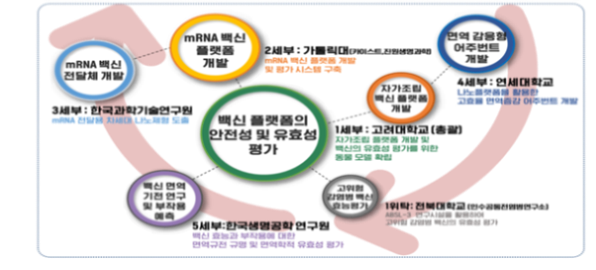
In particular, this research plans to localize core technologies of mRNA vaccines through the development of vaccine antigen candidate derivation platforms, vaccine delivery systems and immune enhancers, evaluation of recombinant protein-mRNA vaccine heterologous boosting, and establishment of efficacy and safety evaluation technologies.
Researchers from various institutions are participating, including Professor Song Dae-seop of Korea University, an expert in virus vaccine development and preclinical evaluation; Professor Nam Jae-hwan of The Catholic University of Korea, an mRNA vaccine expert; Dr. Geum Gyo-chang of KIST, an expert in organic chemical synthesis and new drug development; Professor Ham Seung-joo of Yonsei University, an expert in virus-nano fusion technology; and Dr. Kang Jeong-ah of the Korea Research Institute of Bioscience and Biotechnology, an immunology expert.
Vice Minister Yong Hong-taek said, “mRNA vaccines are a technology that can quickly respond to new and variant infectious diseases,” and added, “Even if it takes time, we must secure our own technological capabilities.” He also stated, “We will support strengthening infectious disease science and technology capabilities by developing core technologies for next-generation vaccines such as mRNA vaccines, advancing preclinical support systems for clinical linkage, and creating a virus research cooperation ecosystem.”
© The Asia Business Daily(www.asiae.co.kr). All rights reserved.

















