China's Largest Battery Maker CATL Unveils Sodium-Ion Battery
Battery Charges to 80% in 15 Minutes, Low Energy Density Remains a Challenge
[Asia Economy Beijing=Special Correspondent Jo Young-shin] Electric vehicles based on sodium (salt) batteries are expected to be released as early as next year.
On the 30th, according to Chinese media such as Caixin, CATL, China's largest electric vehicle battery manufacturer, has developed and unveiled a 'sodium-ion battery' that can charge 80% of its battery capacity in 15 minutes.
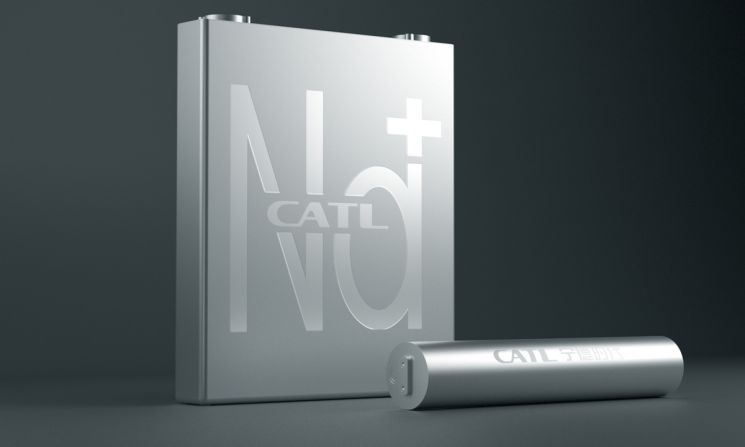
CATL revealed the performance of its self-developed sodium-ion battery and presented a blueprint to establish an industrial supply chain for sodium-ion batteries by 2023. It is expected that electric vehicles equipped with sodium-ion batteries will make their debut in China as early as next year.
CATL explained that the time required to charge 80% of the battery capacity at room temperature is 15 minutes, significantly improving the biggest weakness of electric vehicles, charging time. CATL emphasized, "15 minutes is not much different from the refueling time of gasoline cars," and "sodium-ion batteries can solve the biggest drawback of electric vehicles, which is charging time."
They also added that the battery capacity retention rate is over 90% at a low temperature of minus 20 degrees Celsius.
CATL particularly expects that because sodium is used as the cathode material, the battery price can be up to 30% cheaper, playing a significant role in the spread of electric vehicles. Lithium-ion batteries use nickel, cobalt, and manganese as cathode materials (ternary batteries), and most electric vehicles use ternary batteries.
However, sodium-ion batteries have the disadvantage of lower energy density (battery power) compared to lithium iron phosphate batteries (180Wh/kg) or ternary batteries (240Wh/kg). If the energy density cannot be increased, the battery size must be larger, which in turn burdens the vehicle body.
Regarding this, CATL Chairman Zheng Yuqin stated, "The energy density of the currently developed sodium-ion battery is 160Wh/kg," and "we will improve the energy density to 200Wh/kg in the future."
Battery lifespan was also mentioned. Caixin pointed out that the charge-discharge cycles of lithium iron phosphate batteries and ternary batteries are 6000 and 3000 times respectively, but the charge-discharge cycles of sodium-ion batteries are 1500 times, indicating a shorter battery lifespan.
A source in the battery industry predicted, "Since sodium-ion batteries have both advantages and disadvantages, the efficiency during actual driving will be the key to their adoption."
© The Asia Business Daily(www.asiae.co.kr). All rights reserved.
![User Who Sold Erroneously Deposited Bitcoins to Repay Debt and Fund Entertainment... What Did the Supreme Court Decide in 2021? [Legal Issue Check]](https://cwcontent.asiae.co.kr/asiaresize/183/2026020910431234020_1770601391.png)















