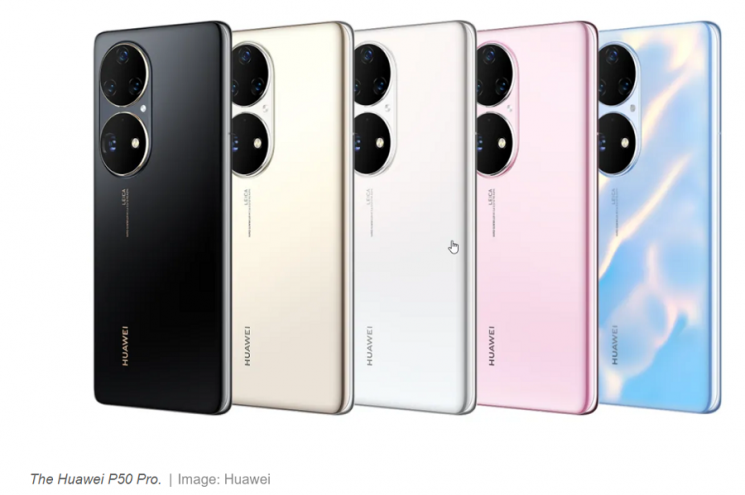
[Asia Economy Reporter Koo Eun-mo] Chinese tech giant Huawei has unveiled its flagship smartphone series, the P50. However, due to stringent sanctions imposed by the U.S. government, Huawei was unable to procure advanced semiconductor chip components, resulting in the P50 being released exclusively as a 4G model rather than supporting 5G.
According to Chinese media outlets including Tencent Technology on the 29th, Huawei held an online event to introduce two products: the P50 and P50 Pro.
The system-on-chip (SoC) used in these devices is a mix of Qualcomm's Snapdragon 888 from the U.S. and Huawei's self-designed Kirin 9000, which was manufactured by Taiwan's TSMC. Both models were produced solely for 4G networks. The SoC is an integrated semiconductor component that combines the smartphone's brain?the application processor (AP), neural processing unit (NPU), graphics processing unit (GPU), and modem chip?into one.
Since September, U.S. government sanctions have escalated to their highest level, preventing Huawei from obtaining cutting-edge 5G-exclusive semiconductors. However, the U.S. government has partially allowed companies like Qualcomm to sell relatively lower-tech 4G-only SoCs to Huawei. The reality that Huawei can only release its top-tier flagship products as 4G-only models, despite showcasing advanced technological capabilities, starkly illustrates the severe business difficulties Huawei faces due to these stringent U.S. sanctions.
Unable to incorporate 5G technology into the P50, Huawei instead focused on promoting other smartphone features such as photography. The premium P50 Pro is equipped with four rear cameras: a 40-megapixel wide-angle camera, a 50-megapixel wide-angle camera, a 13-megapixel ultra-wide-angle camera, and a 64-megapixel telephoto camera. Pricing starts at 4,488 yuan (approximately 790,000 KRW) for the P50 and 5,988 yuan (approximately 1,060,000 KRW) for the P50 Pro.
Additionally, Huawei's independently developed HarmonyOS (Hongmeng, 鴻蒙) was pre-installed as the operating system. Since last month, Huawei has been gradually replacing Android on existing customers' smartphones with HarmonyOS, but the P50 series is the first to come with HarmonyOS installed from the factory. Huawei's decision to abandon Android in favor of HarmonyOS is an unavoidable choice driven by U.S. sanctions. These sanctions have dealt a significant blow to Huawei's smartphone business. Huawei also sold off its mid-to-low-end smartphone brand, Honor.
Huawei's decline continues even in China, the world's largest smartphone market. In the second quarter of this year, Huawei failed to rank within the top five in China's smartphone market. According to market research firm IDC, Vivo led the Chinese smartphone market in Q2 with a 23.8% market share, shipping 18.6 million units and achieving 23.6% growth. Oppo followed in second place with 16.5 million units shipped and a 21.1% market share. Xiaomi shipped 13.4 million units, capturing 17.2% of the market and posting the highest year-over-year growth rate of 47%, surpassing Apple, which shipped 8.6 million units and held a 10.9% share, to take third place. Meanwhile, Huawei did not make the top five and was categorized under 'Others,' whose combined shipment volume has halved compared to the same period last year.
© The Asia Business Daily(www.asiae.co.kr). All rights reserved.

















