Abolishing the 'Teuk, Sang, Botong, Ha' system, which is easily mistaken as reflecting quality standards despite not doing so, and improving it to the 'High Average Price, Medium Average Price, Low Average Price' system reflecting prices by transaction method
 Garak Mall
[Asia Economy Reporter Park Jong-il] Seoul Agro-Fisheries & Food Corporation (President Kim Kyung-ho) plans to undertake a major improvement of the price information it has provided for 36 years since the opening of Garak Market.
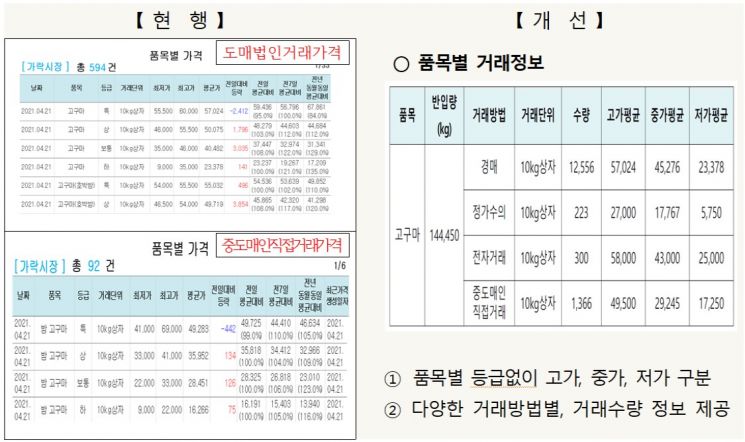
The price information provided on the corporation’s website is basically calculated by applying volume weights according to the daily price ranking into categories of ‘Special, High, Normal, Low’.
Although volume weights vary by item, generally the average price of the top 5% is calculated as ‘Special’, 35% as ‘High’, 40% as ‘Normal’, and 20% as ‘Low’.
The background for calculating grade prices using volume weights is that producers’ grade labeling is subjective, and unlike livestock products, there is no official grading system, so the wholesale market at the final consumption point had no choice but to create non-official grade prices as a last resort.
However, this grade-based (Special, High, Normal, Low) price information has the problem of causing misunderstandings that the quality grades set by the National Agricultural Products Quality Management Service are reflected in the prices, even though quality standards are not actually applied.
Moreover, even agricultural products of the same quality grade can have different grades depending on the volume brought in when shipped to Garak Market at different times, creating a contradiction.
Due to these issues, there have been criticisms that Garak Market’s price information does not accurately reflect distribution information.
The corporation has operated a Distribution Information Improvement Task Force, conducted overseas case studies, commissioned research from specialized institutions, and reflected the results of surveys of distribution information users. Going forward, to prevent misunderstandings about price information among users, the existing ‘Special, High, Normal, Low’ system will be replaced with a ‘High Price Average, Mid Price Average, Low Price Average’ system.
The volume weights for each price group after the transition will refer to the results of specialized research: the high price average will reflect the top 20%, the mid price average the middle 60%, and the low price average the bottom 20%. To assist shippers in choosing transaction methods, volume and price information by transaction method will also be provided for each item.
The newly revamped price information system will be similar to the price information format used in Japan, which has a similar trading structure to Korea. In a survey of distribution information users (76 respondents), 74% supported the direction of the reform.
President Kim Kyung-ho stated, “With this reform of the distribution information system, we will improve the problem that despite the introduction of various transaction methods beyond auctions, volume and price by transaction method were not provided diversely. This will enhance users’ understanding of transaction shares by method and price distribution by item, improving the convenience of using distribution information. We plan to conduct a pilot operation within this year and then proceed with full-scale reform including computer program enhancements.”
© The Asia Business Daily(www.asiae.co.kr). All rights reserved.

















