Increasing the Proportion of US-Made Components in Procured Goods to 75% by 2029
Biden: "We Must Not Rely on Other Countries for Key Items Like Semiconductors"
Commerce Secretary: "Decision on Subsidies for Overseas Semiconductor Companies Like Samsung Is the President's Responsibility"
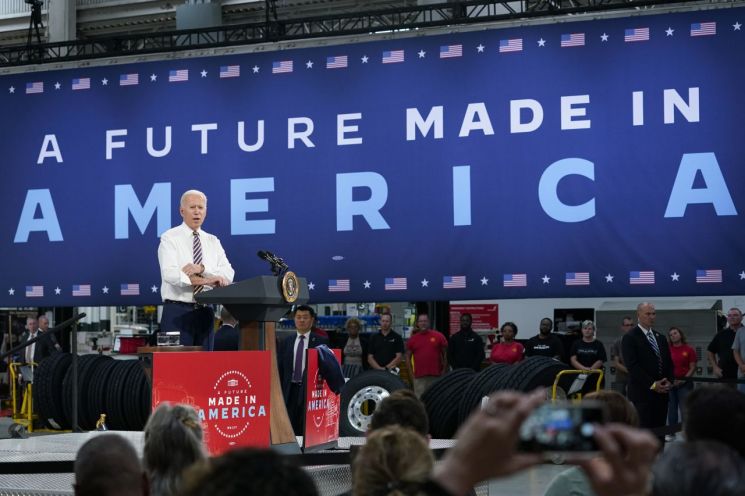
[Asia Economy New York=Correspondents Baek Jong-min and Kim Su-hwan] The Biden administration in the United States has strengthened regulations requiring the purchase of American-made products for procurement items. President Biden also expressed a strong commitment to stabilizing supply chains by producing semiconductors and batteries domestically in the U.S.
Accordingly, it is expected that Korean companies will need to increase the use of American-made parts and expand local production to target the U.S. procurement market, which is worth approximately $600 billion annually (about 692 trillion KRW).
"Use of Over 75% American-Made Parts"
On the 28th (local time), the White House announced a significant increase in the regulation that currently recognizes a finished product as American-made if more than 55% of its parts are American-made, allowing the federal government to purchase it.
This measure will immediately recognize products using 60% American-made parts as American-made, which is 5 percentage points higher than the current standard. Subsequently, the proportion of American-made parts will be gradually increased so that by 2029, products must use 75% American-made parts to be recognized as American-made.
By strengthening the usual 6% price preference given to American-made products during bidding for key items, the administration plans to support the development and expansion of domestic supply chains. Reporting requirements for key items will also be newly established to improve government data on the proportion of American-made content. The White House explained that this measure will support the production of goods necessary for U.S. economic security within the United States.
President Biden, during a visit to a Mack Trucks plant in Pennsylvania on the same day, said, "We have made semiconductor companies from Korea and Taiwan build factories in the U.S.," adding, "We are prioritizing discussions on semiconductors, batteries, and pharmaceuticals. While we will trade with allies, we must have resilient supply chains so that we never again rely on other countries for critical goods." He further stated, "I will bet on America," signaling a commitment to winning the competition with China and restoring the competitiveness of American manufacturing.
Earlier, President Biden issued directives to federal agencies to expand the purchase of American-made goods and signed related executive orders. He has expanded the ‘Made in America’ policy of the previous Trump administration by strengthening the ‘Buy American’ policy.
The Washington Post (WP) explained that this plan reflects the intention to strengthen the U.S. manufacturing base and produce key materials such as semiconductors, batteries, and medical supplies domestically.
"Decision on Subsidy Support for Samsung and Others Lies with the President"
Additionally, U.S. Secretary of Commerce Gina Raimondo stated that President Biden will make the final decision on whether the federal government will provide semiconductor subsidies to overseas semiconductor manufacturers such as Samsung Electronics.
In an interview with Bloomberg News on the same day, Secretary Raimondo said, "Whether to provide funds only to companies headquartered in the U.S. will ultimately be decided by President Biden after internal policy discussions within the administration are completed."
Secretary Raimondo mentioned that there are "some hard realities" to consider when deciding on semiconductor subsidies for foreign companies, citing Samsung Electronics as an example of a company whose fate depends on President Biden’s decision. She said, "Samsung, which is in our ally (Korea) and is a great company, is not headquartered in the U.S. They are leaders in this industry."
During the interview with Bloomberg News, Secretary Raimondo also raised the issue of dependence on Taiwan. She cited geopolitical risks as one reason to reduce reliance on Taiwan for semiconductor chip production. She added that geopolitical risks should be analyzed when deciding which companies receive government subsidies.
The U.S. identifying dependence on Taiwan as a risk factor is believed to stem from concerns that China might pursue unification with Taiwan by force in extreme cases. If such a scenario materializes, the U.S. could face disruptions in securing a stable semiconductor supply chain due to its dependence on Taiwan for semiconductors.
© The Asia Business Daily(www.asiae.co.kr). All rights reserved.

















