Ministry of Education and City/Provincial Offices of Education Announce 'Comprehensive Education Recovery Plan'
3 Trillion Won Invested Over 3 Years to Build New and Expand Existing Schools with Overcrowded Classes
This Year, 1,155 Schools Targeted for Special Classroom Conversion, Modular Classrooms, and Expansion
'Focused Curriculum Supplement Program' to be Implemented from Second Semester through Next Year
Teachers to Provide Customized Small Group Classes After School or During Vacations
[Asia Economy Reporter Han Jinju] The Ministry of Education has decided to eliminate overcrowded classes with more than 28 students by 2024. It will also fully cover the tuition fees for special supplementary curriculum programs for 2 million students who suffered learning losses due to COVID-19.
On the 29th, the Ministry of Education announced the basic plan for the "Comprehensive Education Recovery Measures" at the Government Seoul Office with metropolitan area superintendents. Since last year, as in-person and remote classes were conducted simultaneously, the number of school days decreased, the proportion of students below basic academic achievement levels increased, and learning gaps widened. This reflects the opinions from teacher and parent surveys that supplementary academic support is needed following the expansion of in-person attendance in the second semester.
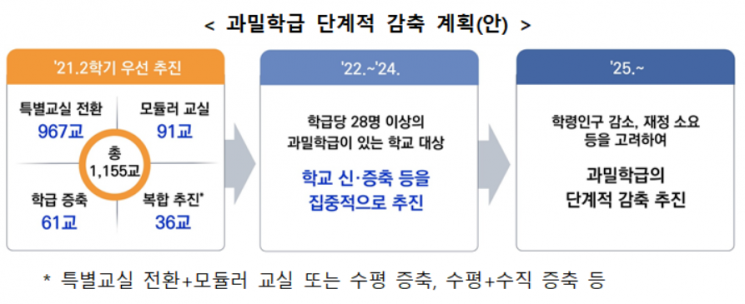
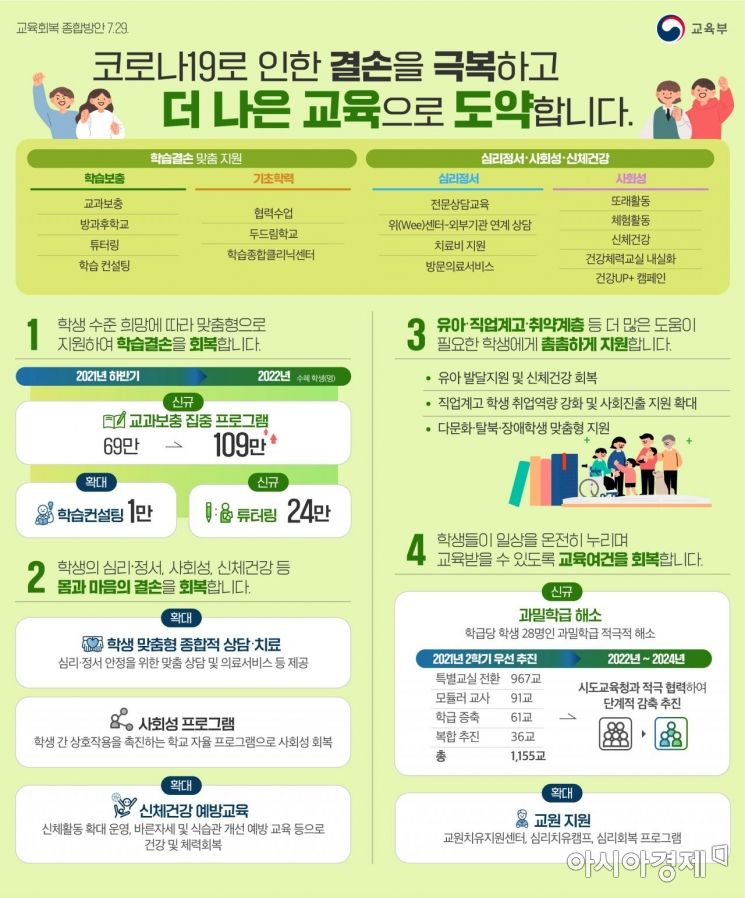
The Ministry of Education will address severe overcrowded classes in new towns in preparation for the expansion of in-person attendance in the second semester and similar infectious diseases. To eliminate overcrowded classes with more than 28 students (40,439 classes, 18.6%) by 2024, it will invest 3 trillion won over three years. Starting from the second semester, it will secure additional classes by converting special classrooms, installing modular classrooms, and expanding classes in 1,155 schools. From next year, it will reestablish regional student placement plans, conduct investment reviews, and proceed with expansions, renovations, or new school establishments.
An official from the Ministry of Education explained, "The highest numbers of overcrowded classes with more than 28 students are in Gyeonggi, Seoul, and Chungnam, and among the places starting additional class securing from the second semester, 89% are in the metropolitan area. Once metropolitan and provincial offices of education establish overcrowded class resolution plans and class placement plans, specific implementation measures will be prepared."
To ensure school establishment aligns with apartment complex move-ins, the number of investment reviews will be increased to four times a year, and investment review criteria will be revised. The School Site Act will be amended within the year to secure school sites near apartment complexes that are easy for commuting. Temporary increases in teacher demand will be met by employing temporary teachers, and a new teacher supply and demand model will be developed in the mid to long term to reallocate personnel.
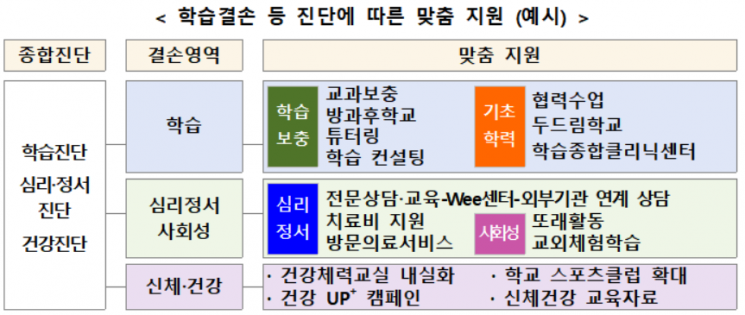
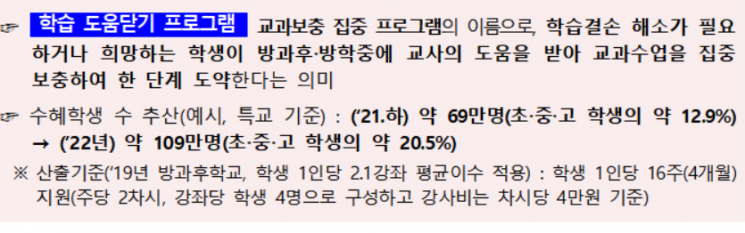
From the second semester, the focused supplementary curriculum program "Student Help Run" will also be conducted. Students who wish to participate and teachers recommended will receive customized programs in small groups of 3 to 5 students per teacher after school or during vacations. The support targets not only students with poor basic academic skills but also those in the middle tier whose academic performance has declined and need supplementation. Tuition fees will be fully covered for 2.03 million students, more than one-third of all elementary, middle, and high school students. This scale corresponds to 3 to 6 times the estimated number of students below basic academic achievement level (Level 1) in academic achievement assessments. The Ministry of Education will support 1.78 million students with a special grant of 570 billion won and increase the number of beneficiaries by additional local education finance grants from metropolitan and provincial offices of education.
An official from the Ministry of Education stated, "The goal is for both academic performance and student psychology to return to pre-COVID-19 levels. If metropolitan and provincial offices of education invest their own budgets, the scale of program support will increase beyond this, and there will be few students who cannot receive help due to budget limitations."
After school starts, all students will be diagnosed for learning losses through EBS’s AI learning diagnostic system (Danju) and emotional-behavioral characteristic tests, and linked to recovery programs. In addition to the supplementary curriculum program, tutoring will be provided to assist small group learning supplementation and counseling by students from education universities and teacher training colleges. Furthermore, the number of elementary schools operating cooperative classes to improve basic academic skills will expand from 1,700 to 2,200 schools.
Considering the decline in language, emotional, and physical development of young children due to COVID-19, after-school program models will be operated in 600 kindergartens nationwide. Support will be provided for qualification exam fees to assist employment in vocational high schools, and employment linkage will be supported through job training courses connected to recruitment.
© The Asia Business Daily(www.asiae.co.kr). All rights reserved.



















