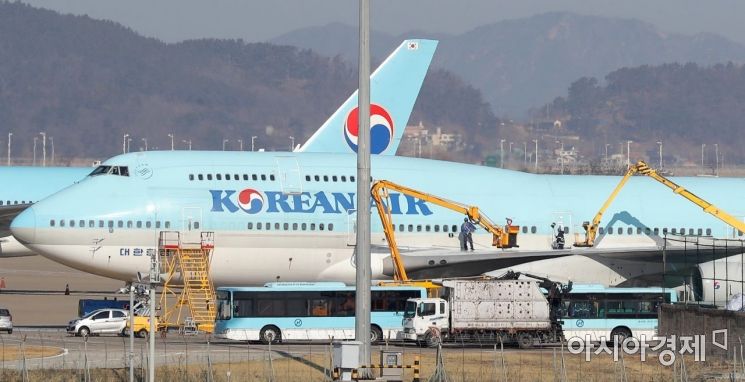
[Asia Economy Reporter Seongpil Cho] A court ruling has stated that if a flight delay caused by an aircraft defect is due to force majeure, the airline is not obligated to compensate passengers.
On the 29th, according to the legal community, Judge Kangmin Park of the Seoul Central District Court Civil Division 46 ruled against 72 passengers, including Mr. Kang, who filed a damage compensation lawsuit against Korean Air. The court stated, "The aircraft defect was caused by force majeure beyond Korean Air's control," and "Since Korean Air took measures to minimize damage to passengers after discovering the defect, there is a ground for exemption from liability for the delayed departure."
Mr. Kang and others were scheduled to depart from Frankfurt Airport, Germany, at 7:10 PM on October 19, 2018, and arrive at Incheon International Airport the next day. However, about 30 minutes before takeoff, a warning message appeared on the aircraft's temperature control device, and Korean Air notified passengers that the departure time was changed to 5 PM the following day. The passengers filed a lawsuit claiming 900,000 KRW per person in damages, arguing that "the airline failed to fulfill its maintenance obligations, causing sudden cancellation of planned schedules and resulting in mental distress and disruption to work."
Korean Air argued, "The departure delay was caused by a defect in a device that could not be remedied," and "we took all reasonably required measures to prevent passenger damages." The court accepted Korean Air's argument and dismissed the claims of Mr. Kang and others. The court noted, "An aircraft is composed of numerous devices and parts and is an advanced mechanical system requiring high technical understanding, and the manufacturer is best positioned to know the causes of defects," and "the airline must perform maintenance according to the maintenance manual provided by the manufacturer." Furthermore, the court stated, "Despite Korean Air taking various measures on the problematic temperature control device according to the maintenance manual, the defect message did not disappear," and "it is reasonable to exempt Korean Air from liability for the delay."
The court also found that Korean Air did not neglect follow-up measures after discovering the aircraft defect. In fact, Korean Air paid for hotel accommodations, food and beverages, transportation costs, electronic discount coupons, and connecting flight-related expenses for passengers due to the delay. The total related costs amounted to 84 million KRW.
© The Asia Business Daily(www.asiae.co.kr). All rights reserved.
![Clutching a Stolen Dior Bag, Saying "I Hate Being Poor but Real"... The Grotesque Con of a "Human Knockoff" [Slate]](https://cwcontent.asiae.co.kr/asiaresize/183/2026021902243444107_1771435474.jpg)
















