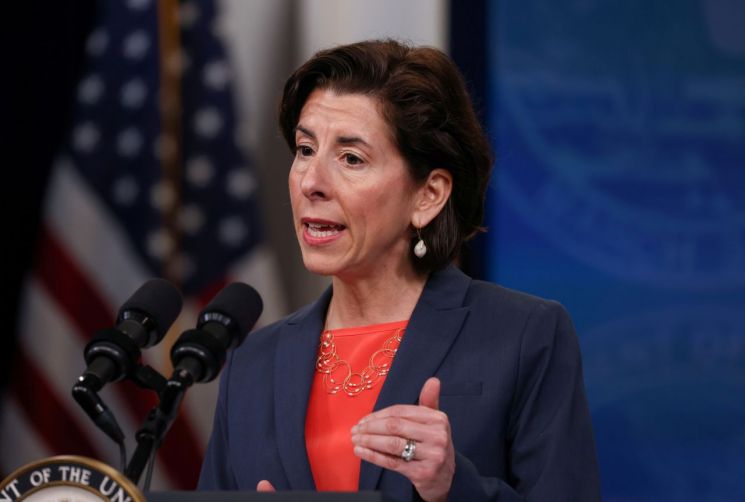
[Asia Economy Reporter Kim Suhwan] The U.S. Secretary of Commerce stated that whether overseas semiconductor manufacturers such as Samsung Electronics will receive semiconductor subsidies from the U.S. federal government is ultimately a decision to be made by President Joe Biden.
Gina Raimondo, U.S. Secretary of Commerce, said in an interview with Bloomberg News on the 28th (local time), "Whether to provide funding only to companies headquartered in the U.S. will ultimately be decided by President Biden after internal policy discussions within the administration are completed."
Secretary Raimondo said, "No final conclusion has been reached yet," and added, "There are many procedures to go through before deciding whether to cooperate with foreign companies." She also stated, "I will discuss this matter with President Biden."
Secretary Raimondo mentioned that there are "some tough realities" to consider when deciding whether to provide semiconductor subsidies to foreign companies, citing Samsung Electronics as one example of a company subject to President Biden's decision.
She said, "Samsung, which is located in our ally (South Korea) and is an excellent company, is not headquartered in the U.S. They are leaders in this industry."
Earlier, the Biden administration regarded semiconductors as core infrastructure for various advanced industries. Accordingly, to secure a stable supply chain, counter China's rise, and expand domestic production, it prepared a bill to provide $52 billion in federal funding, which passed the Senate in June.
The bill passed in the Senate does not discriminate between U.S. and foreign companies, but during the House review process, some minority lawmakers reportedly argued that funding should be provided only to companies headquartered in the U.S.
Currently, U.S. company Intel has announced the construction of a foundry plant worth $20 billion, while among foreign companies, Samsung Electronics and Taiwan's TSMC have announced large-scale investment plans in the U.S.
Secretary Raimondo also mentioned the issue of Taiwan dependency during the interview with Bloomberg News that day.
Bloomberg News reported that Secretary Raimondo cited geopolitical risks as one reason to reduce dependency on Taiwan in semiconductor chip production.
The U.S. identifies Taiwan dependency as a risk factor due to concerns that China might pursue reunification with Taiwan by force in extreme cases. If such a scenario materializes, the U.S.'s reliance on Taiwan for semiconductors could disrupt securing a stable semiconductor supply chain.
Secretary Raimondo said, "We are extremely dependent on Taiwan. Taiwan is currently an ally."
She added that geopolitical risks should be analyzed when deciding which companies receive government subsidies.
According to foreign media, the U.S. Department of Commerce is jointly conducting an analysis of semiconductor supply chain vulnerabilities with the European Union (EU) and is cooperating with allied countries to promote various policies to boost domestic semiconductor production.
Currently, Secretary Raimondo chairs the Trade and Technology Council, a working group established to promote cooperation between the U.S. and the EU, with the first meeting expected to be held in September.
Secretary Raimondo emphasized, "We will secure supply chains not only domestically but also with our allies to ensure that the U.S. has access to all parts of the semiconductor supply chain," adding, "The most important thing for the U.S. is its numerous allies, including Europe."
© The Asia Business Daily(www.asiae.co.kr). All rights reserved.

















