Assets Increased by 5.1 Trillion Won... Urban Railway Corporation Debt Surges 30% Due to Low Realization Rate and Passenger Decline
[Asia Economy Reporter Lim Cheol-young] Last year, the assets of 407 local public enterprises increased by 5.1 trillion KRW, and the debt ratio slightly rose to 34.9%. Despite the COVID-19 crisis, the debt ratio of local public enterprises remained in the 30% range for the third consecutive year. However, due to low tariff realization rates and other factors, the debt of urban railway corporations surged by more than 30%, recording a net loss of 1.82 trillion KRW for the year.
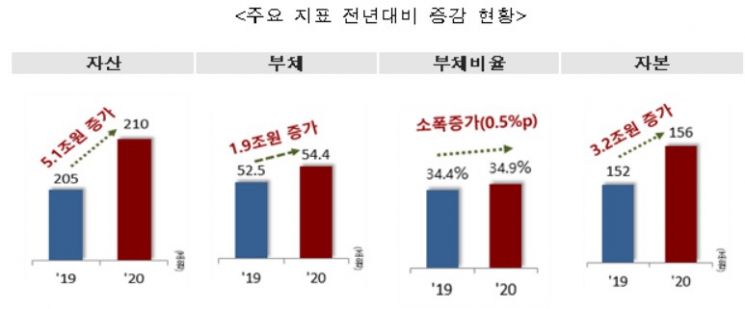
According to the Ministry of the Interior and Safety on the 29th, the year-end settlement results showed that last year, local public enterprises had assets of 210 trillion KRW, liabilities of 54.4 trillion KRW (debt ratio 34.9%), and capital of 156 trillion KRW. Assets increased by 5.1 trillion KRW, liabilities by 1.9 trillion KRW, and capital by 3.2 trillion KRW, with the debt ratio slightly increasing by 0.5 percentage points.
By type, the total debt of directly managed enterprises was 7 trillion KRW, with a net loss of 1.3928 trillion KRW. Among directly managed enterprises, water supply and sewage debts were 600 billion KRW and 5.1 trillion KRW, respectively. Compared to the previous year, water supply increased by 0.5%, while sewage decreased by 8.8%. Due to the continued low tariff realization rate, COVID-19-related tariff reductions, and postponements or cancellations of tariff increase plans, the net loss for water supply and sewage amounted to 1.9672 trillion KRW.
The debt of urban railway corporations increased significantly. The debt of urban railway corporations reached 8.3 trillion KRW, a 30.7% increase from the previous year. Structural factors such as low tariff realization rates and continued losses from free rides, along with a decrease in passengers due to COVID-19, led to a net loss of 1.8235 trillion KRW, continuing operational deficits.
Next, the debt of urban development corporations was 36.6 trillion KRW, a 2.7% increase from the previous year, and net profit was 916.9 billion KRW, up 171.8 billion KRW from the previous year. Other corporations’ debt was 2.2 trillion KRW, down 6.0% from the previous year, and net profit increased by 70.9 billion KRW to 77.9 billion KRW compared to the previous year.
Park Jae-min, Director of the Local Finance and Economy Office, said, “Despite management difficulties in some local public enterprises such as water supply and sewage and urban railways due to the impact of COVID-19, the debt ratio is stably maintained in the 30% range.” He added, “Although the situation remains difficult due to COVID-19 as in the previous year, we will not spare support for local public enterprises so that they can fulfill their social responsibilities, including efforts to improve management and revitalize the local economy.”
© The Asia Business Daily(www.asiae.co.kr). All rights reserved.

















