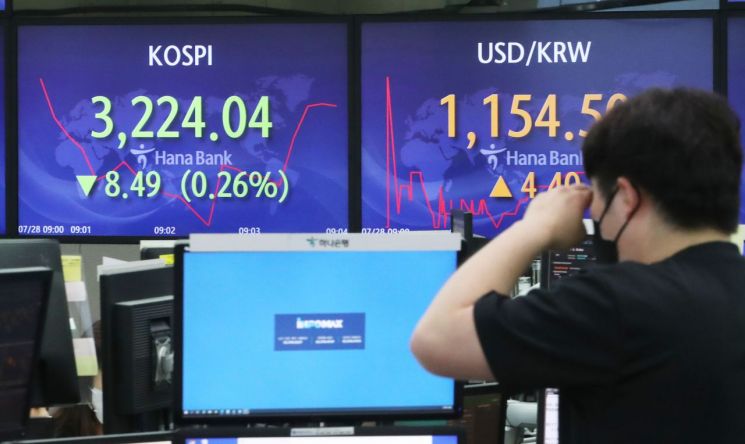
[Asia Economy Reporter Lee Seon-ae] On the 28th, the domestic KOSPI index, which started lower, closed higher. The KOSDAQ index ended the session down more than 1%.
On that day, the KOSPI index opened at 3,226.06, down 6.47 points from the previous day (0.20%↓), and fluctuated slightly throughout the session before closing up 4.33 points (+0.13%) at 3,236.86. The KOSDAQ started the session at 1,043.19, down 3.36 points (0.32%↓), and closed lower at 1,035.68, down 10.87 points (-1.04%).
Only individual investors recorded net buying. Individuals purchased approximately 132.9 billion KRW and 256.7 billion KRW in the KOSPI and KOSDAQ markets, respectively. Foreign investors showed a selling bias in both markets, selling 422.4 billion KRW in the KOSPI market and 71.2 billion KRW in the KOSDAQ market. Institutions bought 307.3 billion KRW in the KOSPI market but sold 168.5 billion KRW in the KOSDAQ market.
By sector in the KOSPI, telecommunications (+2.01%), distribution (+0.83%), and finance (+0.67%) showed strength, while medical precision (-2.23%), textiles and apparel (-1.37%), and machinery (-1.12%) closed lower.
In the KOSDAQ sectors, most sectors such as broadcasting services (-2.70%), digital content (-2.20%), and telecommunications services (-1.96%) closed down, with only some sectors like transportation equipment and parts (+0.87%) and metals (+0.08%) showing strength.
Lee Kyung-min, a researcher at Daishin Securities, explained, "In the early session, foreign futures demand supported the KOSPI to record a firm close, but volatility in the Greater China markets due to regulatory uncertainties and the won-dollar exchange rate exceeding 1,555 KRW acted as negative factors for foreign demand, causing intraday declines." He added, "Concerns about the July FOMC results also entered the market that day." He further analyzed, "China's regulatory issues have only a limited impact on exports and are unrelated to the performance of domestic companies. While China's regulations may trigger short-term anxiety, they are unlikely to damage fundamentals or the upward trend of the stock market."
Lee Eun-taek, a researcher at KB Securities, said, "Concerns about 'economic peak + tightening' may cause continued volatility for a while, but price adjustments due to tightening are not the 'start of a bear market'; rather, they should be understood as a 'speed control process' that relieves valuation pressure." He emphasized, "Therefore, after the adjustment, the market is expected to return to a bull market, and price fluctuations present another buying opportunity." He added, "Value stocks, which are in a 'good earnings + oversold' state, may see a short-term rebound, but growth stocks (KOSDAQ) remain positive in the mid to long term." He recommended, "During growth stock corrections, gradually increasing holdings through incremental purchases is advised."
© The Asia Business Daily(www.asiae.co.kr). All rights reserved.

















