 A domestic research team has developed a transparent polymer core material that is currently being fully imported from Japan.
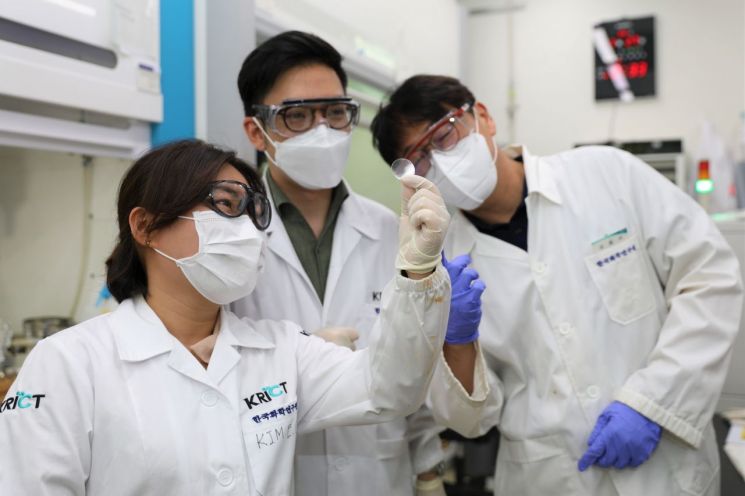
 The research team led by Dr. Yongseok Kim and Dr. Seongmin Park at the High-Performance Polymer Research Center of the Korea Research Institute of Chemical Technology announced on the 28th that they have developed a transparent polymer material based on cyclic olefin with significantly enhanced stretchability. The photo shows the KRICT research team examining a film made from the cyclic olefin polymer material. 2021.7.28 [Image source=Yonhap News]
[Asia Economy Reporter Seulgina Cho] Domestic researchers have developed a core transparent polymer material that has been entirely imported from Japan.
On the 28th, the Korea Research Institute of Chemical Technology announced that the research team led by Dr. Yongseok Kim and Dr. Seongmin Park at the High-Performance Polymer Research Center developed a transparent polymer material based on cyclic olefin with more than twice the stretchability compared to existing materials.
The global market size for cyclic olefin polymer materials is estimated to exceed 1 trillion KRW. Cyclic olefin copolymer (COC), a type of polymer plastic, is emerging as a next-generation electronic material in displays and 5G fields due to its excellent mechanical strength, heat resistance, and high transparency.
However, most commercialized materials are monopolized by Japanese companies. The key challenge is increasing the elongation rate (the ratio of stretch without breaking when pulled unidirectionally) because of low elasticity and difficulty in film formation. Japan is also investing efforts to develop this.
The research team succeeded in polymerizing cyclic olefin polymer materials that overcome these drawbacks by applying a new catalyst system to norbornene-based monomers (monomers containing cyclic hydrocarbon molecular structures). They freely controlled the polymer glass transition temperature, which affects the processing temperature of the material, from 92℃ to 192℃ depending on the monomer content, and developed an easy film fabrication method through dissolving in solvents or heating processes.
Additionally, they controlled the elongation rate from 4% to 245%, achieving physical properties more than twice as stretchable as existing materials. This is evaluated as overcoming the brittleness of existing norbornene-based cyclic olefin polymer materials. The research team is promoting technology transfer to domestic companies related to materials.
Dr. Seongmin Park said, "Cyclic olefin polymer materials were developed by Japanese companies under strict technology security, and domestic demand depends on imports from Japan, so independent technology development is urgently needed. Although it is still in the early stages, such as developing new monomers for property improvement and functionality, this technology development will accelerate localization."
Director Im Hye-mi of the Korea Research Institute of Chemical Technology expressed, "This achievement secures core technology for cyclic olefin polymer development and enhances fundamental understanding of the materials, which is expected to reduce dependence on Japanese materials and improve competitiveness in related materials, parts, and equipment industries."
This research achievement was published as the cover paper in this month's issue of the prestigious international polymer journal 'Macromolecules.'
© The Asia Business Daily(www.asiae.co.kr). All rights reserved.

















