Seoul Apartment Jeonse Prices Rise for 108 Consecutive Weeks
Jeonse Share Under 500 Million Won Drops from 65% to 55%
Jeonse Increase Leads to Sales Price Rise Vicious Cycle
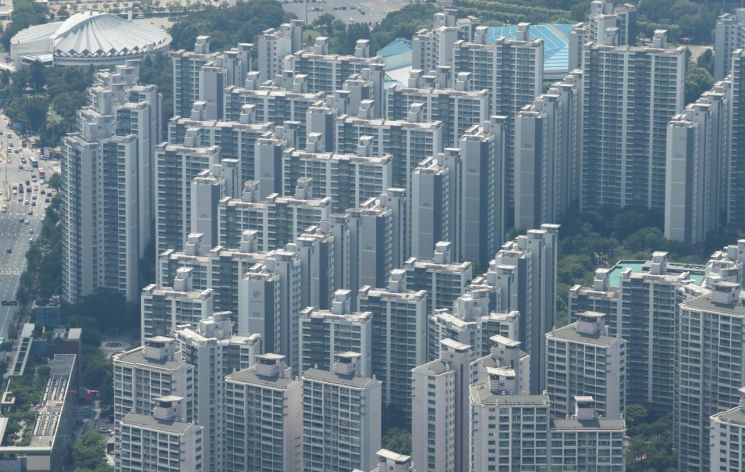
[Asia Economy Reporter Onyu Lim] With runaway housing prices, tenants are not only losing their dreams of owning a home but are also being pushed to the outskirts due to the government's poorly implemented three rental laws, turning into jeonse refugees. Contrary to the government's policy promotion that "it is helping stabilize the rental market," Seoul apartment jeonse prices have continued to rise for 108 consecutive weeks. As mid-to-low priced jeonse rapidly decreases in the market, many tenants who have been pushed out of the protection of the lease renewal right cannot afford the soaring jeonse prices and are being forced to move to the outskirts.
According to the Korea Real Estate Board on the 28th, Seoul apartment jeonse prices have risen for 108 consecutive weeks from the first week of July 2019 to the third week of this month. In particular, the new rental laws, including the lease renewal right and the rent cap system implemented at the end of July last year, have fueled the rising trend of Seoul jeonse prices. This month, the average jeonse price for apartments in Seoul was 634.83 million KRW, up 135.61 million KRW (27%) from 499.22 million KRW a year ago.
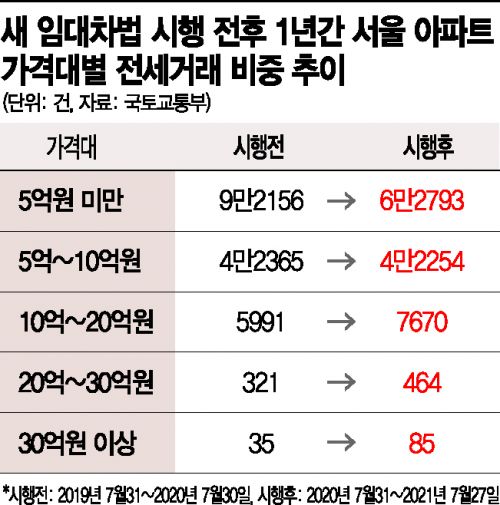
The new rental laws have caused a surge in jeonse prices, rapidly eliminating affordable jeonse in Seoul. An analysis by Asia Economy of Seoul apartment jeonse transactions around the one-year mark of the new rental law implementation shows that jeonse contracts under 500 million KRW dropped sharply from 92,156 to 62,793, a decrease of 29,363 contracts (32%). The share of this price range in total transactions also fell by 10 percentage points from 65.4% to 55.4% within a year. Conversely, the share of contracts between 500 million KRW and 1 billion KRW increased by 7.3 percentage points from 30% to 37.3%. The new rental laws, which were supposed to protect ordinary citizens, have instead triggered price surges due to supply-demand imbalances in the jeonse market, threatening people's livelihoods.
The proportion of high-priced jeonse over 1 billion KRW has also increased. In the year before the new rental laws were implemented, there were no jeonse contracts over 5 billion KRW, but now there have been four such cases.
In particular, the rapid rise in jeonse prices is creating a vicious cycle that drives up sale prices. Even in Seoul, many tenants are shifting to affordable purchase demand, stimulating housing prices in areas like No, Do, Gang (Nowon, Dobong, Gangbuk districts) and Geum, Gwan, Gu (Geumcheon, Gwanak, Guro districts), which in turn triggers a domino effect leading to rising housing prices in Gyeonggi Province. In Nowon-gu, which has recorded the highest rate of increase for 15 consecutive weeks in Seoul, a 115㎡ apartment in Junggye-dong Life was sold last month for 1.535 billion KRW, surpassing the loan restriction limit. This price is 300 million KRW higher than a year ago.
Jang Jaehyun, head of research at Real Today, said, "Due to the implementation of the new rental laws, listings are extremely scarce, and as subscription demand accumulates in the 3rd phase new towns, jeonse prices can only continue to rise," expressing concern that "the phenomenon of jeonse prices pushing up sale prices will persist in the second half of the year."
© The Asia Business Daily(www.asiae.co.kr). All rights reserved.


















