In Negotiations for Factory Sale and Relocation with Pyeongtaek-si
Actively Reviewing Land Use Change Plans
Liquidity Boosted by Rising Land Prices
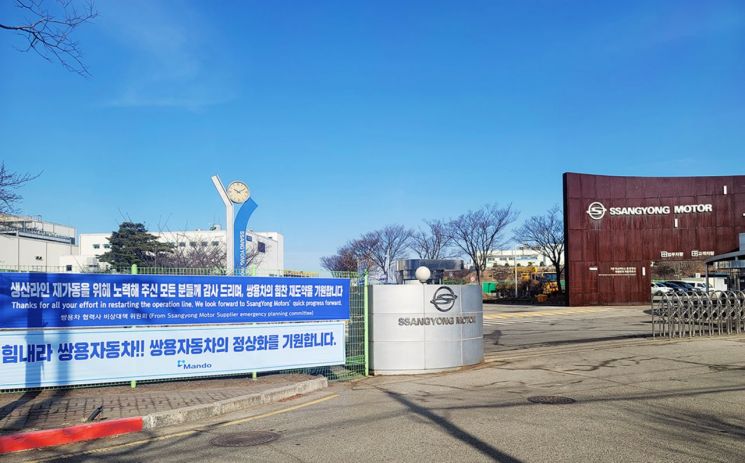
[Asia Economy Reporter Ki-min Lee] The change in the use of the Pyeongtaek plant, which Ssangyong Motor and Pyeongtaek City are negotiating, is expected to be a turning point for Ssangyong Motor's recovery.
According to related industries on the 28th, Ssangyong Motor's administrator Jeong Yong-won held a meeting with Pyeongtaek City officials the day before and began detailed discussions regarding the sale and relocation of the plant. On the 9th, Ssangyong Motor signed a joint cooperation agreement with Pyeongtaek City for the relocation and construction of the Pyeongtaek plant, aiming to promote a business transition to eco-friendly vehicles.
Pyeongtaek City is reportedly actively considering changing the use of the current Pyeongtaek plant site to residential land or other purposes. The plan is that as Ssangyong Motor sequentially relocates to the newly built plant, the land will be converted to allow housing or commercial buildings, helping Ssangyong Motor sell the factory land and meeting the increasing housing demand in Pyeongtaek City. Near the Pyeongtaek plant in Chilgoe-dong, Pyeongtaek City, there is Jije Station, an exclusive SRT station, and the Pyeongtaek-Jecheon Expressway. Within 2 km, the Samsung Electronics Pyeongtaek Campus is being constructed, increasing demand for housing and commercial spaces. For cost reduction and efficiency in developing the Pyeongtaek plant site and constructing the new plant, Ssangyong Motor and Pyeongtaek City have decided to seek advice from a consulting firm.

If the use of the Pyeongtaek plant site is changed, the land price will rise, easing Ssangyong Motor's liquidity. Recently, through asset revaluation, the price of the 850,000㎡ Pyeongtaek plant site was estimated at about 900 billion KRW. However, if the land use changes, its value will increase to over 1.5 trillion KRW based on the current surrounding market price (around 6 million KRW per 3.3㎡).
Ssangyong Motor plans to build a new plant on the outskirts of Pyeongtaek City, including new vehicles such as the mid-size SUV J100 and a dedicated electric vehicle line, using the liquidity obtained from the sale. Ssangyong Motor plans the relocation cost to be between 800 billion and less than 1 trillion KRW, so even after constructing the new plant, several hundred billion KRW in liquidity will remain.
Therefore, Ssangyong Motor's merger and acquisition (M&A) and recovery prospects are also expected to improve. Previously, an investment of about 800 billion to 1 trillion KRW was required, including Ssangyong Motor's public claims and post-acquisition investment costs, but now part of the investment costs can be covered internally, reducing the acquisition burden.
The trade creditors group also conveyed to Ssangyong Motor's administrator Jeong Yong-won the day before that they will continuously cooperate to ensure Ssangyong Motor's plan can be realized. A representative of the trade creditors group said, "If Ssangyong Motor's plan to sell the Pyeongtaek plant proceeds smoothly, the possibility of Ssangyong Motor's recovery will increase, so we will cooperate," adding, "We are trying to find a way to get loans using the previously tied-up claims as collateral."
© The Asia Business Daily(www.asiae.co.kr). All rights reserved.


















