Unable to Remove Masks Despite COVID-19 Risks
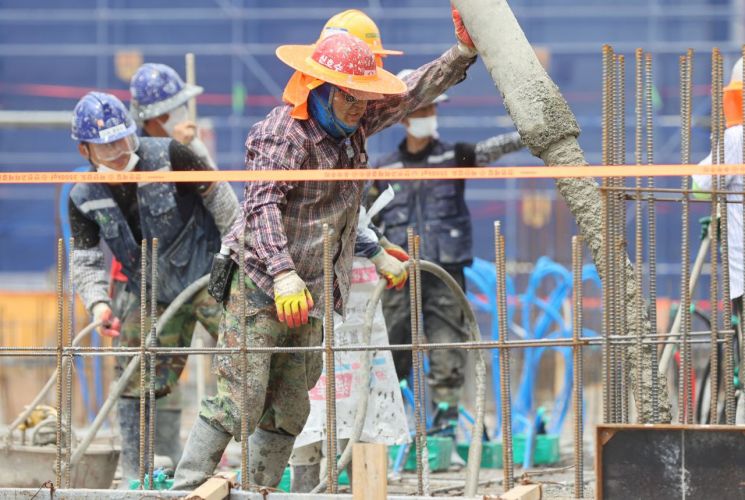 Amid heatwave warnings issued across the country, a site worker is seen working at an apartment construction site in Jung-gu, Incheon on the 20th. [Image source=Yonhap News]
"Due to the intense heat radiating from the concrete floors and rebar at the site, the temperature at the construction site approaches 40 degrees Celsius."
Seo Mo (51), who works at an apartment construction site in Seodaemun-gu, Seoul, said, "I've worked as a rebar worker for over 10 years, but this is the first time I've experienced heat like this." Despite this, Seo cannot take off his mask due to the risk of infection. Even when the mask becomes soaked with sweat and breathing becomes difficult, there is little space or time to escape the heat with shade tents or fans at the site.
As the heatwave continues day after day, outdoor workers exposed to heat-related illnesses are struggling. Parcel delivery logistics centers, where cargo volume has greatly increased due to COVID-19, are also harsh workplaces. Im Mo (44), who works at a parcel delivery logistics center in Gyeonggi-do, said, "I work all day in a place without air conditioning or even ventilation facilities," adding, "The internal temperature often exceeds 30 degrees Celsius, and since ventilation is poor, I work while facing the risk of COVID-19."
According to a related survey conducted by the Korean Confederation of Trade Unions Construction Union among 1,452 union members, only 22.8% reported taking regular breaks of 10 to 15 minutes after working for one hour during heatwave warnings (perceived temperature above 33 degrees Celsius), and 76.1% said they did not shorten work hours or stop work. The Ministry of Employment and Labor, following the three basic heatstroke prevention guidelines, requires that if the perceived temperature remains above 33 degrees Celsius for two or more consecutive days, outdoor work during the hottest hours (2 p.m. to 5 p.m.) should be shortened or work hours adjusted. However, the atmosphere on site suggests these rules are not being followed. It was analyzed that 26.3% of construction sites lack washrooms, and 45.1% do not have adequate facilities for washing. Particularly, only 33.6% of workers rest in places completely shaded from the sun.
Professor Kang Hee-taek of the Department of Family Medicine at Chungbuk National University Hospital said, "Especially elderly people have less body water compared to younger people and their central nervous system functions that sense thirst are diminished, so they can develop heat-related illnesses outdoors without realizing it." He added, "They should regularly hydrate and immediately stop work and rest in a cool place if symptoms such as dizziness or nausea appear."
© The Asia Business Daily(www.asiae.co.kr). All rights reserved.

















