Following Tax Law Amendment Announcement, Repeated Rebuttals to Large Corporations' Tax Cuts Controversy
"Major countries worldwide are in an infinite competition for technological supremacy... Promising astronomical national support"
Ministry of Economy and Finance Taxation Office Chief: "I do not think the effective tax rate will drop significantly due to support for future growth sectors"
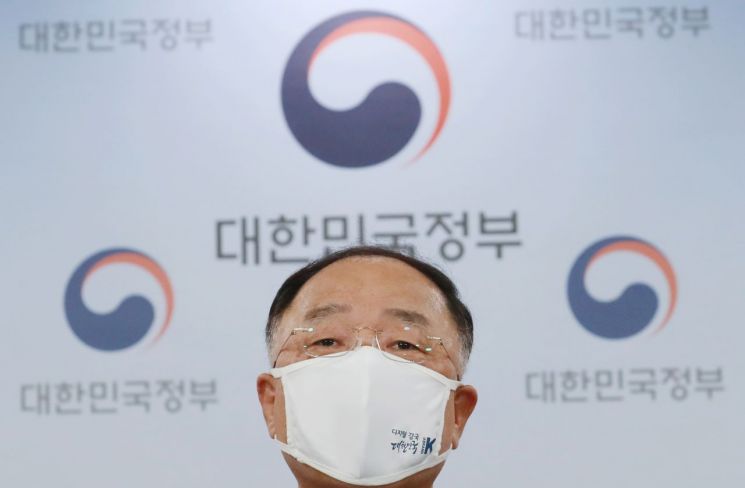
[Sejong=Asia Economy Reporter Kim Hyunjung] Deputy Prime Minister for Economy Hong Nam-ki has rebutted claims that the tax cut effects from this year's tax law amendment are concentrated on large corporations, stating that "this is not true." He emphasized that the next 2-3 years will be a 'golden time,' a turning point for securing competitiveness in strategic technology fields, and stressed that the government and companies must become a 'one team.'
On the morning of the 27th, Hong posted on his social media (SNS), saying, "Criticism framing this tax reform as a 'large corporation tax cut' is not only untrue but also an undesirable perspective," and asserted, "The benefits are distributed evenly among large corporations, small and medium-sized enterprises (SMEs), and mid-sized companies."
He explained, "One of the key tasks of the tax reform plan is to strengthen tax support for national strategic technology research and development (R&D) and facility investment to transition to a leading economy," adding, "This includes unprecedented, bold support measures such as significantly increasing deduction rates compared to general investments and investments in new growth and foundational technologies." He continued, "Recently, major countries worldwide such as the U.S., EU, China, and Japan have entered into infinite competition to gain an advantage in global technological supremacy and supply chain competition for strategic items like semiconductors, promising astronomical levels of national support," and emphasized, "The government's recent announcements of the K-Semiconductor Strategy (May 13) and Battery Development Strategy (July 8) are also aimed at keeping pace with this trend and maintaining and securing a competitive edge in global competition."
He repeatedly stressed the importance of the government and companies becoming a 'one team' at this critical turning point to secure competitiveness in the global technology market. Hong Nam-ki said, "Just as we established measures to strengthen the competitiveness of materials, parts, and equipment two years ago in response to Japan's export regulations, we must act proactively to secure industrial competitiveness," explaining, "The next 2-3 years will be a golden time, an important turning point to secure and maintain our economy's global competitiveness in strategic technology fields." He added, "In this crucial period, it is undesirable to view this tax reform plan through a biased and dichotomous lens as support for large corporations or a tax cut for the wealthy, especially when the government and companies must unite as one team and exert all efforts."
Furthermore, he criticized, "The number of SMEs and mid-sized companies that will benefit from the tax reform related to national strategic technologies is expected to exceed 200," adding, "These companies could grow into key players in our economy's future. Criticism of tax cuts for large corporations could result in depriving these companies of the benefits they would receive."
Earlier, the government estimated that through this year's tax law amendment, tax revenue will decrease by approximately 1.505 trillion KRW (net basis) over about five years from next year through 2026. This is the first total tax revenue reduction in three years since 2018, with corporate tax (1.3064 trillion KRW) accounting for the largest portion, followed by income tax (331.8 billion KRW). Value-added tax and other tax revenues are expected to increase by 7.3 billion KRW and 125.9 billion KRW, respectively.
In particular, as the reduction in tax burden is expected to be concentrated on large corporations, some have raised concerns about 'preferential treatment.' In fact, large corporations account for 57.6% (866.9 billion KRW) of the total tax burden reduction, while SMEs account for 308.6 billion KRW (20.5%), and low- and middle-income groups for 329.5 billion KRW (21.8%).
However, this is interpreted as a result of the tax law amendment focusing on recovery from COVID-19, securing new national growth engines, and strengthening competitiveness in key technologies through support for national strategic technologies. Structurally, the scale of tax support inevitably increases in proportion to related investment and employment size. Excluding tax support for national strategic technologies, the tax burden on large corporations is estimated to increase by 16.1 billion KRW, while that on SMEs is expected to decrease by 31.6 billion KRW.
Kim Tae-ju, head of the Ministry of Economy and Finance Taxation Office, said on a radio program on the morning of the 27th, "About 20-30% of the tax support effects also go to SMEs, and the system is designed to flow throughout the industrial ecosystem," emphasizing, "South Korea's highest corporate tax rate is among the highest in the OECD, and the effective tax rate has continued to rise. I do not think the effective tax rate will drop significantly due to partial support for the future and growth sectors of our economy."
© The Asia Business Daily(www.asiae.co.kr). All rights reserved.
![Clutching a Stolen Dior Bag, Saying "I Hate Being Poor but Real"... The Grotesque Con of a "Human Knockoff" [Slate]](https://cwcontent.asiae.co.kr/asiaresize/183/2026021902243444107_1771435474.jpg)
















