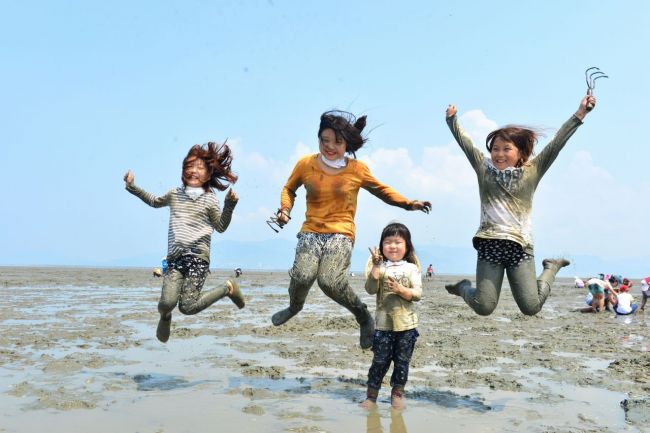
[Gochang=Asia Economy Honam Reporting Headquarters Reporter Kim Jae-gil] The Gochang mudflat in Jeonbuk has been registered as a UNESCO World Natural Heritage site.
The county announced on the 27th that at the 44th World Heritage Committee held in Fuzhou, China, around 7 p.m. on the 26th, the "Korean Mudflats," including the "Gochang Mudflat," were unanimously decided to be finally registered as UNESCO World Natural Heritage.
The World Heritage Committee evaluated, "The Korean mudflats are one of the most important and meaningful habitats worldwide for the conservation of global biodiversity, and especially valuable as a stopover site for endangered migratory birds, thus recognizing its 'Outstanding Universal Value' (OUV)."
This World Heritage Committee decision came after the UNESCO advisory body IUCN (International Union for Conservation of Nature) recommended a "refusal" regarding the "Korean Mudflats" in May, making the registration uncertain.
However, based on close cooperation among related organizations, the value of Korea's mudflats was actively persuaded to the member countries, achieving a two-step upgrade of the advisory body's opinion.
In particular, the Korean mudflats are the second World Natural Heritage site registered in Korea following the "Jeju Volcanic Island and Lava Tubes (2007)."
The registration of the "Korean Mudflats" as a World Natural Heritage site consists of a serial heritage of four locations: Gochang (Gochang Mudflat) in Jeonbuk, Seocheon (Seocheon Mudflat) in Chungnam, Sinan (Sinan Mudflat) in Jeonnam, and Boseong-Suncheon (Boseong-Suncheon Mudflat). This is the result of efforts by five cities and counties since 2015.
The county's mudflats in Buan-myeon, Haeri-myeon, and Simwon-myeon are included in the registration.
The "Gochang Mudflat" is a globally rare mudflat where the sedimentation patterns dynamically change among tidal flat, mixed tidal flat, and sandy tidal flat depending on the season. It is a mudflat of great geomorphological and geological significance, featuring chenier formations (Chenier, ridges formed by sand or shell deposits along the coast) as storm sand deposits.
The county has worked together with local residents to register the "Gochang Mudflat" as a World Natural Heritage site.
In particular, the IUCN inspection team that visited Gochang in October 2019 showed interest in the local residents' efforts to preserve the mudflat, including children's ecological and geological experience learning (Geo Dream), and predicted the prospect of this natural heritage registration.
With the registration of the "Korean Mudflats" as a World Heritage site, Gochang is recognized as a true "UNESCO World Heritage City," possessing natural heritage (Gochang Mudflat), cultural heritage (Gochang Dolmen), intangible cultural heritage of humanity (Nongak, Pansori), and UNESCO Biosphere Reserve (entire Gochang County).
County Governor Yoo Ki-sang said, "This is an achievement made possible by the cooperation of Gochang residents who have protected the mudflats as their living space, the Cultural Heritage Administration, Jeonbuk Province, and the mudflat local governments (Seocheon, Sinan, Boseong, Suncheon)."
He added, "The Gochang Mudflat is an ecological treasure trove inhabited by numerous rare bird species such as the endangered Black-faced Spoonbill and Saunders's Gull, as well as the globally unique genus and species Beomgye. We will continue active conservation activities of the mudflat ecosystem and do our best to develop it into a world-class ecological and cultural tourism resource."
Gochang=Asia Economy Honam Reporting Headquarters Reporter Kim Jae-gil gjg7070@asiae.co.kr
© The Asia Business Daily(www.asiae.co.kr). All rights reserved.

















