Stock Prices Plummet Amid Successive Corporate Regulations in China
[Asia Economy New York=Correspondent Baek Jong-min] An analysis revealed that the market capitalization of Chinese companies listed on the U.S. stock market has disappeared by $765 billion (883 trillion won) in just five months. This means that U.S. investors are suffering significant losses due to China's offensive targeting U.S.-listed companies amid U.S.-China tensions.
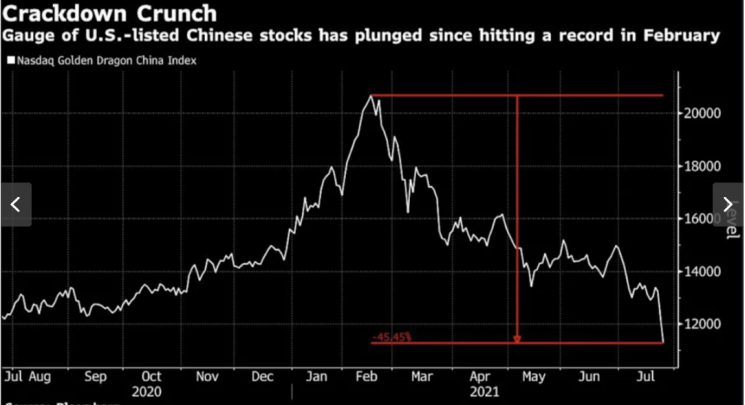
Bloomberg reported on the 26th (local time) that after Chinese authorities announced a ban on the public offering of education-related stocks, the Nasdaq Golden Dragon China Index fell 6.9% that day.
The market capitalization of companies included in the Nasdaq Golden Dragon China Index plunged for two consecutive days, decreasing by $765 billion compared to the all-time high recorded in February.
The Nasdaq Golden Dragon China Index includes 98 Chinese companies listed on the U.S. stock market.
Continuous regulations by Chinese authorities are causing companies listed on the U.S. stock market to fall one after another.
Stocks of education companies such as TAL Education Group and New Oriental Education, which plunged 50-70% in the last trading session last week due to regulatory announcements, also showed a drop of more than 20% that day.
China's largest food delivery service Meituan lost $30 billion in market capitalization following announcements regarding the protection of delivery workers.
Didi Chuxing's stock price fell 42% in less than a month after being listed on the U.S. stock market. Alibaba's stock also dropped 7% that day, and representative Chinese tech companies such as Weibo and Baidu were also down by around 5%.
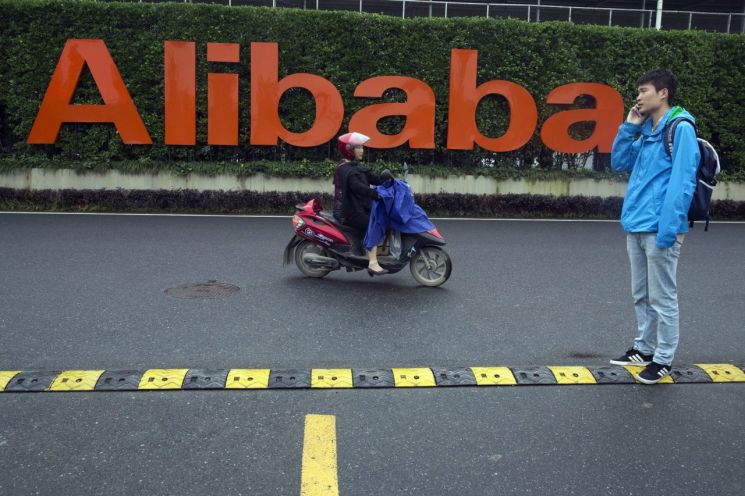
Following antitrust regulations on Alibaba and Tencent earlier this year, Chinese authorities have recently launched an overt offensive against companies listed on the U.S. stock market, triggered by Didi Chuxing's listing.
U.S. investors are rushing to sell Chinese stocks. The ARK Innovation Exchange-Traded Fund (ETF), managed by "Money Tree Sister" Cathie Wood, reduced its Chinese stock holdings from 8% in February to less than 0.5% recently. Well-known Chinese companies such as Baidu, Tencent, and JD.com became targets of selling.
Oliver Jones, Senior Economist at Capital Economics, expressed concern, saying, "The recent situation clearly shows that Chinese authorities intend to harm investors to pursue broad political objectives."
Bloomberg also pointed out that Chinese authorities do not consider how much loss overseas investors are incurring at all.
© The Asia Business Daily(www.asiae.co.kr). All rights reserved.


















