2nd Supplementary Budget Pan-Government TF Announces Meeting Details
[Asia Economy reporters Kim Hyun-jung (Sejong) and Jang Se-hee] High-net-worth individuals owning houses with a publicly announced land price of around 1.5 billion KRW (market value approximately 2.1 billion KRW) or deposits of about 1.3 billion KRW will be excluded from the disaster relief fund, which is to be distributed to 88% of the entire population. Considering special provisions for single-person households and dual-income households, approximately 20.34 million households are expected to receive the support funds.
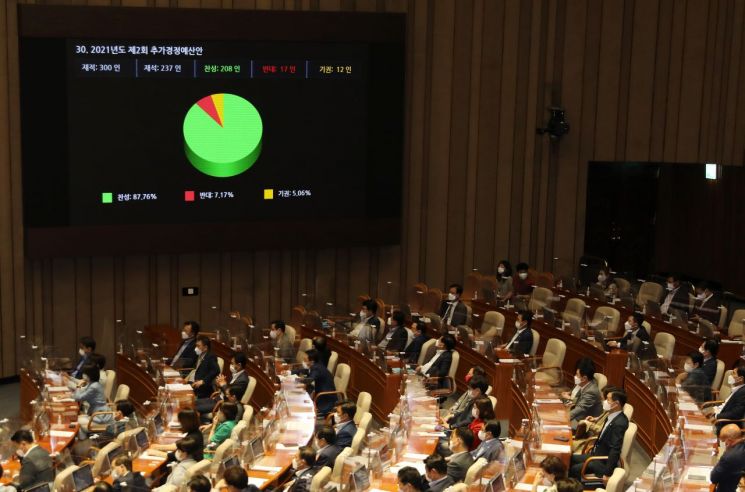
On the 26th, the Ministry of Economy and Finance announced the contents of the 2021 second supplementary budget government-wide task force (TF) meeting reflecting these details. Earlier, on the 24th, the ruling and opposition parties approved the second supplementary budget, which expanded the government's plan to provide disaster relief funds to 18.56 million households (41.36 million people) in the bottom 80% income bracket to cover 87.7% (approximately 88%) of the population in the lower income bracket. The total budget increased from the original 10.4 trillion KRW (8.1 trillion KRW in national funds) to 11 trillion KRW (8.6 trillion KRW in national funds).
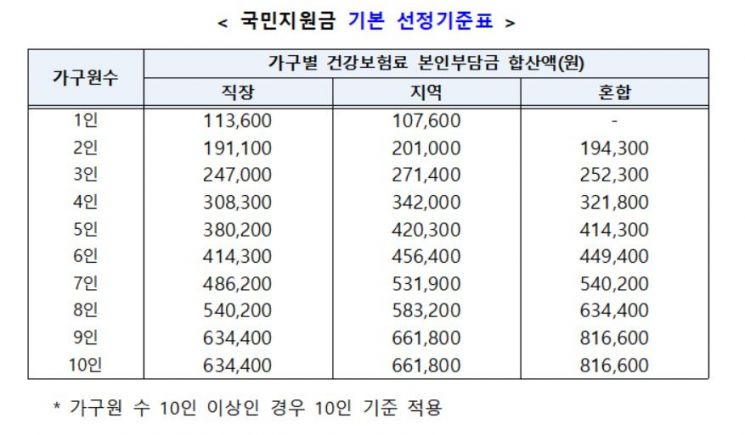
During the National Assembly review process of the supplementary budget, the goal was set as "broader and deeper support." First, dual-income and single-person households, among others, will be broadly included to receive 250,000 KRW per person. The basic principle is to provide funds to those whose combined health insurance premiums for June fall within the bottom 80%. By household size, the health insurance premiums (for workplace subscribers) are approximately 113,600 KRW for a single-person household, 191,100 KRW for two-person households, 247,000 KRW for three-person households, and 308,300 KRW for four-person households. The cutoff applies up to a 10-person household (634,400 KRW); for households larger than this, the 10-person standard is applied.
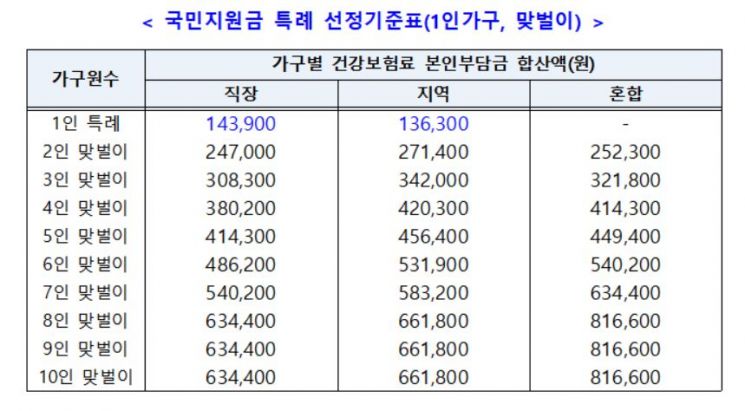
Additionally, separate criteria tables are applied considering the characteristics of single-person and dual-income households. Reflecting the characteristics of single-person households with many elderly and non-active population members, funds will be provided first to those with an annual income below 50 million KRW. For dual-income households, the selection criteria table adds one more household member. For example, a dual-income workplace subscriber household of four people will be eligible if their health insurance premium is below 380,200 KRW, not the 308,300 KRW standard for a four-person household. Moreover, dual-income households include not only couples but also households where two or more income earners reside, such as a father and adult child.
Conscious of fairness controversies raised in the market, the ruling party and government decided to exclude high-net-worth individuals even if they meet the health insurance premium criteria. The cutoff criteria are households with a combined property tax base exceeding 900 million KRW in 2020 or whose household members' total financial income exceeded 20 million KRW in 2020. The 900 million KRW property tax base corresponds to a house with a publicly announced land price of 1.5 billion KRW (market value between 2.0 and 2.2 billion KRW), and the financial income criterion corresponds to holding 1.3 billion KRW in cash deposits (assuming an annual interest rate of 1.5%).
Separate criteria have also been established for regional subscribers. If the comprehensive income reported and paid in 2020 decreased compared to 2019, adjustments can be made through an appeal. According to the special selection criteria table, the health insurance premium self-payment standards for regional subscribers eligible for support are approximately 136,300 KRW for a single-person household, 271,400 KRW for two-person households, 342,000 KRW for three-person households, 420,300 KRW for four-person households, 456,400 KRW for five-person households, and 531,900 KRW for six-person households.
In addition, the government will provide an additional 100,000 KRW per person to low-income groups such as basic livelihood security recipients, near-poverty groups, and single-parent families. The Small Business Hope Recovery Fund has been increased to a maximum of 20 million KRW. The eligible recipients are expected to number around 2.96 million, including 2.34 million basic livelihood security recipients, 590,000 legally defined near-poverty groups, and 340,000 single-parent families receiving child-rearing support. The funds are expected to be deposited into existing benefit accounts around the 24th of next month without a separate application. The "cashback project," known as the mutual growth consumption support fund, will have its implementation timing adjusted. It provides a 10% credit card cashback on monthly card usage exceeding 3% compared to the average monthly usage in the second quarter. However, reflecting the current rapid increase in COVID-19 cases, the implementation is expected to be delayed somewhat.
The Small Business Hope Recovery Fund will provide up to 20 million KRW to 200,000 small business owners who were subject to at least one gathering ban measure from August 16 last year to June 6 this year. Businesses under operating restrictions can receive up to 9 million KRW, and those in management crisis industries up to 4 million KRW. Additionally, losses incurred by small businesses due to government quarantine measures after July 7 will be compensated proportionally with tailored support. The specific calculation method will be prepared in October, with payments starting at the end of the same month.
Experts predict that opposition and fairness controversies will continue among those excluded from this plan. Professor Kim So-young of Seoul National University's Department of Economics explained, "Excluding some from the disaster relief fund only increases controversy and does not significantly help secure funding." She added, "The cutoff criteria are also tied to publicly announced prices, and eligibility can hinge on a difference of a few thousand won, which leaves much room for dissatisfaction." She further pointed out, "The true purpose of selection is to identify those relatively more affected, and excluding only some ultra-high-income earners cannot be considered true selection."
© The Asia Business Daily(www.asiae.co.kr). All rights reserved.



















