Another Late Step Up to Level 3 Starting Tomorrow
1,318 New Cases, Highest Ever on Sunday
"Delta Variant Expected to Exceed 50% This Week"
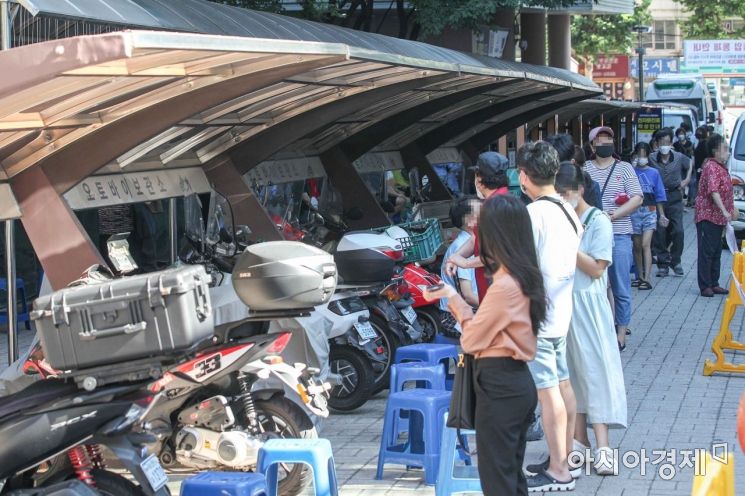 On the 26th, when a 'heatwave advisory' was issued in most regions nationwide, citizens visiting the screening clinic set up at Gwanak-gu Public Health Center in Seoul are waiting to get tested for COVID-19. Photo by Jinhyung Kang aymsdream@
[Asia Economy Reporter Seo So-jeong] As the number of domestic COVID-19 confirmed cases reached the highest ever on a Sunday with over 1,300 cases, the proportion of cases outside the metropolitan area exceeded 40% of the total domestic cases. This is the first time since the 'first major outbreak' that the non-metropolitan area case ratio has surpassed 40%.
According to the Central Disease Control Headquarters on the 26th, as of midnight, the new confirmed cases totaled 1,318, with 1,264 domestic cases and 54 imported cases.
Although the new cases slightly decreased from the previous day's 1,400 range, it is still the highest number recorded on a Sunday. The previous record was 1,251 cases last Sunday, breaking the record again within a week.
The metropolitan area confirmed cases were 749, consisting of 339 in Seoul, 343 in Gyeonggi, and 67 in Incheon, accounting for 59.3% of domestic cases. The number of metropolitan area cases dropping to the 700 range is the first time in 13 days since the 13th. The government extended the highest level 4 of 'social distancing' in the metropolitan area for two more weeks from today until July 8 to curb the spread.
While the metropolitan area spread remains stagnant, the epidemic is spreading rapidly in non-metropolitan areas. On this day, new confirmed cases outside the metropolitan area were 515, accounting for 40.7% of domestic cases.
Daejeon’s confirmed case rate per 100,000 population exceeds 4... Higher than Gyeonggi and Incheon
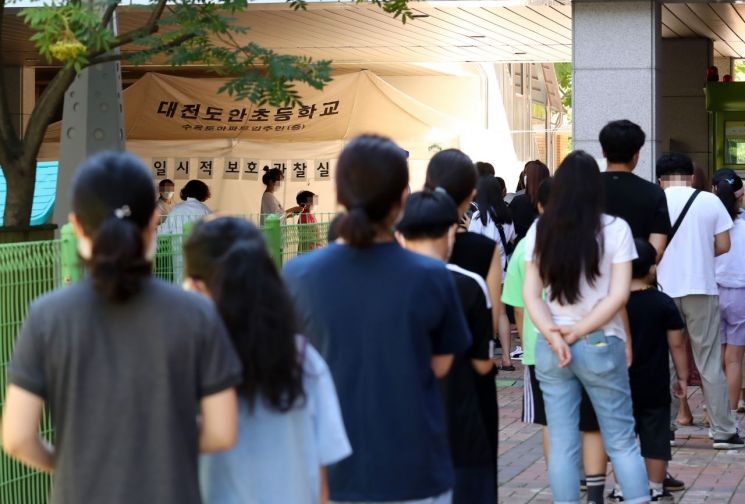
The non-metropolitan area proportion first exceeded 30% on the 18th at 31.6%, maintained the 30% range for eight consecutive days, and then surged to the 40% range for the first time on this day. The 40% range in non-metropolitan areas is the first since the early last year’s 'first major outbreak' centered on Daegu and Gyeongbuk.
Two-digit confirmed cases surged nationwide, including 83 in Busan, 75 in Gyeongnam, 71 in Daejeon, 61 in Chungnam, and 60 in Daegu.
Son Young-rae, head of the Social Strategy Division at the Central Disaster and Safety Countermeasures Headquarters, said at a briefing, "There is a large regional variation in non-metropolitan areas, with rapid increases in confirmed cases in Daejeon, Chungcheong, Busan, Gyeongnam, Jeju, and Gangwon. Especially in Daejeon, the confirmed case rate per 100,000 population exceeds 4, which is higher than in Gyeonggi and Incheon."
As non-metropolitan confirmed cases have remained in the 500 range for six consecutive days, the government will uniformly raise social distancing to level 3 in non-metropolitan areas starting from the 27th.
Professor Lee Jae-gap of Hallym University Kangnam Sacred Heart Hospital pointed out, "During the metropolitan outbreak, experts repeatedly emphasized the need to raise the level in non-metropolitan areas due to concerns about the 'balloon effect,' but the step-up to level 3 was again delayed. With the peak summer vacation season at the end of July and early August, movement between metropolitan and non-metropolitan areas will be active, making it difficult to curb the spread for the time being."
© The Asia Business Daily(www.asiae.co.kr). All rights reserved.


















