Traditionally, August is a weak month for the US stock market
Exploration continues until global economic direction is confirmed
Responding with selective selling... Portfolio review underway
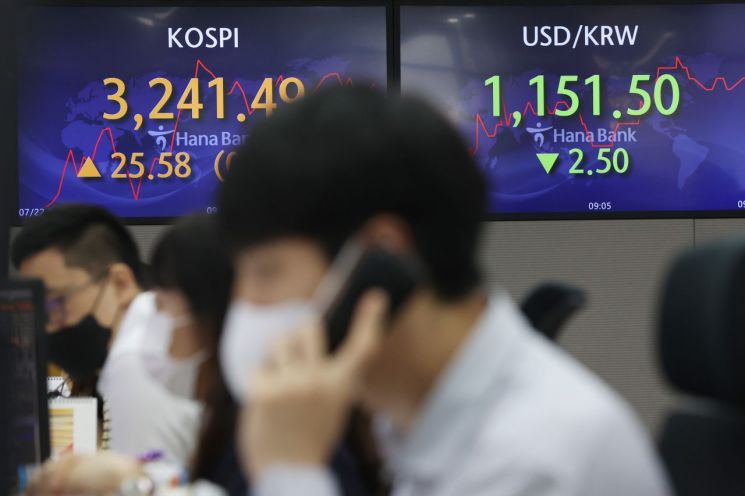
[Asia Economy Reporter Lee Seon-ae] The securities industry’s outlook on the stock market in August is not optimistic. While maintaining a positive view of the second half of the year’s stock market, it is expected that the market will remain trapped in a box range for the time being, continuing to fluctuate as it "searches for direction." If the global economic direction remains uncertain due to the spread of COVID-19 and the slowdown in economic recovery momentum, the domestic stock market’s "cautious trading" may continue for some time. In particular, the traditionally weak U.S. stock market in August is expected to be a burden. Investment advice includes "portfolio rebalancing" (readjusting the allocation of managed assets) in preparation for the fourth quarter or adopting a "barbell strategy" that includes both cyclical stocks and growth stocks in the portfolio.
According to Daishin Securities on the 26th, the U.S. stock market (S&P 500), which influences the domestic market, has historically shown weakness in August and September. Excluding 2020 when COVID-19 struck, the S&P 500’s returns for August-September from 2010 to 2019 (2015-2019) were -0.5% (-1.0%) and 0.3% (0.3%), respectively. August was the second-lowest monthly return of the year, and September showed the lowest positive return among months with positive returns.
This year, the U.S. stock market is showing a trend not significantly deviating from past seasonal patterns, making it highly likely that the market will take a cooling-off period during August and September. Other reasons for expecting a slowdown in August-September include the decline in U.S. economic strength, represented by slowing economic growth rates and profit growth rates. The U.S. quarterly economic growth rates (quarter-on-quarter, annualized) for the first to fourth quarters this year were 6.4%, 9.0%, 7.1%, and 5.1%, respectively, showing a slowdown in growth after the second quarter. Since the U.S. stock market’s trend has been linked to growth rates, the slowdown wave, coinciding with the U.S. driving season and the spread of the Delta variant, inevitably burdens the stock market. Additionally, August is the period when the second-quarter earnings season passes its midpoint and attention shifts to third and fourth-quarter results. The S&P 500’s quarterly earnings per share (EPS) growth rates peaked at 75.0% year-over-year in the second quarter and are expected to slow to 26.8% and 19.4% in the third and fourth quarters, respectively, continuing to slow into the first quarter of next year (3.6% year-over-year). Moon Nam-jung, a researcher at Daishin Securities, emphasized, "Market concerns about the continuous profit slowdown are likely to be reflected in the stock market."
Accordingly, domestic stocks are expected to have difficulty showing a clear direction, leading to investment advice for "stock-specific trading." Kim Young-hwan, a researcher at NH Investment & Securities, said, "Since there is controversy over the global economic direction led by the U.S., it is difficult for the stock market to have a clear direction," adding, "It will be important for stock prices whether earnings can continue to rise not only in the second quarter but also through 2022."
Regarding this week’s market outlook, he said, "The factors supporting the KOSPI’s rise are the easing of concerns about U.S. economic slowdown and positive second-quarter earnings forecasts, while the downside risks include the spread of COVID-19 and short-term declines in U.S. consumer sentiment," adding, "U.S. economic indicators are scheduled to be released this week, and the stock market will fluctuate depending on the results of these indicators."
He suggested stock-specific trading as investment advice, emphasizing, "The sectors expected to show the largest improvement in operating profit from 2021 to 2022 are utilities, media, software, healthcare, semiconductors, distribution, construction, IT home appliances, and automobiles, in that order." He continued, "It is important to select stocks that can form themes in a rotation mainly among sectors with favorable long-term earnings prospects until 2020," adding, "Since domestic stocks are expected to have difficulty showing a clear direction for some time, stock-specific trading is necessary."
Han Dae-hoon, a researcher at SK Securities, also said, "Since many events that could raise caution are scheduled, the stock market is expected to continue fluctuating within a box range," emphasizing, "Among growth stocks, it is necessary to respond with a barbell strategy by including secondary battery and bio sectors, and among cyclical stocks, semiconductors, IT components, and automobile sectors in the portfolio."
Shin Seung-jin, a researcher at Samsung Securities, said, "Last week, the strong second and fourth-quarter earnings announcements centered on cyclical stocks such as POSCO and Hyundai Motor stood out, but the stock price response was lukewarm due to concerns that these sectors will peak in the second half of the year," adding, "This week, the July Federal Open Market Committee (FOMC) meeting and major U.S. economic indicators are scheduled to be released, so investors’ cautious stance and stock-specific rotation are expected to continue."
© The Asia Business Daily(www.asiae.co.kr). All rights reserved.
![Clutching a Stolen Dior Bag, Saying "I Hate Being Poor but Real"... The Grotesque Con of a "Human Knockoff" [Slate]](https://cwcontent.asiae.co.kr/asiaresize/183/2026021902243444107_1771435474.jpg)
















