[Asia Economy Reporter Seulgina Jo] The Ministry of Science and ICT and the National IT Industry Promotion Agency (NIPA) announced on the 26th that they will actively promote a flagship project to expand the application of intelligent Internet of Things (IoT) as part of the Digital New Deal to create tangible results for the public and discover leading service models.
Starting this year, seven flagship projects will be intensively supported, focusing on five strategic areas: individuals and small business owners, digital healthcare, energy, logistics and transportation, and manufacturing.
As a result of the first half-year project call, which received applications from 60 consortia involving more than 300 institutions, the seven final selected projects are: ▲ Intelligent IoT-based indoor air quality management system (supporting individuals and small business owners) ▲ IoT-applied virtual and augmented reality (VR·AR) rehabilitation treatment system (digital healthcare) ▲ AIoT technology-based integrated control service for multi-use facilities (safety management) ▲ AI semi-autonomous renewable energy harvesting system (energy) ▲ Intelligent IoT integrated cold chain service (logistics and transportation) ▲ Predictive maintenance service for small and medium equipment manufacturing companies (manufacturing) ▲ AIoT robotic musical instruments-based non-face-to-face performance hall (entertainment).
The seven projects are composed of three regionally linked public experience projects (6 billion KRW) and four leading services for productivity innovation (8 billion KRW).
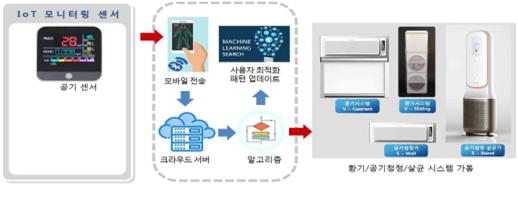
Among the three regionally linked public experience projects, the intelligent IoT-based indoor air quality management system refers to a system where indoor and outdoor sensors measure air quality in real time, and AI controls air sterilizers, ventilation systems, and air purifiers to automatically manage indoor air quality. It provides optimized operation patterns tailored to the user's space and situation, effectively improving indoor air. It is planned to be applied and expanded to 140 demand sites such as nursing homes, senior centers, daycare centers, and administrative welfare centers in cooperation with Goyang City.
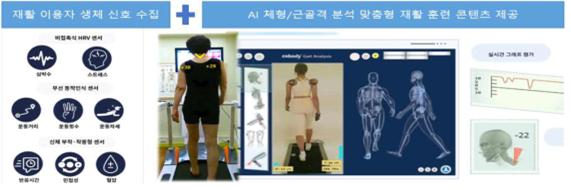
The IoT-applied VR·AR rehabilitation treatment system is a service for vulnerable rehabilitation patients such as stroke patients, the elderly, and traumatic brain injury patients. Palm-sized contactless radar sensors and motion recognition sensors collect biometric data such as heart rate, respiration, movement, and posture of rehabilitation patients, and AI calculates the type, duration, and intensity of rehabilitation exercises needed, recommending customized VR·AR rehabilitation content. Since it can provide safe and enjoyable rehabilitation programs for the elderly and others, it is expected to be applied in nursing hospitals or community care centers in the future to support effective rehabilitation.
The integrated control service for multi-use facilities using AIoT technology installs sensors in mechanical equipment, electrical rooms, generators, and reservoirs within buildings to measure temperature, noise, power consumption, etc., to prevent damage such as floods and fires in multi-use facilities. AI detects abnormal signs. In case of emergencies, intelligent patrol robots approach the site to provide necessary information in real time, supporting initial suppression. This service will be established in cooperation with Chungbuk Development Corporation at Chungbuk Research Institute, Chungbuk Enterprise Promotion Agency, and Cheongju Millennium Town.
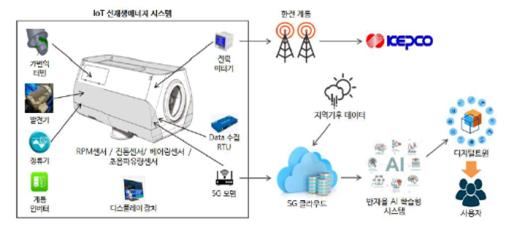
A representative project for leading services for productivity innovation is the AI semi-autonomous renewable energy harvesting system. It is a semi-autonomous operation system for small hydropower generators applicable to reservoirs and land-based fish farms. Generators equipped with internal and external sensors monitor weather conditions and generator status, and AI automatically protects the generator by stopping operation as needed, which is expected to greatly improve power generation efficiency. Small hydropower energy is a renewable energy source capable of generating power even with low head, and it is expected to be applicable to more than 900 fish farms (as of 2015), but its spread has been limited, accounting for only about 0.12% of total power generation.
The intelligent IoT integrated cold chain service installs sensors in cold chain infrastructure (logistics warehouses, vehicles, boxes) to monitor temperature, humidity, vibration, etc., and AI predicts failure situations before accidents occur. Previously, temperature deviation accidents were handled after occurrence, but this service is expected to enable cold chain maintenance through prior preparation. The lead institution for this project has signed a 'COVID-19 Vaccine Cold Chain Central Control MOU' with the Korea Disease Control and Prevention Agency and plans to conduct a pilot project for safe vaccine storage and management.
Additionally, the predictive maintenance service for small and medium equipment manufacturing companies attaches sensors to manufacturing equipment such as air compressors, which are directly related to paint defect rates, to collect data, and AI forecasts abnormal signs before equipment failure. It is expected to contribute to productivity increase by preventing process defects, manufacturing stoppages for equipment repair, and production disruptions caused by equipment failure. Furthermore, the AIoT robotic musical instruments-based non-face-to-face performance hall refers to a new cultural technology service where AI analyzes user preferences to select music, and robotics IoT directly plays instruments such as piano, drums, guitar, and bass to deliver music.
Hong Jin-bae, Director of Information Security Network Policy at the Ministry of Science and ICT, stated, “Recently, IoT has evolved into object intelligence by converging with AI and 5G, leading digital transformation after COVID-19 and becoming a key foundation supporting the successful settlement of the Digital New Deal.” He added, “Through this flagship project, we expect meaningful outcomes where intelligent IoT changes our lives and significantly improves productivity in other converged industries such as energy and manufacturing.”
© The Asia Business Daily(www.asiae.co.kr). All rights reserved.



















