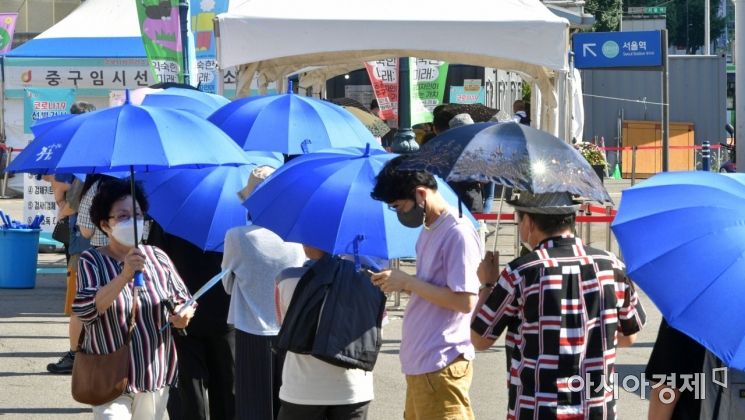
 On the 25th, many citizens lined up at the Seoul Station screening clinic to get tested. Photo by Dongju Yoon doso7@
[Asia Economy Reporter Lee Chun-hee] The number of new domestic COVID-19 cases recorded 1,318. Due to the so-called 'weekend effect,' where the number of tests decreases on weekends, the figure dropped to the 1,300 range for the first time in six days, but it is still the first Monday since the outbreak with cases in the 1,300 range, showing a strong spread.
The Korea Disease Control and Prevention Agency's Central Disease Control Headquarters announced on the 26th at midnight that the cumulative number of COVID-19 cases increased by 1,318 from the previous day to 190,166. The infection routes of new confirmed cases were 1,264 local transmissions and 54 imported cases.
Among the locally transmitted cases, 749 cases, accounting for 59%, occurred in the metropolitan area. This includes Seoul with 339 cases (26.8%), Gyeonggi with 343 cases (27.1%), and Incheon with 67 cases (5.3%).
Non-metropolitan area cases numbered 515, slightly down from 546 the previous day, but the proportion of cases was 40.7%, exceeding 40% for the first time since the 4th wave. By region, confirmed cases were ▲Busan 83 ▲Daegu 60 ▲Gwangju 17 ▲Daejeon 71 ▲Ulsan 3 ▲Sejong 5 ▲Gangwon 28 ▲Chungbuk 31 ▲Chungnam 61 ▲Jeonbuk 23 ▲Jeonnam 26 ▲Gyeongbuk 21 ▲Gyeongnam 75 ▲Jeju 11.
There were 54 imported cases. Among them, 21 were detected during quarantine, and 33 were confirmed locally. There were 29 Korean nationals and 25 foreigners. By country, the largest number was 15 arrivals from Indonesia, where the 'Delta variant (Indian variant)' is rapidly spreading. Among them, 3 were Korean nationals and 12 were foreigners. One additional case related to the Cheonghae Unit was also confirmed.
The total number of tests conducted the previous day was 60,769. Due to the holiday effect, the number of tests was reduced to about half compared to weekdays. At temporary screening clinics set up in the metropolitan area, 34,415 tests were conducted, confirming 197 new cases, and at non-metropolitan temporary screening clinics, 7,355 tests were conducted, confirming 23 cases.
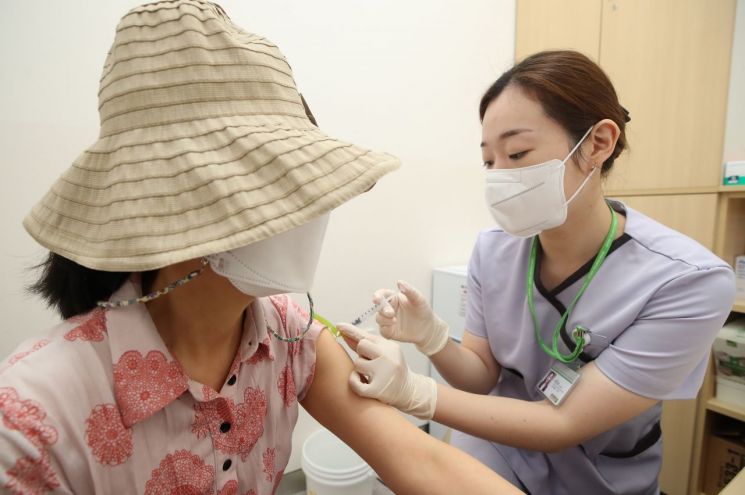 On the morning of the 26th, when COVID-19 vaccinations began for those aged 55 to 59, medical staff were administering vaccines at a COVID-19 vaccination entrusted medical institution in Gangseo-gu, Seoul.
 [Image source=Yonhap News]
Meanwhile, as of midnight on the same day, 1,492 people received new COVID-19 vaccinations. The cumulative number of first-dose vaccinations reached 16,893,124. The vaccination rate relative to the population is 32.9%. All of these newly vaccinated individuals received the Pfizer vaccine. There were no new vaccinations for AstraZeneca (AZ), Moderna, or Janssen.
The number of fully vaccinated individuals increased by 57 from the previous day to 6,858,656. The population vaccination rate for the second dose is 13.4%. Among those who received the first dose of the AZ vaccine, 54 people received a second dose as a cross-vaccination with the Pfizer vaccine. Additionally, 3 people received a third dose with only the Pfizer vaccine, bringing the total number of fully vaccinated individuals to 3,743,070.
Reports of suspected adverse reactions after vaccination increased by 485 cases over two days, totaling 110,879. Reports included 50 cases for AZ, 336 for Pfizer, 4 for Janssen, and 95 for Moderna. The cumulative adverse reaction reporting rates are 0.67% for AZ, 0.26% for Pfizer, 0.66% for Janssen, and 0.82% for Moderna.
Among the newly reported cases, common adverse reactions such as muscle pain, headache, fever, chills, and nausea accounted for 473 cases, making up the majority.
Serious adverse reactions included one suspected case of anaphylaxis and 11 additional major neurological adverse reaction cases. No deaths following vaccination were reported.
Regarding the ongoing first-dose AZ - second-dose Pfizer cross-vaccination this month, a total of 80 additional adverse reactions were reported over two days, bringing the cumulative total to 2,164. The adverse reaction reporting rate for this cross-vaccination is 0.25%. All newly reported adverse reactions were common reactions. Cross-vaccination adverse reactions are included in the Pfizer vaccine adverse reaction statistics.
© The Asia Business Daily(www.asiae.co.kr). All rights reserved.


















