Kim Chang-ryong, Commissioner of the National Police Agency, Marks 1 Year in Office
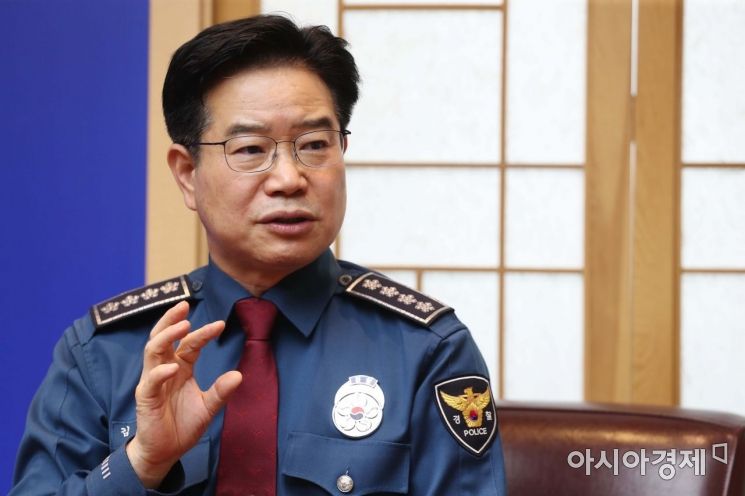
[Asia Economy Reporter Lee Gwan-ju] Marking its first anniversary, the ‘Kim Chang-ryong administration’ police are accelerating efforts to establish proactive and preventive policing activities. However, questions remain regarding the implementation of ‘responsible investigations’ following the adjustment of investigative authority between the prosecution and police, as well as anti-corruption policies within the police force.
Since his inauguration on July 24 last year, Police Commissioner Kim Chang-ryong has been implementing public safety policies under the motto of “the safest country, a police force respected and loved by the people.” The proactive and preventive policing activities that Commissioner Kim has consistently emphasized since taking office are evaluated to have been realized to some extent in both policy and practice. It is said that Commissioner Kim played a significant role in the enactment of the ‘Stalking Punishment Act,’ which allows punishment for stalking behavior previously only regulated under the Minor Offenses Act, as well as in the implementation of the amended ‘Act on the Protection of Children and Juveniles from Sexual Abuse,’ which introduced undercover investigations into online child sexual exploitation crimes.
The police response and support to prevent the spread of COVID-19 have received positive feedback. From the early stages of the outbreak, the police operated a rapid response team to assist with epidemiological investigations, while crackdowns on illegal entertainment establishments, security at residential treatment centers, and safe vaccine transportation have been highly praised. Strengthening public prevention and awareness campaigns against major crimes, regular training for community police officers, and enhancing incentives for preventive activities have also garnered positive responses.
Despite the expansion of police investigative authority due to the adjustment of investigative rights starting this year, there are criticisms that the implementation of responsible investigations remains insufficient. A representative case is the assault incident involving former Deputy Minister of Justice Lee Yong-gu and a taxi driver. The investigating officer concealed the fact despite reviewing the black box footage. Although the police conducted an internal investigation and referred the officer for prosecution on charges of dereliction of duty, it was insufficient to shed the label of a ‘lenient investigation.’ Regarding real estate speculation allegations triggered by the Korea Land and Housing Corporation (LH), investigations into high-ranking officials including members of the National Assembly have stalled, raising doubts about the police’s investigative capabilities. Recently, the ‘fake fisheries businessman’ case sparked controversy over police over-investigation. Although investigative authority over police officers was transferred to the National Police Agency as part of police reform, Commissioner Kim, as the head of public safety, bears heavy responsibility.
The strengthening of anti-corruption capabilities, which Commissioner Kim emphasized from the beginning of his tenure, also appears to have yet to take root. A senior officer at the superintendent level suspected of receiving bribes from a fake fisheries businessman was suspended from duty, and three others, including a high-ranking officer accused of receiving golf entertainment from a businessman, were disciplined with suspensions. In response, Commissioner Kim stated, “In June this year, we established a ‘Mid- to Long-term Anti-corruption Promotion Plan’ that includes measures to eliminate the root causes of corruption and build a sustainable anti-corruption system. We will thoroughly monitor the implementation of detailed tasks and faithfully execute the anti-corruption promotion plan.” There remain numerous challenges to be addressed during the remaining year of his term. With the full implementation of the autonomous police system bringing significant changes, stabilizing the police organization, realizing the National Police Commission, and reforming the Korean National Police University are among the major police reform tasks ahead.
© The Asia Business Daily(www.asiae.co.kr). All rights reserved.

















