One in Three Seoul Citizens Are Members... Surpasses 1 Million in 9 Years, 2 Million in 1 Year 7 Months, and 3 Million in 1 Year
Fare Revenue Up 16.8%, Accidents Down 61.3%
[Asia Economy Reporter Lim Cheol-young] Seoul City announced on the 26th that the cumulative number of members of Ddareungi, the city's public bike-sharing service, surpassed 3 million in the first half of the year. This means that one out of every three Seoul citizens is a Ddareungi member.
The growth rate of membership is also accelerating. It took about nine years to reach 1 million members after Ddareungi was introduced in 2010. Following a surge in users since the start of the COVID-19 pandemic last year, the number exceeded 2 million in about 1 year and 7 months, and then reached 3 million within a year.
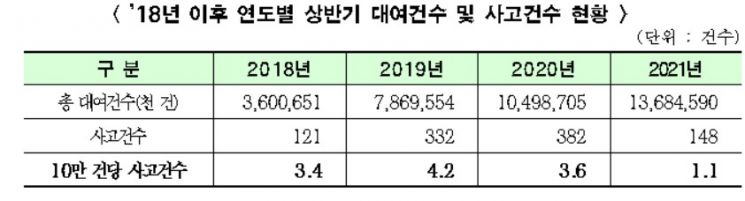
The number of Ddareungi rentals in the first half of this year was 13.684 million, a 30.3% increase compared to the same period last year. Usage rates were higher on weekdays than weekends, especially during commuting hours, indicating that Ddareungi plays a role as a "first-last mile" transportation option complementing public transit before and after use.
In downtown Seoul, since the opening of Sejong-daero Sarangsupgil and Cheonggyecheon bicycle paths in May this year, the usage rate of nearby Ddareungi rental stations has also increased significantly by more than 40%. As Ddareungi usage increased, fare revenue collected in the first half of this year rose by 16.8% compared to the same period last year. On the other hand, the number of accidents in the first half of this year was 148, which corresponds to 1.1 accidents per 100,000 rentals. This is a 61.3% decrease compared to last year's 382 accidents and 3.6 accidents per 100,000 rentals.
Seoul City analyzed that the growing preference among citizens for contactless transportation options that allow social distancing in daily life coexisting with COVID-19 supports the steady growth of Ddareungi. Additionally, the lowering of the minimum usage age (from 15 to 13 years old), the introduction of Saessak Ddareungi and QR-type terminals, and continuous improvements to the public bicycle app have enhanced user convenience, further increasing Ddareungi's popularity.
In line with the increase in Ddareungi usage, Seoul City plans to add 3,000 bikes by the end of this year, expanding the fleet to 45,000 units. Additionally, 500 more rental stations will be installed, bringing the total to 3,000 stations. Considering the usage growth trend in the first half, the number of rentals is expected to exceed 30 million by the end of the year.
Baek Ho, Director of Urban Transportation at Seoul City, said, “Since COVID-19, we have confirmed that Ddareungi has become a safe contactless transportation option as well as a daily transportation means for citizens. Bicycle use reduces carbon emissions, helps prevent air pollution, improves mobility convenience for citizens, expands transportation rights, and also has health benefits.”
© The Asia Business Daily(www.asiae.co.kr). All rights reserved.


















