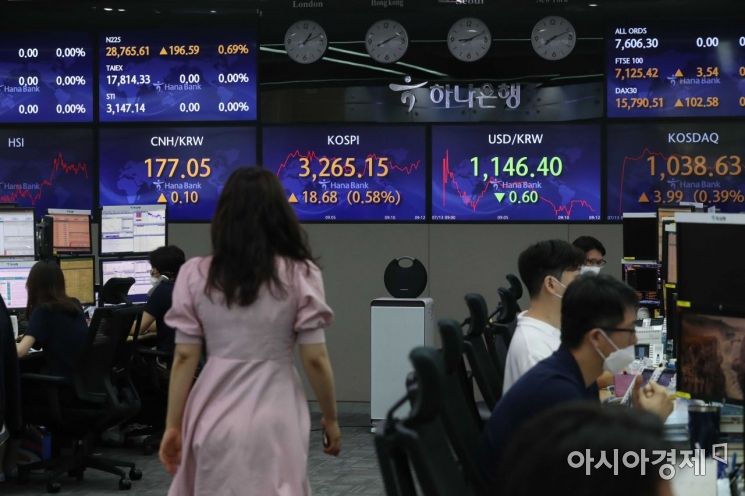
[Asia Economy Reporter Junho Hwang] The KOSPI is approaching the 3300 level. Although the spread of the COVID-19 Delta variant and the possibility of tightening remain latent risk factors, the KOSPI rose on the 22nd and 23rd (3254.42), bringing it once again close to entering the 3300 level. Samsung Securities analyzed on the 24th that this upward trend in the KOSPI is a result of improved fundamentals such as companies securing earnings in the second half of the year, which in turn has enhanced its investment attractiveness.
In particular, the estimated earnings for the domestic stock market over the past three months have increased by about 17.4% (based on MSCI KOREA 12M FWD EPS), but the index rise has been limited to 2.9%. Samsung Securities' analysis suggests that the argument that prices are burdensome simply because the previous high has been reached does not hold at this point.
Looking at technical indicators, there are no signs of overheating. The KOSPI's Relative Strength Index (RSI, 14-day) was around 50 on the 23rd. When the previous high was reached in January, it recorded 80. The overheating threshold is 70. Additionally, considering the exchange rate effect, that is, the ongoing weakness of the Korean won since the beginning of the year, the attractiveness of the stock market is further enhanced. The KOSPI's year-to-date return in won terms is 10.4%, whereas when converted to dollars, it is around 5%. Although foreign buying is still absent, a comeback by foreign investors is expected soon.
The rise of the dollar also deserves attention. With concerns about passing the economic peak and the concurrent spread of the Delta variant, the dollar index has recently shown an upward trend. However, as it approaches the previous high near 93 points, the upward curve is flattening. In the absence of a sharp dollar strength, the downside rigidity of the stock market could become even stronger.
Jung-hoon Seo, a researcher at Samsung Securities' Investment Information Team, said, "When price and value attractiveness are guaranteed like this, it is reasonable to have expectations for the upside rather than worries about the downside." However, he forecasted that "debates about inflation and deflation are likely to continue during the period passing late July to early August."
He added, "I believe interest in economically sensitive value stocks, which had undergone adjustments until recently, may be rekindled," and "It is necessary to keep in mind that the earnings and value attractiveness of material sectors such as steel and chemicals stand out."
© The Asia Business Daily(www.asiae.co.kr). All rights reserved.

















