Controversy Over Regulation Banning Remote Financial Transactions for People with Mental Disabilities
1st and 2nd Trial Courts: "Stop Requiring Guardians to Accompany"
Post Office Bank: "Clear Legal Judgment Needed, Filed Appeal"
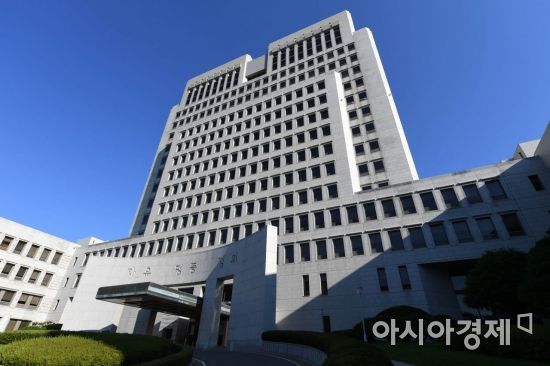
[Asia Economy Reporter Song Seung-seop] It has been found that banks handling deposit services have significantly restricted financial transactions for people with mental disabilities despite discrimination controversies. They either prohibit non-face-to-face transactions or require the presence of a guardian to allow financial transactions. The national institution, Korea Post Bank, lost a lawsuit filed by people with mental disabilities and improved its operational guidelines but has appealed again to the Supreme Court.
According to the legal and financial sectors on the 23rd, the Korea Post Office Headquarters has been conducting a trial following a lawsuit filed by 18 people with mental disabilities demanding cessation of discriminatory acts against disabled persons. The plaintiffs argued that the regulations restricting financial transactions of people with mental disabilities by deposit institutions constitute discriminatory acts violating Articles 17 and 37 of the Act on the Prohibition of Discrimination against Persons with Disabilities. Although the plaintiffs partially won in the first and second trials, the Korea Post Office Headquarters appealed at the end of last year, and the third trial is pending.
So far, most banks, including Korea Post Bank, have restricted non-face-to-face financial transactions for people with mental disabilities who have received a ‘limited guardianship’ decision. Limited guardians are those whom the family court has judged to have insufficient capacity to handle affairs due to illness, old age, or disability. They are individuals with milder mental disabilities than those under ‘adult guardianship,’ where a court-appointed guardian handles legal acts and various affairs on their behalf.
According to internal regulations, people with mental disabilities could not use cash cards or internet/mobile banking and had to visit the counter in person. If the transaction amount exceeded 1 million KRW within 30 days from the withdrawal date, they had to bring their guardian to the counter. Submission of a written consent form from the guardian was not accepted. As a result, some people with mental disabilities faced restrictions in financial transactions, such as being unable to transfer medical expenses on time. The plaintiffs also filed a lawsuit, claiming this constituted discriminatory acts violating Articles 17 and 37 of the Act on the Prohibition of Discrimination against Persons with Disabilities.
The first and second trial courts ordered revisions to the related regulations, ruling that these constituted discriminatory acts. This was due to the possibility of violating the current anti-discrimination law, which prohibits differential financial services based on disability. The Seoul Central District Court ruled at the time, "Stop requiring guardians to accompany," and "The defendant must prepare technical and system measures to enable the plaintiffs to use automatic cash transfers and check card transactions." The Seoul High Court also stated, "Limited guardians are, in principle, persons capable of valid legal acts," and "Korea Post’s measures are considered disadvantageous treatment against disabled persons."
The National Human Rights Commission also stated, "The financial sector’s practice of not allowing non-face-to-face transactions for people with mental disabilities is problematic."
Accordingly, Korea Post Bank changed related operational regulations in June last year. People with mental disabilities were allowed to use ATMs for transactions under 1 million KRW. With a limited guardian’s consent form, they could also conduct transactions over 1 million KRW alone at the counter.
Regarding the reason for appealing to the Supreme Court despite this, the Korea Post Office Headquarters explained, "The appellate court (second trial) recognized that there were many circumstances that made it inevitable for Korea Post to impose restrictions on non-face-to-face transactions, unlike the first trial," and "Since the basis for judgment was not clearly explained and liability for compensation was acknowledged, a clear legal judgment is necessary, which is why the appeal was filed."
This is interpreted as referring to the Seoul High Court’s ruling that "the deposit transaction measures basically originated from the purpose of ensuring the safety of financial transactions for limited guardians." Along with this, the Seoul High Court reduced the compensation ordered by the first trial from 500,000 KRW to 200,000 KRW, considering that Korea Post had corrected a significant part of the discriminatory acts.
Banks with such regulations have claimed these measures are to protect people with mental disabilities. They argue that allowing non-face-to-face transactions for people with mental disabilities increases the risk of financial accidents, thus justifying restrictions. They also said the accompaniment requirement was to clearly confirm the guardian’s consent. At the time, Korea Post also reportedly stated, "Deposit transaction measures apply equally to all persons with mental limitations in handling affairs due to disability, illness, old age, or other reasons," and "This does not constitute discriminatory acts prohibited under the Act on the Prohibition of Discrimination against Persons with Disabilities."
Meanwhile, the National Human Rights Commission issued an opinion in May 2019 to the financial industry, stating, "The financial sector’s practice of not allowing non-face-to-face transactions for disabled persons excessively restricts their rights," and "It is necessary to explore non-face-to-face transaction methods that allow disabled persons to freely conduct financial activities within a certain scope."
© The Asia Business Daily(www.asiae.co.kr). All rights reserved.
![Clutching a Stolen Dior Bag, Saying "I Hate Being Poor but Real"... The Grotesque Con of a "Human Knockoff" [Slate]](https://cwcontent.asiae.co.kr/asiaresize/183/2026021902243444107_1771435474.jpg)











