Full Effort in Managing Workplaces in Electronics and Electrical Industries Including Semiconductors and Displays
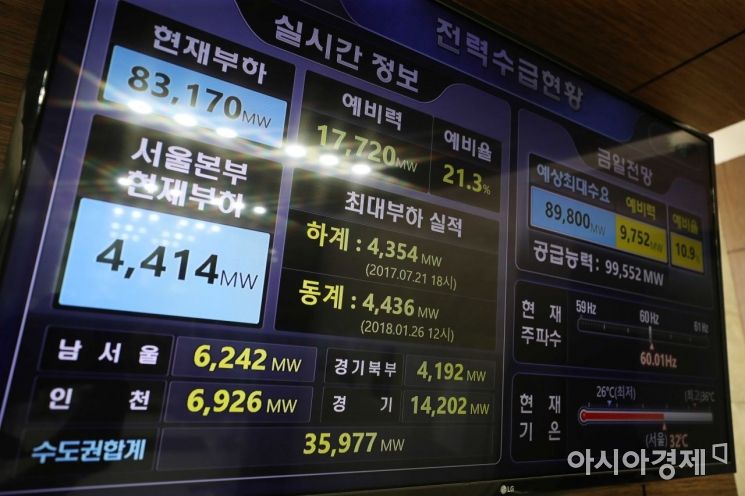 On the 23rd, amid the ongoing sweltering heat, a monitor displaying the current power supply status is installed in the lobby of the annex building of the Korea Electric Power Corporation Seoul Headquarters in Jung-gu, Seoul. / Photo by Mun Ho-nam munonam@
[Asia Economy Reporters Kim Heung-soon and Jung Hyun-jin] Samsung Display is closely monitoring the power supply situation while operating production lines at its domestic sites in Giheung, Gyeonggi Province, and Cheonan and Asan, Chungnam Province. They prioritize operating energy-efficient equipment installed in the factories, such as air conditioners, and during peak hours when energy consumption surges, they refrain from power-intensive tasks. Due to the heatwave with temperatures exceeding 35 degrees Celsius daily, the power reserve margin (supply reserve margin) is expected to drop to single digits, prompting manufacturing sites to continuously check the situation. A Samsung Display official stated, "We are strengthening inspections of power usage fluctuations on production lines and implementing energy-saving guidelines such as turning off standby power at night."
Heightened Attention to 24-Hour Safe Operation
According to industry sources on the 23rd, electronics and electrical manufacturing sites, including Samsung Display, are closely monitoring the government's power supply status and maintaining factory operations during the heatwave. Both semiconductors and displays produced in these sectors are sensitive products, requiring the maintenance of cleanliness and appropriate temperature and humidity levels within the facilities while running factories 24 hours a day. Unexpected incidents such as power outages could cause significant damage, including product loss.
According to the Korea Power Exchange, the power reserve margin was 11.1% the previous day, meeting the stable threshold of over 10%, but with the heatwave expected to continue, the situation remains uncertain. In fact, in 2011, the power reserve margin dropped to the 7% range in late August and plummeted to the 5% range in mid-September during a late heatwave, leading to nationwide rolling blackouts.
The Ministry of Trade, Industry and Energy and the Korea Energy Agency recently sent official letters to energy-intensive industrial sites, including the display industry, requesting the sequential suspension of air conditioner operation by region during peak power hours from 2 to 5 p.m. The country is divided into six regions: Seoul/Incheon, Gyeonggi, North Gyeongsang, South Gyeongsang, Jeolla, and others. From the fourth week of July to the second week of August, they ask for cooperation to stop air conditioners for 30 minutes or minimize loads in each region with staggered timing.

Preparations for Night Work and Self-Generation
Related industries are operating internal guidelines for energy saving independently of government recommendations. Samsung Electronics plans to first turn off unnecessary lights within its sites, maintain appropriate air conditioning temperatures, and if the power reserve margin drops further, adjust air conditioning in common areas and control exhaust fan loads to reduce power consumption.
SK Hynix has instructed employees to maintain appropriate indoor temperatures and unplug unused electrical devices. LG Electronics is also encouraging activities to reduce household power consumption, such as managing indoor temperatures and unplugging unused devices. Additionally, LG Display announced that it conducts major tasks during nighttime when power usage is relatively low.
Samsung Electronics, Samsung Display, and related sites have emergency power generation systems in place to prepare for power outages. LS Cable & System, which has a site in Donghae, Gangwon Province, producing submarine cables and industrial special cables, is preparing uninterruptible power supply (UPS) batteries to respond to emergencies. An LS Cable & System official explained, "Using this equipment, essential processes can continue operating for about 30 minutes even if a power outage occurs."
© The Asia Business Daily(www.asiae.co.kr). All rights reserved.


















