"Travel in Family Units, Avoid Peak Seasons, Go in Off-Season"
Check Quarantine Rules Like Social Distancing by Vacation Spot
Looking for Places Without Crowds?
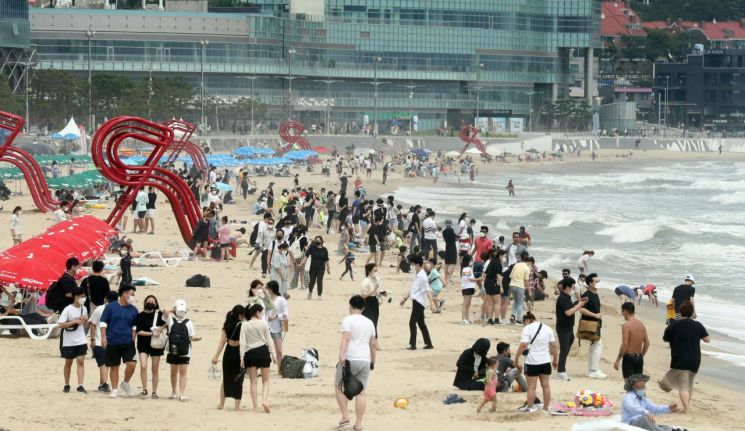
The second summer vacation season has arrived amid the COVID-19 pandemic. Despite the ongoing spread of the fourth wave centered around the Seoul metropolitan area, people are expected to continue traveling to major domestic vacation spots such as Busan, Gangwon, and Jeju. However, non-metropolitan areas are not free from COVID-19 either. Major vacation destinations, including Busan where triple-digit new cases have been reported for two consecutive days, have raised social distancing measures beyond Level 3 to Level 4, the same as the metropolitan area, putting utmost effort into quarantine during the vacation season.
The government urged everyone to strictly follow the ‘Ga-Seong-Bi’ principle to enjoy a safe summer vacation in the COVID-19 era. This means taking vacations in ‘small family units,’ ‘avoiding peak season (late July to early August),’ and ‘dispersing vacations during the off-season.’
-What levels of social distancing are currently applied in non-metropolitan areas?
▲Since the 15th, most non-metropolitan areas have been under Level 2 social distancing. However, local governments have independently strengthened quarantine measures, and many popular vacation spots have already implemented Level 3 or higher. For example, Busan and Jeju have been under Level 3 for some time, and Gangneung has raised its quarantine level to Level 4, the same as the metropolitan area. As of midnight on the 23rd, Daejeon, Yeosu, Wonju and Yangyang in Gangwon Province, as well as Gimhae, Geoje, Haman, Jinju, Changwon, Tongyeong, and Yangsan in the Gyeongnam region, are also classified as Level 3 areas. Considering the recent surge in cases, the government is reviewing a plan to uniformly raise the social distancing level to Level 3 for all non-metropolitan areas starting next month on the 2nd. Therefore, it is essential to check the quarantine rules applied in each region before going on vacation.
For example, in Level 3 areas like Busan or Jeju, the number of people allowed in accommodation facilities cannot exceed the room’s capacity limit. This applies even to immediate family members. Only up to three-quarters of rooms can be operated. When using multi-use facilities such as restaurants, cafes, and shops, groups of five or more are not allowed to enter or make reservations together. In Level 4 areas like Gangneung, only up to two people can gather after 6 p.m.
-Since there are fewer confirmed cases in non-metropolitan areas, is it safer to go there?
▲This is an optical illusion caused by population differences. As of midnight on the day, Jeju reported 28 new daily cases, which is relatively low compared to 516 in Seoul and 90 in Incheon, metropolitan areas. However, when considering the key indicator for social distancing levels?cases per 100,000 population?the situation looks different. Jeju, with a population of 670,000, has thresholds of 7 cases for Level 2, 13 for Level 3, and 27 for Level 4. If the current level of cases continues, Level 4 could be implemented. If Jeju had the same population as the metropolitan area, this would correspond to 1,043 daily cases. In fact, the proportion of cases occurring in non-metropolitan areas compared to total local cases rose from only 15.2% at the start of the fourth wave on the 7th to 35.9% as of this day. This increasing trend in non-metropolitan areas is partly due to ‘exported transmission’ from the metropolitan area, so stricter compliance with quarantine rules is required when traveling to other regions.
-I want to safely go to less crowded places. How can I do that?
▲A ‘congestion traffic light’ service will be introduced at beaches. This service, which was provided at 50 beaches last year, will be expanded to all beaches nationwide this year. Based on IT big data technology, it shows the congestion level relative to the appropriate number of people per beach. The congestion is calculated assuming a 2-meter distance on the sand and is indicated by color: green for 100% or less, yellow for over 100% up to 200%, and red for over 200%. Beach congestion can be checked through portals like Naver and Kakao, as well as the ‘Bada Yeohaeng’ (Sea Travel) website. The government also provides congestion information for major tourist and resort areas. Using big data predictions, the ‘Korea Tourism’ website categorizes congestion into five levels from ‘comfortable’ to ‘crowded.’
-It is difficult to ventilate when air conditioners are on in multi-use facilities these days. How often should ventilation be done?
▲Health authorities emphasize ventilation during the vacation season. Since COVID-19 spreads through droplets, using air conditioning in enclosed spaces can facilitate rapid transmission. Therefore, it is recommended to ventilate for 10 minutes every 2 hours when air conditioning is on, keep windows slightly open continuously when using buses, and wear masks.
-Should masks be worn while playing in the water at the beach?
▲Since it is practically difficult to wear masks while playing in the water, masks can be removed when entering the water. However, masks must be worn immediately upon exiting the water, and physical contact should be avoided as much as possible even in the water. Also, do not go to the beach without a mobile phone fearing it might get wet. This is because ‘Safe Call’ visitor registration service is implemented at all beaches nationwide to track visitors. If you do not have a mobile phone, you must fill out a manual logbook.
To check for fever, ‘temperature stickers’ will be introduced. When attached to the wrist or arm, the sticker turns green if the temperature is normal but changes to yellow if the temperature exceeds 37.5℃. Small beaches with fewer visitors require individual temperature checks, and those with normal temperatures wear ‘safe wristbands.’ It is also necessary to check whether night-time drinking and eating are allowed at the beach. Jeju, Busan, and Incheon have currently issued administrative orders banning drinking and eating after 8 p.m. at beaches.
© The Asia Business Daily(www.asiae.co.kr). All rights reserved.
![Clutching a Stolen Dior Bag, Saying "I Hate Being Poor but Real"... The Grotesque Con of a "Human Knockoff" [Slate]](https://cwcontent.asiae.co.kr/asiaresize/183/2026021902243444107_1771435474.jpg)











