"Second Largest Scale After Volkswagen"
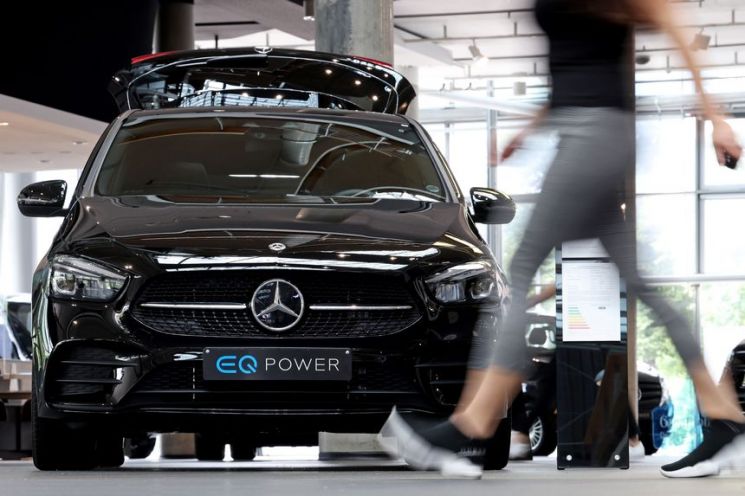
[Asia Economy Reporter Yujin Cho] Mercedes-Benz has officially entered the global electric vehicle (EV) competition. The company plans to invest 40 billion euros (approximately 54.2244 trillion KRW) to convert all its models to electric vehicles by 2030 and will also produce EV batteries in-house.
According to major foreign media such as Bloomberg and The Wall Street Journal (WSJ) on the 22nd (local time), Mercedes-Benz announced plans to develop three dedicated electric vehicle platforms and produce batteries independently by 2025. In collaboration with partners in Europe and Asia, the company aims to establish eight factories worldwide, securing a production capacity of 200 GWh (gigawatt-hours).
To achieve this, Mercedes-Benz will invest a total of 40 billion euros from 2022 to 2030. Bloomberg reported that this 40 billion euro investment is the second-largest EV investment budget among major automakers, following Volkswagen’s 73 billion euros. CEO Ola K?llenius emphasized, "A massive capital reallocation must accompany the transition to the electric vehicle era."
The in-house battery development move is seen as following competitors such as Germany’s Volkswagen and the United States’ General Motors (GM). However, Mercedes-Benz did not specify which partners it will collaborate with for in-house battery cell production. Currently, Mercedes-Benz receives EV batteries from China’s top battery company CATL, as well as South Korea’s LG Energy Solution and SK Innovation.
Earlier this year, Mercedes-Benz privately acquired YASA, a UK-based electric motor technology startup, and formed a partnership with Silanna Nanotechnologies, a Silicon Valley battery materials startup co-founded by former Tesla engineers, focusing on internalizing EV production technology.
Facing criticism for lagging in the EV transition, Mercedes-Benz plans to accelerate the paradigm shift to electric vehicles by launching the large electric sedan ‘EQS,’ an electric version of its flagship S-Class, within this year.
Additionally, to specialize in electric vehicles, the company plans to reduce investment in internal combustion engine vehicles by 80% compared to 2019 levels by 2026. It aims to gradually expand its plug-in product lineup to achieve full electrification by 2030 and to achieve zero carbon emissions for all new vehicles by 2039. Mercedes-Benz expects that by 2025, plug-in hybrids and fully electric vehicles will account for more than half of global car sales.
In a statement on the same day, CEO K?llenius said, "We are approaching the tipping point (the era of EV popularization)," adding, "If market conditions allow, we will transition to a pure electric vehicle company by the end of 2030." He emphasized that the luxury EV market will experience a faster paradigm shift than mass-market EVs due to greater purchasing power.
Previously, Germany’s Volkswagen set a goal to convert half of its total vehicle sales to electric vehicles by 2030 and achieve carbon neutrality by 2040. The US’s General Motors (GM) also announced plans to completely stop producing internal combustion engine vehicles by 2035 and focus solely on electric vehicles.
© The Asia Business Daily(www.asiae.co.kr). All rights reserved.
!["The Woman Who Threw Herself into the Water Clutching a Stolen Dior Bag"...A Grotesque Success Story That Shakes the Korean Psyche [Slate]](https://cwcontent.asiae.co.kr/asiaresize/183/2026021902243444107_1771435474.jpg)
















